Always check the labels of the products you use.
Method
- 1
Dough. Pulse the flour, salt and cold butter in a food processor until the mixture looks like coarse breadcrumbs. Beat the egg with the water, add it and pulse just until the dough clumps, adding 1-2 tbsp more water only if it stays dry. Press into a flat disc, wrap and chill for at least 30 minutes; cold butter and rested gluten make a flaky, easy-to-roll pastry.
- 2
Base. Heat the oil in a large frying pan over medium heat, add the tomato paste and stir for 2 minutes, until it turns brick red. Frying the paste caramelises its sugars and deepens the flavour.
- 3
Vegetables. Add the onion, both peppers, garlic, cumin, paprika, salt and pepper and cook for 5 minutes, stirring, until softened. Stir in the potato and cook for 8-10 minutes more, stirring often, until it is tender at the edges; small cubes cook through fast and keep their shape.
- 4
Beef. Raise the heat to medium-high, add the beef and cook for 6-8 minutes, breaking it up, until browned and it reads 71 °C. Pour in the water and simmer for 2-3 minutes, until the filling is moist but not wet, so the pastry stays crisp.
- 5
Chill. Spread the filling on a plate and chill for at least 20 minutes, until cold. Warm filling melts the butter in the dough and makes it tear.
- 6
Heat. Heat the oven to 200 °C (180 °C fan) and line 2 trays with baking paper.
- 7
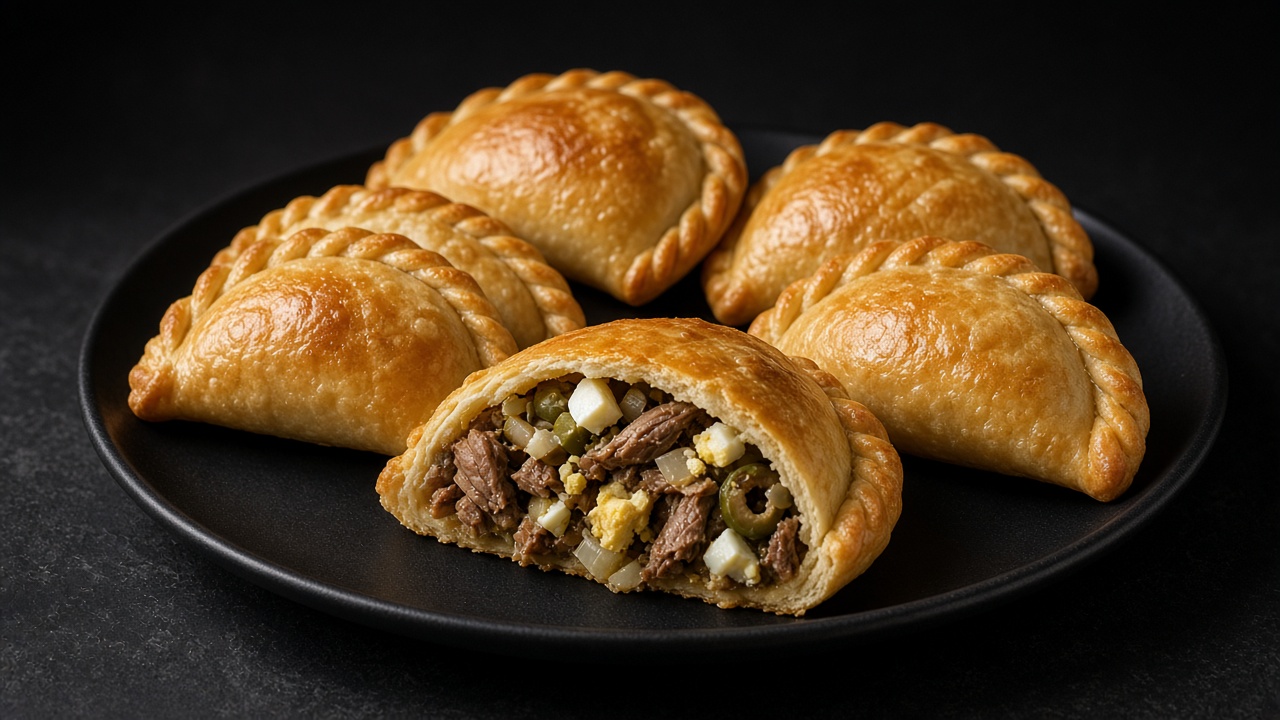
Shape. Roll the dough on a floured surface to 2-3 mm thick and cut out 12 cm rounds, rerolling the scraps once, to make 12. Spoon about 2 tbsp filling onto one half of each round, brush the edge with water, fold over into a half-moon and press out the air as you seal. Crimp by folding the edge over itself in small pleats, or press it with a fork; a tight seal stops the filling bursting out.
- 8
Bake. Set the empanadas on the trays, brush with the egg glaze and bake for 20-25 minutes, swapping the trays halfway, until deep golden. Cool for 10 minutes on a rack so the filling settles before serving.
Storage
Keep in the fridge for up to 3 days. Reheat at 180 °C for 10-12 minutes, until piping hot (74 °C). Freeze baked or unbaked for up to 2 months. Cool leftovers in a shallow container and refrigerate within 2 hours (within 1 hour on a day above 32°C).
EU nutrition claims
- Source of protein: 3.8 g protein per 100 kcal, about 15% of energy (needs ≥ 12%)
- Low sugars: 4 g sugars per 100 g (limit ≤ 5 g)
Per 100 g of the finished dish, worked out from the nutrition per serving and the lowest likely cooked weight (about 66 g a serving), so the true values are, if anything, lower. Thresholds from the Annex to EU Regulation (EC) No 1924/2006. How we decide
Free sugars
0 g per serving
0 % of the 50 g daily maximum · 0 % of the ideal 25 g
Free sugars under 50 g a day, ideally about 25 g, based on WHO free-sugar guidance (not endorsed by WHO). The share shown is the share of one serving. WHO
Equipment
- food processor
- large frying pan
- instant-read thermometer
- rolling pin
- 12 cm round cutter or saucer
- 2 baking trays
- baking paper
- pastry brush
- wire rack
Nutrition per serving Calculated from USDA FoodData Central
| Per serving | Amount |
|---|---|
| Energy | 485 kcal |
| Protein | 18.5 g |
| Carbohydrate | 46.1 g |
| of which sugars | 2.6 g |
| of which free sugars | 0 g |
| Fat | 24.8 g |
| of which saturates | 11.7 g |
| Fibre | 2.9 g |
| Salt | 1.13 g |
Protein per 100 kcal
3.8 g High protein needs ≥ 5 g per 100 kcal (20% of energy) and ≥ 10 g per serving
Calculated from USDA FoodData Central ingredient values