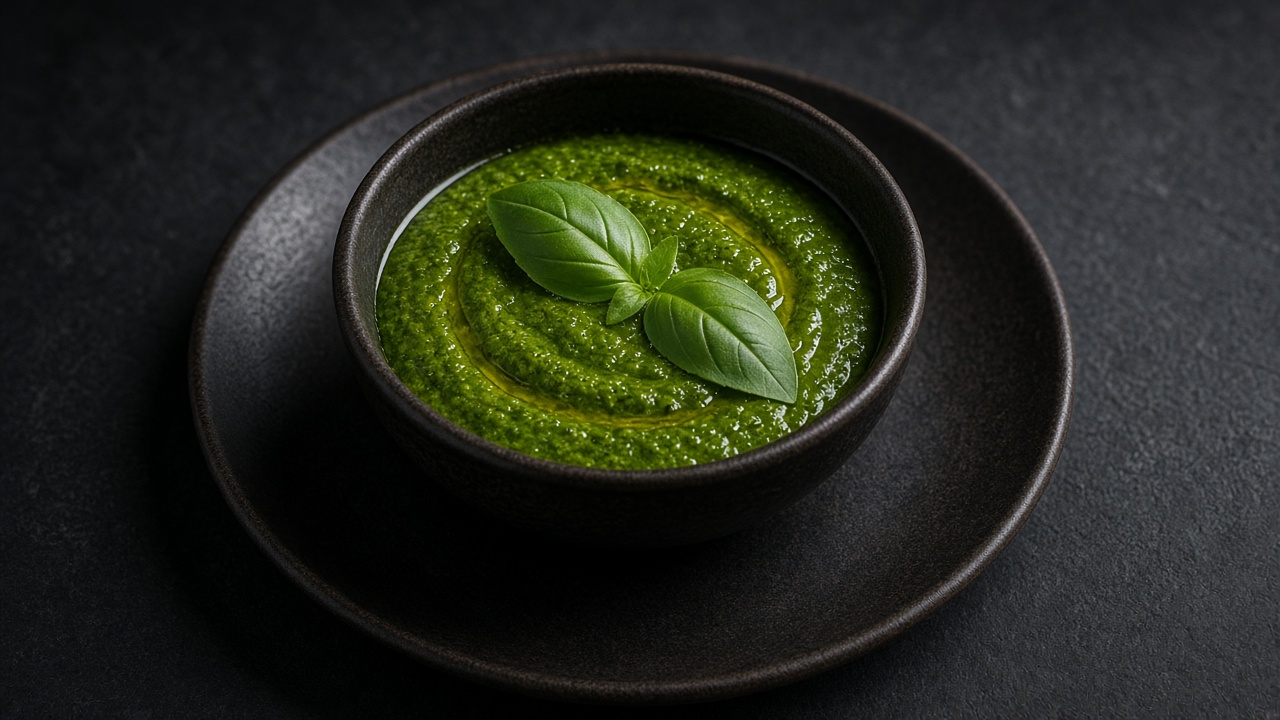
Always check the labels of the products you use.
Method
- 1
Toast the pine nuts. Toast the pine nuts in the dry pan over medium-low heat, stirring often, for 3-4 min until pale golden. Tip them onto a plate straight away so they stop cooking and cool.
- 2
Make the paste. Process the pine nuts and garlic until finely chopped. Add the basil and salt and pulse to a coarse green paste, scraping down the bowl between bursts.
- 3
Stream in the oil. With the motor running, pour the olive oil through the feed tube in a thin stream. Stop as soon as the pesto looks smooth and glossy; over-processing warms and darkens the basil.
- 4
Stir in the cheese. Scrape the pesto into a bowl and fold in the grated Parmesan by hand so it stays light rather than gluey.
- 5
Use it. Toss with freshly drained pasta, loosening with a spoonful of the starchy cooking water, or spoon over soups, new potatoes and sliced tomatoes.
Storage
Keep in a jar under a film of olive oil in the fridge for up to 4 days. Freeze in small portions for up to 3 months. Cool leftovers in a shallow container and refrigerate within 2 hours (within 1 hour on a day above 32°C).
Free sugars
0 g per serving
0 % of the 50 g daily maximum · 0 % of the ideal 25 g
Free sugars under 50 g a day, ideally about 25 g, based on WHO free-sugar guidance (not endorsed by WHO). The share shown is the share of one serving. WHO
Equipment
- small frying pan
- plate
- food processor
- flexible spatula
- jar with lid
Nutrition per serving Calculated from USDA FoodData Central
| Per serving | Amount |
|---|---|
| Energy | 171 kcal |
| Protein | 2.2 g |
| Carbohydrate | 1.6 g |
| of which sugars | 0.2 g |
| of which free sugars | 0 g |
| Fat | 17.8 g |
| of which saturates | 2.9 g |
| Fibre | 0.3 g |
| Salt | 0.41 g |
Protein per 100 kcal
1.3 g High protein needs ≥ 5 g per 100 kcal (20% of energy) and ≥ 10 g per serving
Calculated from USDA FoodData Central ingredient values