Always check the labels of the products you use.
Method
- 1
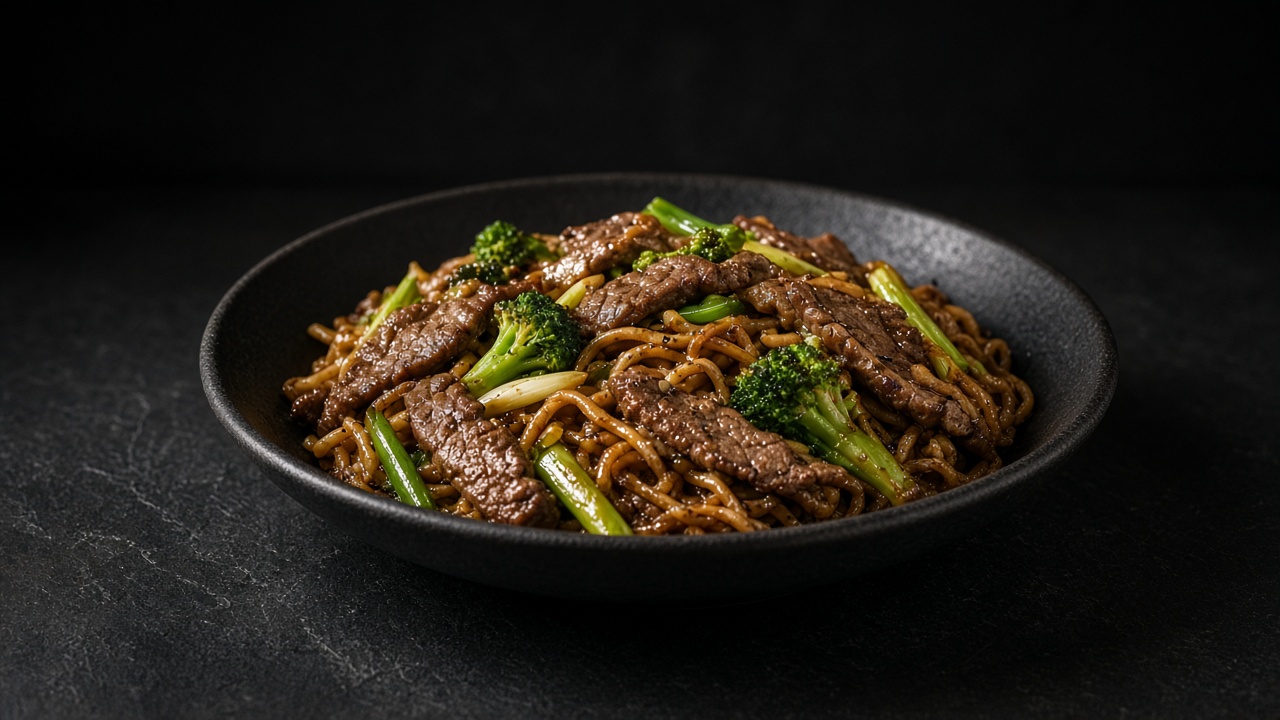
Cook and dry the noodles. This beef and broccoli version follows the same noodle method as the chow mein but fries the noodles loose rather than into a cake. Boil the noodles in 3 litres of unsalted water for 1 minute until flexible, then drain and rinse under cold water. Shake them dry, toss with 1 tsp of the oil and spread on a tray for 10 minutes so the surface isn't wet when it hits the hot pan.
- 2
Velvet the beef. Toss the sliced steak with the bicarbonate of soda and water and leave for 10 minutes, then mix in the soy sauce and cornflour. The bicarbonate raises the surface pH of the meat, which keeps it tender through the fierce heat of stir-frying instead of turning tough and chewy.
- 3
Mix the sauce. Stir together the oyster sauce, light and dark soy sauces, sugar, water and cornflour in a small bowl. Keep it near the wok, as the cornflour will need another stir just before it's added.
- 4
Sear the beef. Heat 1 tbsp of oil in the wok until it's smoking hot, then spread the beef out in a single layer and leave it undisturbed for 1 minute to sear. Stir-fry for a further minute until it's well browned with no pink remaining, then lift it out onto a plate. A smoking-hot wok and an undisturbed sear are what give the beef its colour rather than a greyish, boiled look.
- 5
Fry the noodles loose. Add 2 tbsp of oil and the noodles to the wok, frying them in short bursts — spreading them out, leaving them for a minute, then tossing — for 3-4 minutes until they're crisp in patches. Push them to one side once you're happy with the colour.
- 6
Stir-fry onion and broccoli. Add the remaining oil, onion, garlic and ginger, then the broccoli florets with 2 tbsp of water, and stir-fry for 2-3 minutes. The broccoli is ready when it's turned a brighter green and is just tender, with the water helping it steam through without scorching the garlic.
- 7
Return beef and glaze. Return the beef to the wok, stir the sauce once more and pour it in, then toss everything for 1 minute until the noodles and vegetables are glossy and evenly coated.
- 8
Finish with spring onion. Scatter over the spring onions and give one last toss before serving straight away, while the noodles are still hot and the sauce is glossy rather than sitting in a pool.
Storage
Store in a covered container in the fridge for up to 2 days. Reheat in a hot wok or microwave until steaming hot throughout (at least 74°C). Freezing isn't recommended, as the broccoli and noodles turn soft and watery once thawed. Cool leftovers in a shallow container and refrigerate within 2 hours (within 1 hour on a day above 32°C).
Why this label?
30.3 g protein for 522 kcal = 5.8 g per 100 kcal, so protein gives about 23% of the energy. High protein needs at least 20% (5 g per 100 kcal), the condition in the Annex to EU Regulation (EC) No 1924/2006. How we decide
EU nutrition claims
- Low sugars: 1.5 g sugars per 100 g (limit ≤ 5 g)
Per 100 g of the finished dish, worked out from the nutrition per serving and the lowest likely cooked weight (about 243 g a serving), so the true values are, if anything, lower. Thresholds from the Annex to EU Regulation (EC) No 1924/2006. How we decide
Free sugars
1 g per serving
2 % of the 50 g daily maximum · 4 % of the ideal 25 g
Free sugars under 50 g a day, ideally about 25 g, based on WHO free-sugar guidance (not endorsed by WHO). The share shown is the share of one serving. WHO
Equipment
- large pot (at least 4 litres)
- colander
- rimmed baking tray
- wok (35 cm) or large non-stick frying pan (30 cm)
- wok spatula or tongs
- small bowls for the prepared ingredients
Nutrition per serving Calculated from USDA FoodData Central
| Per serving | Amount |
|---|---|
| Energy | 522 kcal |
| Protein | 30.3 g |
| Carbohydrate | 53.6 g |
| of which sugars | 3.7 g |
| of which free sugars | 1 g |
| Fat | 20.9 g |
| of which saturates | 3.9 g |
| Fibre | 2.6 g |
| Salt | 2.08 g |
Protein per 100 kcal
5.8 g meets High protein (≥ 5 g per 100 kcal = 20% of energy, and ≥ 10 g per serving)
Calculated from USDA FoodData Central ingredient values