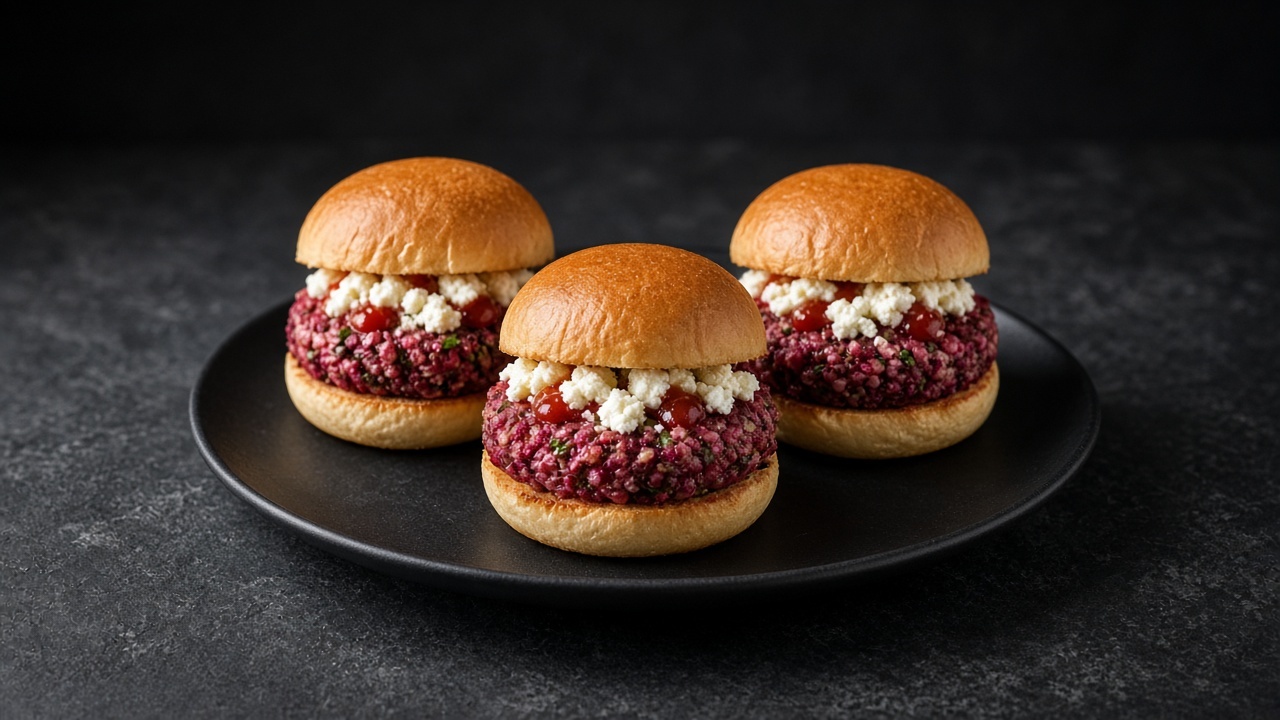
Beetroot, Rice and Goats' Cheese Burgers
By Joe
Source: NYT Cooking.
Earthy roasted beetroot and creamy goats' cheese bind fluffy rice and white beans into sturdy, satisfying vegetarian patties.
Always check the labels of the products you use.
Method
- 1
Purée. Purée 1 drained and rinsed 400 g tin white beans with 1 tbsp lemon juice and 1 large egg in a food processor (or mash with a fork).
- 2
Mix. Combine 300 g cooled cooked brown or white rice, 135 g finely diced or grated roasted beetroot and 15 g chopped fresh herbs (parsley and dill); scrape in the bean purée and stir through 57 g crumbled soft goats' cheese, ¾ tsp fine salt and ¼ tsp ground black pepper.
- 3
Shape. With wet hands shape 6 patties and place on a plate.
- 4
Brown. Heat 1 tbsp of 30 ml extra-virgin olive oil or rapeseed oil in an ovenproof frying pan over medium heat and brown 3 of the patties 2 min on one side.
- 5
Bake. Turn the patties, put the pan in the oven at 190 °C (170 °C fan) for 10 min until 71 °C in the centre, then remove to a plate.
- 6
Repeat. Brown and bake the remaining 3 patties with the rest of the oil.
- 7
Serve. Place in 6 burger buns with 6 tsp ketchup and your usual toppings, or serve on their own with ketchup.
Storage
Because they contain cooked rice, chill leftover patties quickly and eat within 1 day, reheated until piping hot. Cool leftovers in a shallow container and refrigerate within 2 hours (within 1 hour on a day above 32°C).
Why this label?
- Total fat: 20.5 % of energy (limit ≤ 30%)
- Saturated fat: 6.1 % of energy (limit < 10%)
- Free sugars: 1.3 % of energy (limit < 10%)
- Salt: 1.6 g (limit ≤ 1.7 g)
- Fibre or fruit & veg: 4.4 g fibre / 23 g veg (limit ≥ 4.4 g fibre or 80 g fruit & veg)
Per serving, worked out from the nutrition table against our rule based on the WHO healthy diet guidance. Not endorsed by WHO.
EU nutrition claims
- Source of protein: 3.3 g protein per 100 kcal, about 13% of energy (needs ≥ 12%)
- Low sugars: 2.9 g sugars per 100 g (limit ≤ 5 g)
Per 100 g of the finished dish, worked out from the nutrition per serving and the lowest likely cooked weight (about 115 g a serving), so the true values are, if anything, lower. Thresholds from the Annex to EU Regulation (EC) No 1924/2006. How we decide
Free sugars
1.1 g per serving
2.2 % of the 50 g daily maximum · 4.4 % of the ideal 25 g
Free sugars under 50 g a day, ideally about 25 g, based on WHO free-sugar guidance (not endorsed by WHO). The share shown is the share of one serving. WHO
Equipment
- large bowl
- food processor (or a fork)
- heavy ovenproof frying pan
- fish slice
- instant-read thermometer
Nutrition per serving Calculated from USDA FoodData Central
| Per serving | Amount |
|---|---|
| Energy | 352 kcal |
| Protein | 11.7 g |
| Carbohydrate | 58.2 g |
| of which sugars | 3.3 g |
| of which free sugars | 1.1 g |
| Fat | 8 g |
| of which saturates | 2.4 g |
| Fibre | 4.4 g |
| Salt | 1.6 g |
Protein per 100 kcal
3.3 g High protein needs ≥ 5 g per 100 kcal (20% of energy) and ≥ 10 g per serving
Calculated from USDA FoodData Central ingredient values