Always check the labels of the products you use.
Method
- 1
Brown the Butter. Melt the butter in the light-coloured pan over medium heat, swirling as it foams. The foam will settle and the milk solids turn hazelnut brown with a nutty smell after 5-7 minutes; a pale pan lets you watch the colour change clearly, and since the solids go from brown to burnt within seconds, pour the butter into the jug immediately, scraping in all the browned bits.
- 2
Infuse the Milk. Warm the milk with the thyme sprigs and crushed garlic over low heat for 10 minutes to let the flavours infuse, then strain out the solids. This gentle warming draws out aroma without boiling the milk, which could otherwise make it taste flat.
- 3
Peel, Cut and Simmer the Potatoes. Peel the potatoes and cut into 4-5 cm chunks, rinsing until clear. Cover with fresh cold water by 2 cm, add the 10 g salt, bring to the boil and simmer gently for 15-20 minutes, until a knife slides in with no resistance.
- 4
Drain and Press Through a Ricer. Drain, rinse briefly under hot water to remove loose starch, dry over low heat for a minute, then pass through a ricer or food mill back into the pot. This keeps the texture light rather than pasty.
- 5
Fold in the Brown Butter and Milk. Fold in all but 2 tbsp of the brown butter until absorbed, then fold in the warm infused milk across three additions over low heat. Season with salt and pepper to taste.
- 6
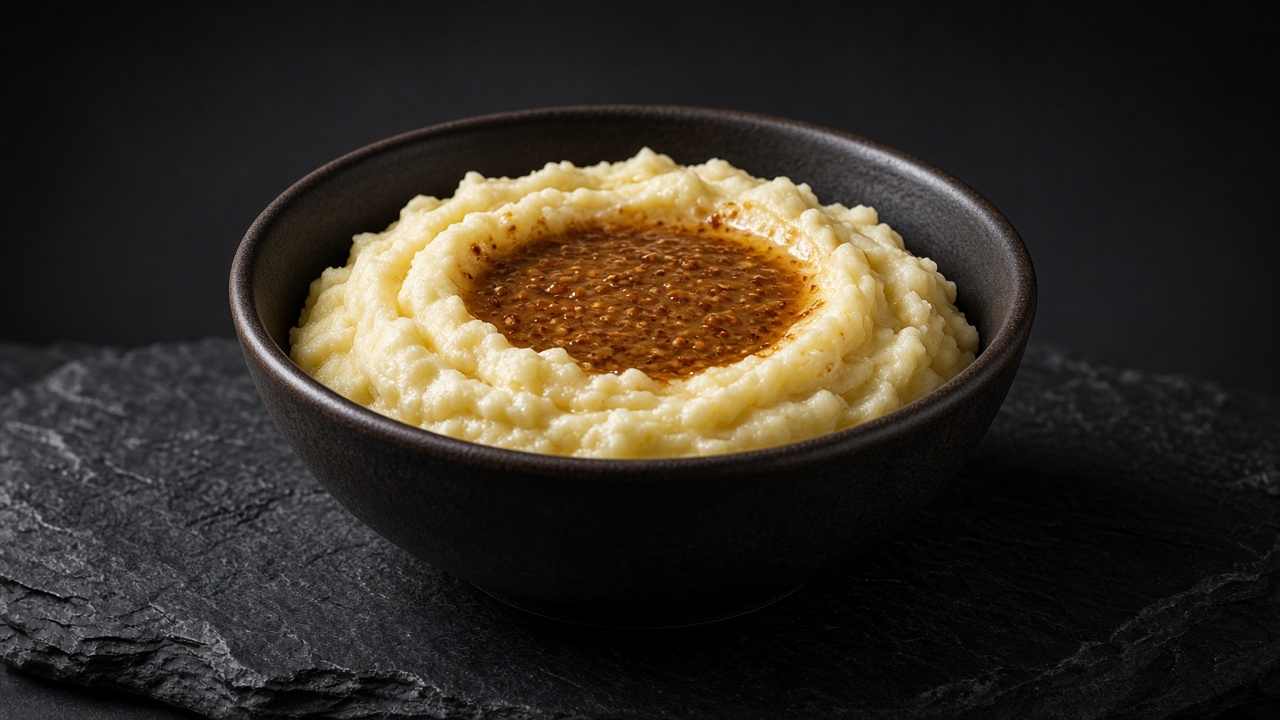
Finish With a Pool of Brown Butter. Spoon the mash into a serving bowl, make a small well in the centre and pour in the reserved brown butter. Serving it this way means the nutty aroma hits you before the first spoonful.
Storage
Keep covered in the fridge for up to 3 days; reheat gently on the hob or in the microwave with a splash of milk, stirring until piping hot (74°C). It freezes for up to 1 month, though the finishing pool of brown butter is best added fresh after reheating. Cool leftovers in a shallow container and refrigerate within 2 hours (within 1 hour on a day above 32°C).
EU nutrition claims
- Low sugars: 3.2 g sugars per 100 g (limit ≤ 5 g)
Per 100 g of the finished dish, worked out from the nutrition per serving and the lowest likely cooked weight (about 133 g a serving), so the true values are, if anything, lower. Thresholds from the Annex to EU Regulation (EC) No 1924/2006. How we decide
Free sugars
0 g per serving
0 % of the 50 g daily maximum · 0 % of the ideal 25 g
Free sugars under 50 g a day, ideally about 25 g, based on WHO free-sugar guidance (not endorsed by WHO). The share shown is the share of one serving. WHO
Equipment
- large saucepan (at least 4 litres)
- colander
- potato ricer or food mill (or a masher)
- small saucepan
- flexible spatula
- light-coloured small saucepan
- heatproof jug
Nutrition per serving Calculated from USDA FoodData Central
| Per serving | Amount |
|---|---|
| Energy | 339 kcal |
| Protein | 6.1 g |
| Carbohydrate | 39.8 g |
| of which sugars | 4.3 g |
| of which free sugars | 0 g |
| Fat | 18 g |
| of which saturates | 11.3 g |
| Fibre | 4.5 g |
| Salt | 0.58 g |
Protein per 100 kcal
1.8 g High protein needs ≥ 5 g per 100 kcal (20% of energy) and ≥ 10 g per serving
Calculated from USDA FoodData Central ingredient values