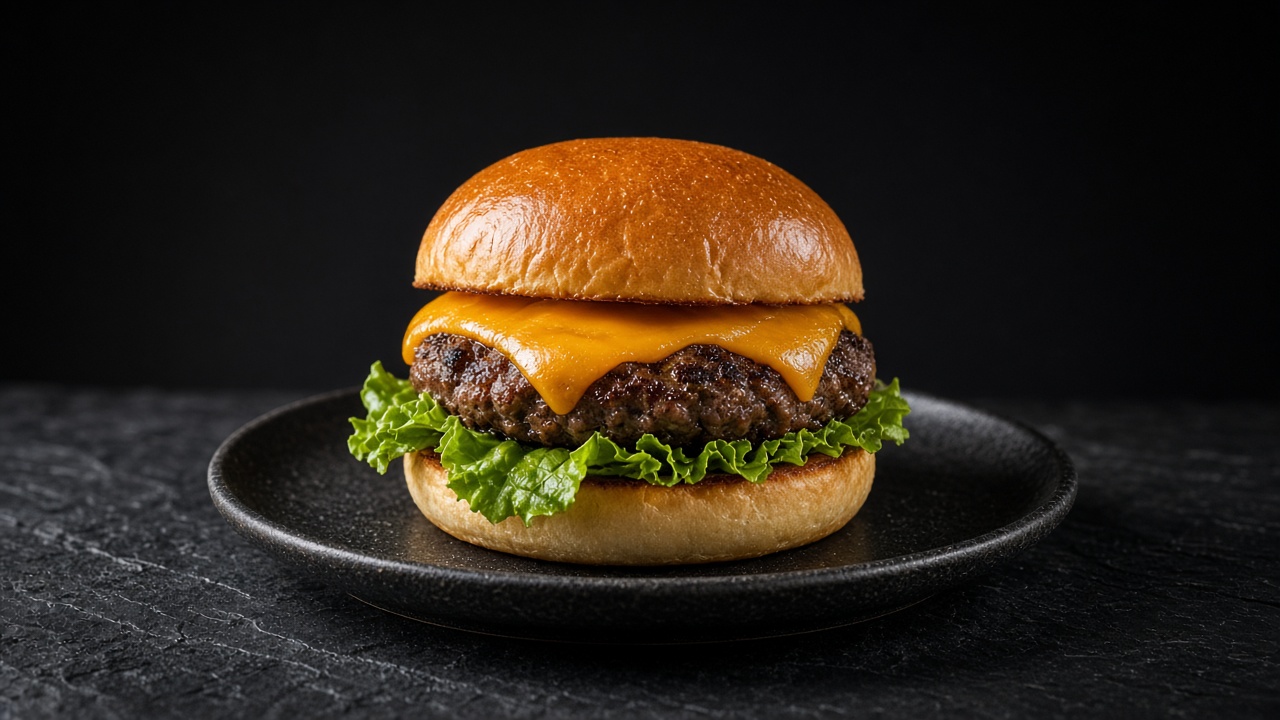
Mature Cheddar Cheeseburger with Caramelised Onions
By Joe
Source: Serious Eats and America's Test Kitchen.
A rich cheeseburger built around slow-caramelised onions, sharp melted cheddar and a mustard mayo for extra bite.
Always check the labels of the products you use.
Method
- 1
Caramelise the onions. Cook sliced onions in butter and oil with a pinch of salt over medium heat for 30-35 minutes, stirring every few minutes and adding a splash of water (1-2 tbsp) whenever bits stick to the pan. They're ready when deep amber and jammy; tip them out and wipe the pan. Slow, steady browning develops deep, sweet, savoury flavour without scorching.
- 2
Make the mustard mayo. Mix the mayonnaise with the yellow mustard in a small bowl and set aside. A simple combination like this adds sharpness that cuts through the richness of the cheese and onions.
- 3
Shape the patties. Divide 600g cold beef mince into four 150g portions and shape into patties 11-12cm wide and about 1.5cm thick, pressing a shallow dimple into the centre of each. This keeps them flat rather than domed as they cook.
- 4
Chill before cooking. Chill the shaped patties for 10 minutes so the fat firms up. A cold patty holds its shape and sears more evenly in the hot pan.
- 5
Season just before cooking. Season both sides with salt and pepper only once ready to cook, since early salting makes the mince springy rather than tender. Toast the buttered buns cut-side down over medium heat for 1-2 minutes and set aside.
- 6
Sear the first side. Heat the pan over medium-high for 3 minutes, add 1 tsp of oil, then cook the patties (2 at a time, or all 4 in a 30cm pan) untouched for 4 minutes. A deep brown crust that releases easily is the sign to flip.
- 7
Flip and melt the cheddar. Flip once and cook for a further 3 minutes, adding thick slices of mature cheddar for the final 1.5 minutes under a lid. Mature cheddar is firmer and drier than processed cheese, so it needs that trapped heat to melt through properly. The patties are done at 71°C in the centre; rest for 2 minutes before building.
- 8
Build the burger. Spread the mustard mayo on both cut sides, then layer rocket, the cheddar-topped patty, a generous heap of caramelised onions and pickles. The peppery rocket balances the sweetness of the onions and the richness of the melted cheese.
Storage
Cooked patties and caramelised onions keep separately in the fridge for up to 2 days; the patties also freeze well for up to 2 months without toppings. Reheat everything until piping hot and the patty reaches 74°C at the centre. Cool leftovers in a shallow container and refrigerate within 2 hours (within 1 hour on a day above 32°C).
EU nutrition claims
- Source of protein: 4.7 g protein per 100 kcal, about 19% of energy (needs ≥ 12%)
- Low sugars: 3.5 g sugars per 100 g (limit ≤ 5 g)
Per 100 g of the finished dish, worked out from the nutrition per serving and the lowest likely cooked weight (about 264 g a serving), so the true values are, if anything, lower. Thresholds from the Annex to EU Regulation (EC) No 1924/2006. How we decide
Free sugars
4.4 g per serving
8.8 % of the 50 g daily maximum · 17.6 % of the ideal 25 g
Free sugars under 50 g a day, ideally about 25 g, based on WHO free-sugar guidance (not endorsed by WHO). The share shown is the share of one serving. WHO
Equipment
- large heavy frying pan or cast-iron skillet (at least 26 cm)
- lid or large upturned heatproof bowl
- metal spatula
- instant-read thermometer
Nutrition per serving Calculated from USDA FoodData Central
| Per serving | Amount |
|---|---|
| Energy | 840 kcal |
| Protein | 39.4 g |
| Carbohydrate | 41 g |
| of which sugars | 9.1 g |
| of which free sugars | 4.4 g |
| Fat | 57 g |
| of which saturates | 21 g |
| Fibre | 3.2 g |
| Salt | 2.94 g |
Protein per 100 kcal
4.7 g High protein needs ≥ 5 g per 100 kcal (20% of energy) and ≥ 10 g per serving
Calculated from USDA FoodData Central ingredient values