Always check the labels of the products you use.
Method
- 1
Heat. Set the oven to 200 °C.
- 2
Prepare. Mix 50 g grated cheese with 4 tbsp chopped mixed fresh herbs (thyme, parsley and basil) and set aside.
- 3
Combine. Blend 30 g melted unsalted butter with 30 ml rapeseed oil in a small bowl.
- 4
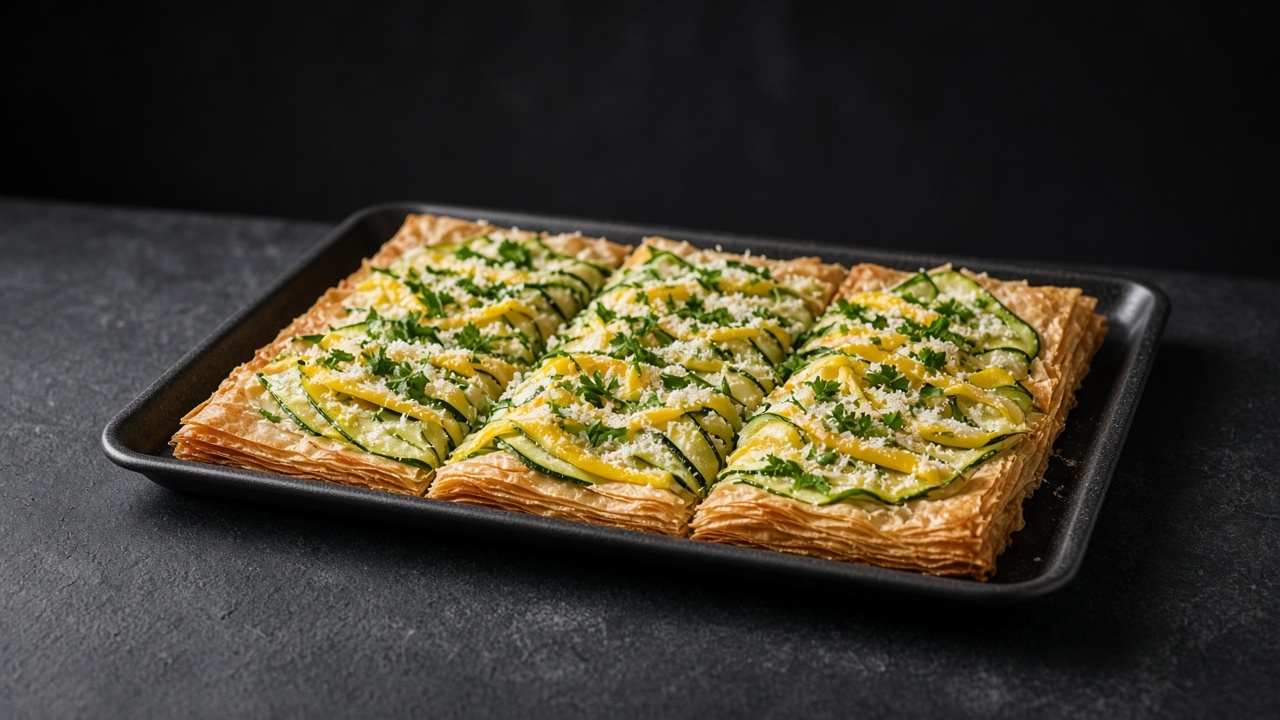
Layer. Brush a light coating of the butter mixture over a large baking tray, keeping the 12 filo sheets under a damp tea towel to prevent drying; lay 2 sheets on the tray, brush gently with the mixture and scatter 2 tbsp herb cheese and 1 tsp wheat germ over the top, then repeat this process four more times and finish with the last 2 sheets and a brush of butter-oil on top.
- 5
Arrange. Leaving a 4 cm border around the edge, scatter the ½ finely chopped red onion across the surface, then lay the thinly sliced green and yellow courgette in alternating overlapping rows.
- 6
Finish. Sprinkle the remaining herb cheese and wheat germ over the courgette, drizzle any leftover butter-oil across the surface and bake for 15 to 20 minutes until the filo is light golden and the cheese has melted.
- 7
Serve. Cool briefly on a rack then cut into 8 cm squares.
Storage
This is best eaten on the day it is made; leftovers keep chilled for 1 day and can be re-crisped in the oven. Cool leftovers in a shallow container and refrigerate within 2 hours (within 1 hour on a day above 32°C).
Free sugars
0 g per serving
0 % of the 50 g daily maximum · 0 % of the ideal 25 g
Free sugars under 50 g a day, ideally about 25 g, based on WHO free-sugar guidance (not endorsed by WHO). The share shown is the share of one serving. WHO
Equipment
- large baking tray
- pastry brush
- small bowl
- damp tea towel
- wire rack
Nutrition per serving Calculated from USDA FoodData Central
| Per serving | Amount |
|---|---|
| Energy | 366 kcal |
| Protein | 10.4 g |
| Carbohydrate | 37 g |
| of which sugars | 3.5 g |
| of which free sugars | 0 g |
| Fat | 20 g |
| of which saturates | 7.3 g |
| Fibre | 2.8 g |
| Salt | 1.19 g |
Protein per 100 kcal
2.8 g High protein needs ≥ 5 g per 100 kcal (20% of energy) and ≥ 10 g per serving
Calculated from USDA FoodData Central ingredient values