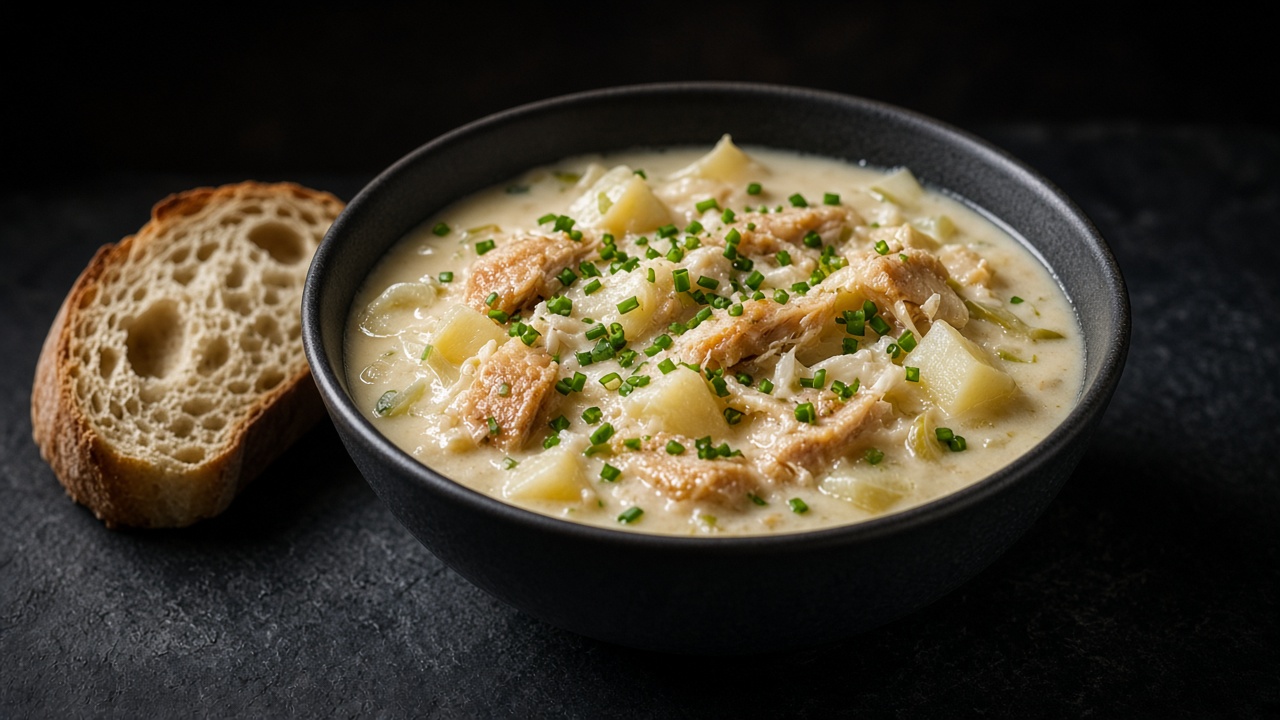
Cullen Skink: Scottish Smoked Haddock and Potato Soup
By Joe
Source: Serious Eats — Daniel Gritzer, Cullen Skink (Scottish Smoked Fish Chowder).
A cullen skink (scottish smoked fish chowder) recipe for 6 servings, written from a single tested source, with times and temperatures kept as the source set them.
Always check the labels of the products you use.
Method
- 1
Finish. Heat milk with bay leaf over a mid-sized flame till nearly simmering in a 3-quart saucepan. Add fish and cook till only just starting to flake. Remove fish to paper towels to tip off the liquid; keep to one side using a slotted spoon. Discard bay leaf. Move milk to heatproof mixing bowl or other container; keep to one side. Wash saucepan and return to mid-sized heat. Add butter and cook till melted. Add onion and cook, mixing often, till nicely softened but not browned, around 6 minutes. Return milk to saucepan plus tip in potatoes. Return milk to bare simmer. Next cook till potatoes are tender, around 10 minutes; mix and scrape saucepan now and then to prevent milk from scorching. Crush potatoes in pot till partially mashed using a potato masher or big wooden spoon. You want one good range of potato bits, some so little they thicken the broth but also larger chunks. Take out and discard any skin or bones from fish; next flake into the soup. Add cream. Add salt and pepper till it tastes right, and, if wanted, mix in pinch of cayenne. Serve, scattering chives on top of each bowl.
Storage
Keep covered and eat within a few days; freeze leftovers if the dish allows it.
Why this label?
21 g protein for 336 kcal = 6.3 g per 100 kcal, so protein gives about 25% of the energy. High protein needs at least 20% (5 g per 100 kcal), the condition in the Annex to EU Regulation (EC) No 1924/2006. How we decide
EU nutrition claims
- Low salt: 0.22 g salt per 100 ml (limit ≤ 0.3 g)
Per 100 ml of the finished dish, worked out from the nutrition per serving and the lowest likely cooked weight (about 135 ml a serving), so the true values are, if anything, lower. Thresholds from the Annex to EU Regulation (EC) No 1924/2006. How we decide
Free sugars
0 g per serving
0 % of the 50 g daily maximum · 0 % of the ideal 25 g
Free sugars under 50 g a day, ideally about 25 g, based on WHO free-sugar guidance (not endorsed by WHO). The share shown is the share of one serving. WHO
Equipment
- mixing bowl
- scales
- saucepan
Nutrition per serving Calculated from USDA FoodData Central
| Per serving | Amount |
|---|---|
| Energy | 336 kcal |
| Protein | 21 g |
| Carbohydrate | 25.2 g |
| of which sugars | 10.6 g |
| of which free sugars | 0 g |
| Fat | 17 g |
| of which saturates | 10.2 g |
| Fibre | 1.6 g |
| Salt | 0.3 g |
Protein per 100 kcal
6.3 g meets High protein (≥ 5 g per 100 kcal = 20% of energy, and ≥ 10 g per serving)
Calculated from USDA FoodData Central ingredient values