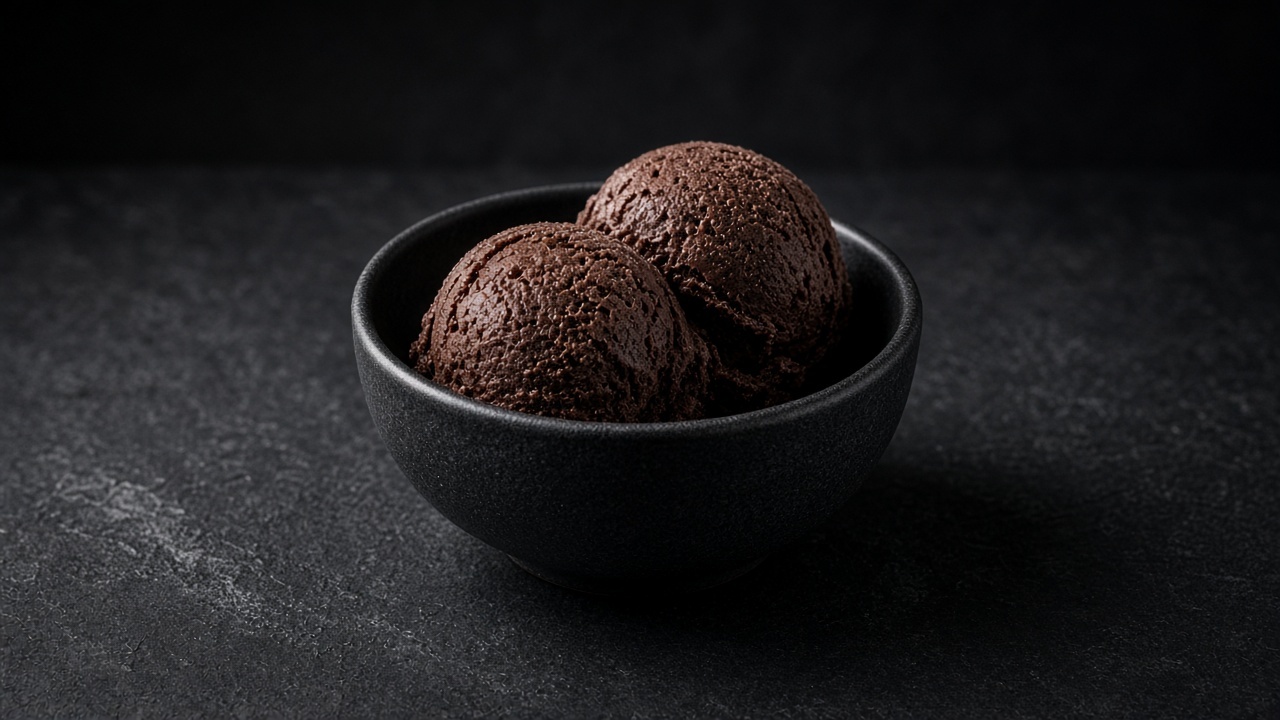
Dark Chocolate Ice Cream (No Egg)
By Joe
Source: America's Test Kitchen.
A deep, intense chocolate ice cream from 70% chocolate and cocoa, with a little coffee to make the chocolate taste darker rather than of coffee.
Always check the labels of the products you use.
Method
- 1
Cocoa milk. Whisk the cocoa with a splash of the milk in the saucepan to a smooth paste, then whisk in the rest of the milk, the sugar, syrup, salt and coffee. Bring just to a simmer, whisking.
- 2
Melt the chocolate. Pour the hot cocoa milk over the chopped chocolate in the heatproof bowl, wait 1 min, then whisk until glossy and smooth.
- 3
Add the cream. Whisk in the cold cream and vanilla, which also starts the cooling. Chill for at least 4 h; the base thickens noticeably.
- 4
Churn. Churn for 20-30 min. Chocolate bases set quickly, so stop as soon as it holds soft peaks.
- 5
Freeze. Pack into the container, cover and freeze for at least 4 h. Soften for 10-15 min before scooping, as chocolate ice cream freezes harder.
Storage
Keep covered with baking paper pressed on the surface in the freezer for up to 2 weeks. Soften for 10 min in the fridge before scooping.
EU nutrition claims
- Low salt: 0.27 g salt per 100 g (limit ≤ 0.3 g)
Per 100 g of the finished dish, worked out from the nutrition per serving and the lowest likely cooked weight (about 105 g a serving), so the true values are, if anything, lower. Thresholds from the Annex to EU Regulation (EC) No 1924/2006. How we decide
Caffeine · Free sugars
- Per serving: about 2 mg caffeine (serving: 1 of 8 servings). Source: 0.5 g instant coffee/espresso powder × USDA FDC SR Legacy #171893 (instant coffee powder, 3142 mg/100 g); divided by 8 servings.
- Scaling: making more servings does not change the caffeine in each serving; what counts is how many servings you drink in a day. 1 serving: 2 mg · 2 servings: 4 mg · 3 servings: 6 mg · 4 servings: 8 mg.
- General guideline: EFSA Scientific Opinion on the safety of caffeine (2015): for healthy adults, up to 200 mg in a single dose and up to 400 mg per day do not raise safety concerns. 1 serving = 1 % of 400 mg. EFSA
24 g per serving
48 % of the 50 g daily maximum · 96 % of the ideal 25 g
Free sugars under 50 g a day, ideally about 25 g, based on WHO free-sugar guidance (not endorsed by WHO). The share shown is the share of one serving. WHO
Equipment
- ice-cream maker
- medium saucepan
- whisk
- silicone spatula
- large jug
- freezer container with lid
- heatproof bowl
Nutrition per serving Calculated from USDA FoodData Central
| Per serving | Amount |
|---|---|
| Energy | 395 kcal |
| Protein | 4.6 g |
| Carbohydrate | 32.7 g |
| of which sugars | 27.6 g |
| of which free sugars | 24 g |
| Fat | 28.5 g |
| of which saturates | 17.6 g |
| Fibre | 2.7 g |
| Salt | 0.28 g |
Protein per 100 kcal
1.2 g High protein needs ≥ 5 g per 100 kcal (20% of energy) and ≥ 10 g per serving
Calculated from USDA FoodData Central ingredient values