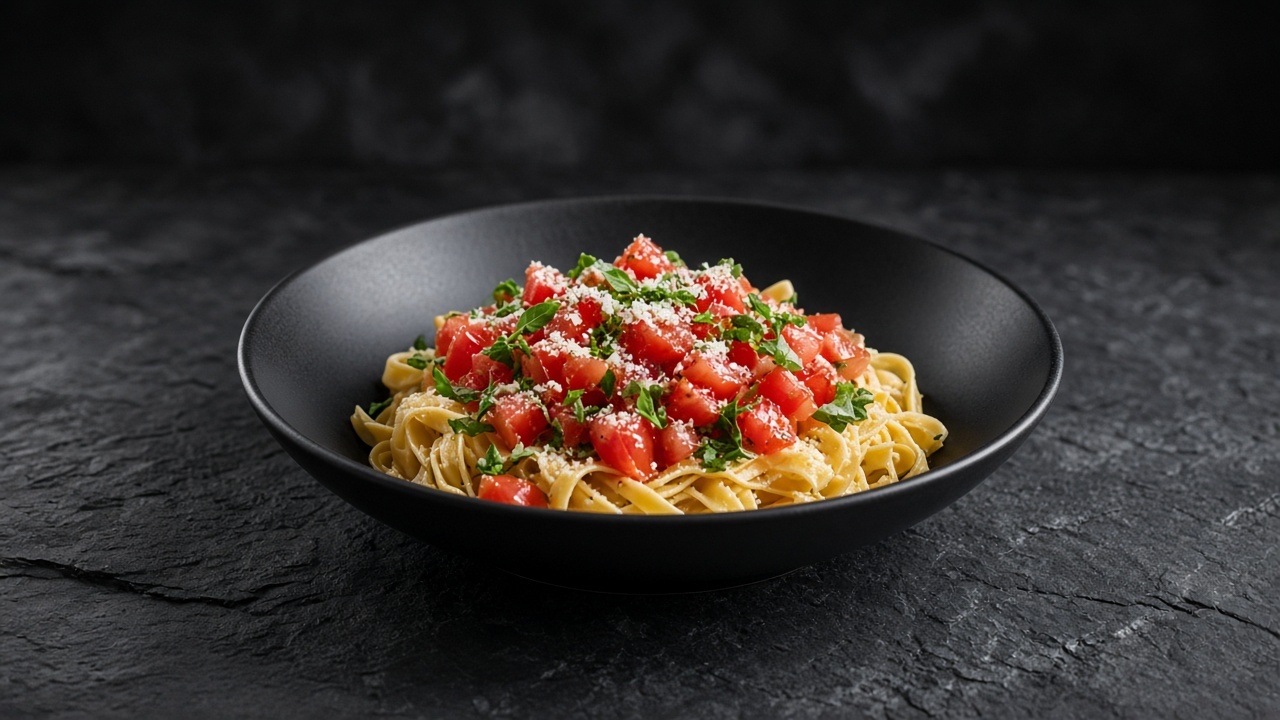
Fresh Fettuccine with Raw Tomato and Herb Sauce
By Joe
Source: NYT Cooking.
Hot fresh fettuccine under a cold, uncooked sauce of ripe tomatoes, garlic, herbs and Parmesan, made for high summer.
Always check the labels of the products you use.
Method
- 1
Herbs. With the processor running, drop the garlic through the feed tube to mince it. Stop, add the basil, oregano, parsley and oil and pulse to chop.
- 2
Tomatoes. Add the tomato chunks and pulse just until coarsely chopped; over-blending makes the sauce watery and pink.
- 3
Cheese. Tip into a bowl and stir in the Parmesan and pepper. The cheese seasons the sauce, so there is no added salt.
- 4
Cook the pasta. Boil the fettuccine in 4 litres salted water for 2-3 min until tender, then drain.
- 5
Serve. Divide the hot pasta between bowls and spoon the cold sauce over at once. It only works with tomatoes at their summer best.
Storage
Best eaten straight away. The sauce keeps refrigerated for up to 1 day. Cool leftovers in a shallow container and refrigerate within 2 hours (within 1 hour on a day above 32°C).
Why this label?
- Total fat: 19.7 % of energy (limit ≤ 30%)
- Saturated fat: 6.3 % of energy (limit < 10%)
- Free sugars: 0 % of energy (limit < 10%)
- Salt: 0.64 g (limit ≤ 1.7 g)
- Fibre or fruit & veg: 3.9 g fibre / 275 g veg (limit ≥ 6.5 g fibre or 80 g fruit & veg)
Per serving, worked out from the nutrition table against our rule based on the WHO healthy diet guidance. Not endorsed by WHO.
EU nutrition claims
- Source of protein: 4.5 g protein per 100 kcal, about 18% of energy (needs ≥ 12%)
- Low saturated fat: 1 g saturated fat per 100 g, 6.3% of energy (limits ≤ 1.5 g and ≤ 10%)
- Low sugars: 2 g sugars per 100 g (limit ≤ 5 g)
- Low salt: 0.18 g salt per 100 g (limit ≤ 0.3 g)
Per 100 g of the finished dish, worked out from the nutrition per serving and the lowest likely cooked weight (about 363 g a serving), so the true values are, if anything, lower. Thresholds from the Annex to EU Regulation (EC) No 1924/2006. How we decide
Free sugars
0 g per serving
0 % of the 50 g daily maximum · 0 % of the ideal 25 g
Free sugars under 50 g a day, ideally about 25 g, based on WHO free-sugar guidance (not endorsed by WHO). The share shown is the share of one serving. WHO
Equipment
- food processor
- large pot (at least 5 litres)
- colander or tongs
- heatproof mug for pasta water
Nutrition per serving Calculated from USDA FoodData Central
| Per serving | Amount |
|---|---|
| Energy | 517 kcal |
| Protein | 23.4 g |
| Carbohydrate | 81.7 g |
| of which sugars | 7.4 g |
| of which free sugars | 0 g |
| Fat | 11.3 g |
| of which saturates | 3.6 g |
| Fibre | 3.9 g |
| Salt | 0.64 g |
Protein per 100 kcal
4.5 g High protein needs ≥ 5 g per 100 kcal (20% of energy) and ≥ 10 g per serving
Calculated from USDA FoodData Central ingredient values