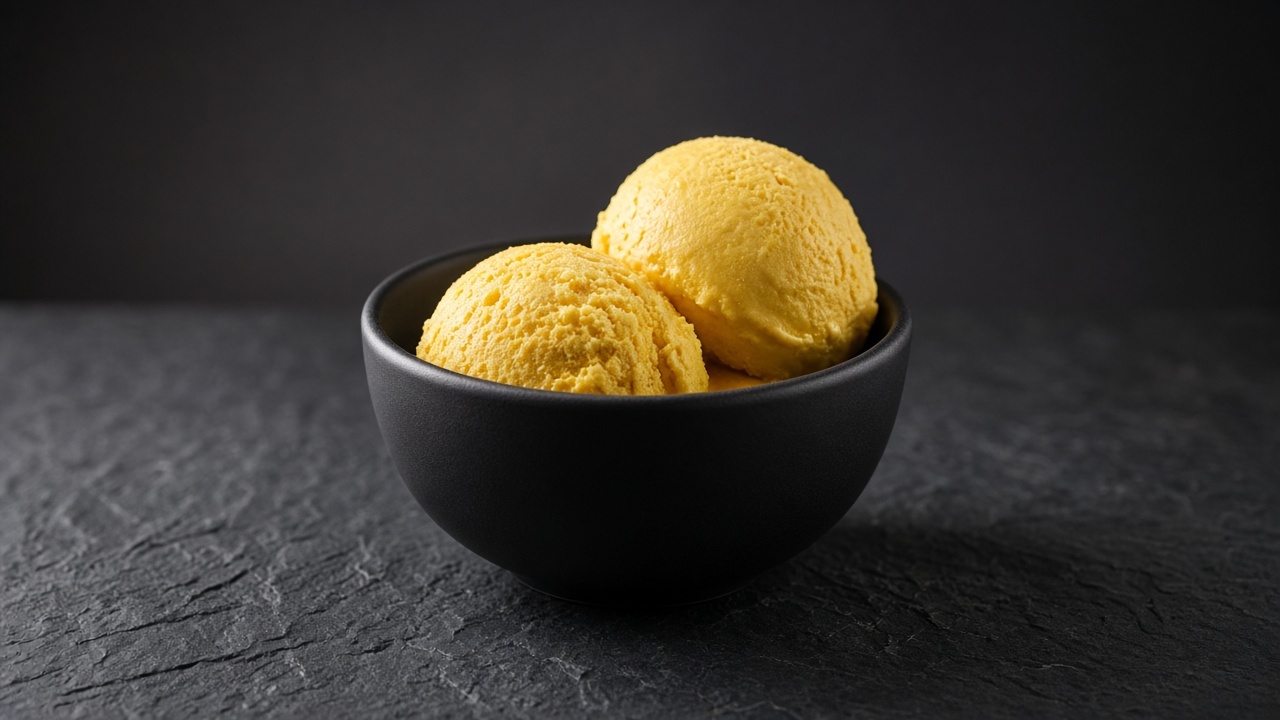
Ginger and Turmeric Frozen Yoghurt
By Joe
Source: America's Test Kitchen.
A warming golden frozen yoghurt infused with ginger and turmeric. The exotic spices create a sophisticated, earthy flavour.
Always check the labels of the products you use.
Method
- 1
Drain. Line a colander with three layers of muslin, set it over a bowl, add the 900 g yoghurt, cover and refrigerate for 8-12 h, until 300 ml of whey has dripped out.
- 2
Whey. Discard 180 ml whey from the drained liquid. Scatter 1 tsp gelatine over the 120 ml whey you kept, leave it 5 min, then microwave about 30 s, until it bubbles round the edge and the gelatine has melted.
- 3
Infuse. Stir 1½ tbsp finely grated fresh ginger, 1 tsp ground ginger and 1 tsp ground turmeric into the warm gelatine, cool for 5 min, then strain through a fine sieve, pressing the solids.
- 4
Mix. Whisk 150 g caster sugar, 3 tbsp golden syrup, a pinch of fine salt, the drained yoghurt and the spiced whey until the sugar dissolves.
- 5
Chill. Chill in the fridge or over an ice bath for about 3 h to 4 °C or below.
- 6
Churn. Churn in the ice-cream maker for about 20 min to thick soft-serve.
- 7
Freeze. Freeze in an airtight container for about 2 h; keeps for 5 days.
Storage
Store in an airtight container in the freezer for up to 5 days.
Free sugars
25.1 g per serving
50.2 % of the 50 g daily maximum · 100.4 % of the ideal 25 g
Free sugars under 50 g a day, ideally about 25 g, based on WHO free-sugar guidance (not endorsed by WHO). The share shown is the share of one serving. WHO
Equipment
- ice-cream maker
- colander or sieve lined with three layers of muslin
- large bowl
- cling film
- microwave-safe bowl
- fine sieve
- whisk
- instant-read thermometer
- airtight container
Nutrition per serving Calculated from USDA FoodData Central
| Per serving | Amount |
|---|---|
| Energy | 148 kcal |
| Protein | 3 g |
| Carbohydrate | 29.3 g |
| of which sugars | 28.6 g |
| of which free sugars | 25.1 g |
| Fat | 2.5 g |
| of which saturates | 1.6 g |
| Fibre | 0.1 g |
| Salt | 0.21 g |
Protein per 100 kcal
2 g High protein needs ≥ 5 g per 100 kcal (20% of energy) and ≥ 10 g per serving
Calculated from USDA FoodData Central ingredient values