Always check the labels of the products you use.
Method
- 1
Prepare the cure. Mix the brown sugar and salt in a small bowl, breaking up any lumps. Brown sugar gives a deeper, slightly caramel sweetness than white.
- 2
Season the fillet. Lay the salmon skin side down in the glass dish and brush the flesh with lemon juice. Rub the sugar and salt evenly over it, then cover with the chopped dill in a dense blanket.
- 3
Weigh it down. Cover loosely with cling film, rest a second dish on top and load it with heavy tins. The weight pushes out moisture and presses the flesh into a firm, dense texture.
- 4
Baste each day. Refrigerate for about 3 days, lifting off the weights once a day to spoon the collected brine back over the fish. It is ready when the thickest part feels firm all over.
- 5
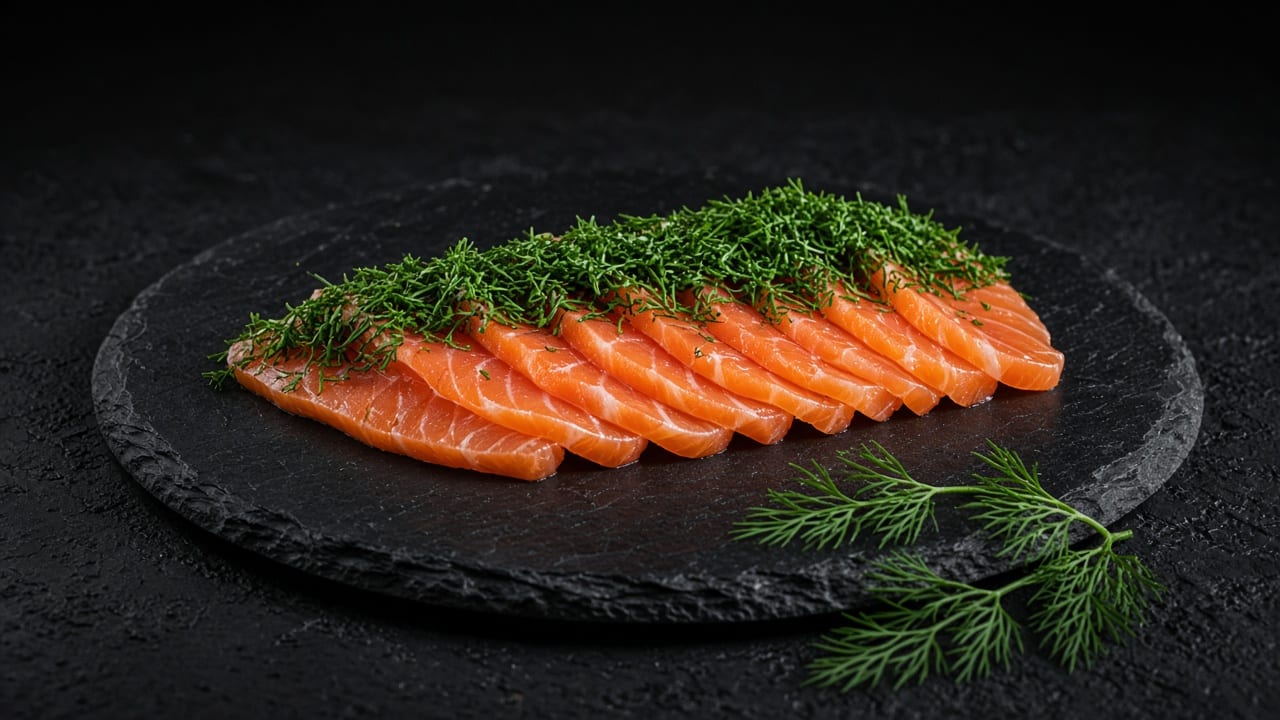
Slice and finish. Scrape off the dill and cure and pat the salmon dry. Cut very thin slices on a sharp angle, lifting each away from the skin, lay them on a board and heap fresh dill over the top with lemon wedges beside.
Storage
Once cured, wrap the salmon tightly and keep it in the fridge for up to 3 days. Cool leftovers in a shallow container and refrigerate within 2 hours (within 1 hour on a day above 32°C).
Free sugars
11.4 g per serving
22.8 % of the 50 g daily maximum · 45.6 % of the ideal 25 g
Free sugars under 50 g a day, ideally about 25 g, based on WHO free-sugar guidance (not endorsed by WHO). The share shown is the share of one serving. WHO
Equipment
- small bowl
- glass dish about 33 x 23 cm
- cling film
- second dish or plate and heavy tins for weights
- spoon for basting
- kitchen paper
- very long thin slicing knife
Nutrition per serving Calculated from USDA FoodData Central
Approximate: more salt than a serving would eat is listed (coarse sea salt; a brine, rub or typo), so salt is capped at 3 g. No nutrition labels are shown for this recipe until it is fixed.
| Per serving | Amount |
|---|---|
| Energy | 193 kcal |
| Protein | 14.6 g |
| Carbohydrate | 12.1 g |
| of which sugars | 11.4 g |
| of which free sugars | 11.4 g |
| Fat | 9.5 g |
| of which saturates | 2.1 g |
| Fibre | 0.1 g |
| Salt | 3.03 g |
Protein per 100 kcal
7.6 g High protein needs ≥ 5 g per 100 kcal (20% of energy) and ≥ 10 g per serving
Calculated from USDA FoodData Central ingredient values