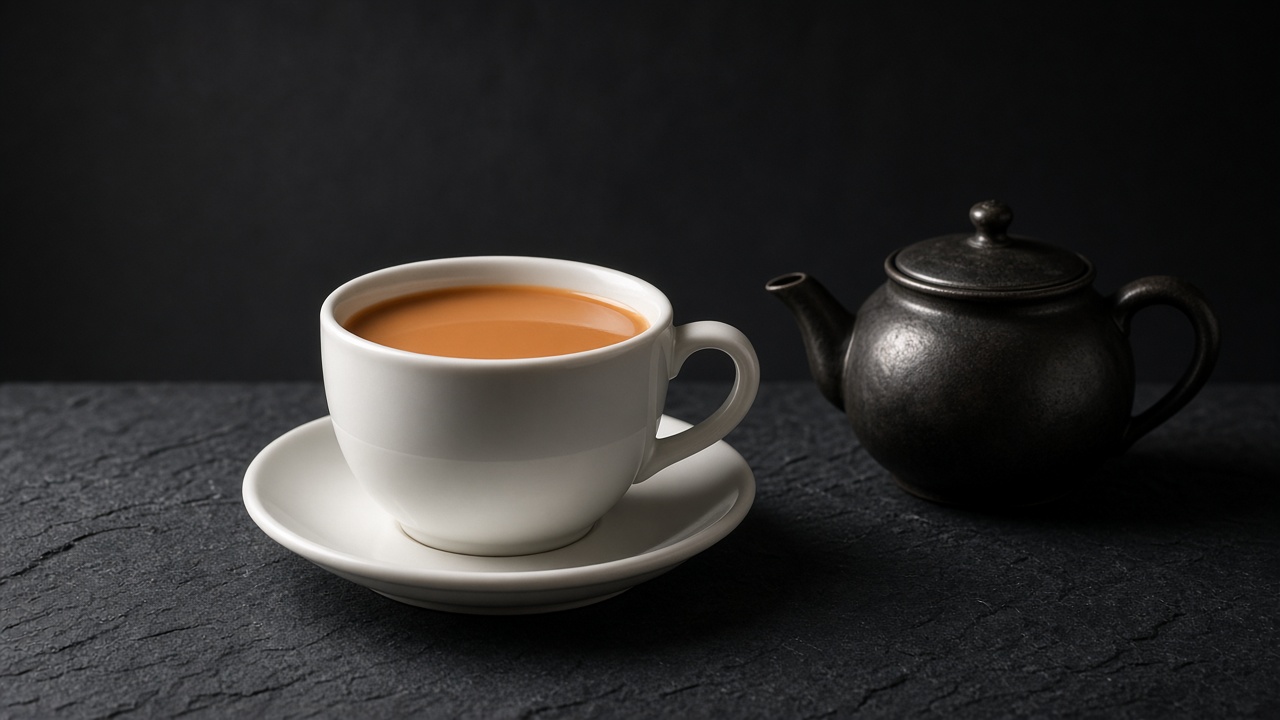
Hong Kong Milk Tea with Evaporated Milk
By Joe
Source: Serious Eats — Genevieve Yam, Hong Kong Milk Tea.
A hong kong milk tea recipe for 2 servings, written from a single tested source, with times and temperatures kept as the source set them.
Always check the labels of the products you use.
Method
- 1
Mix. Bring water to a boil over a high flame in a little saucepan. Tip in tea bags, reduce heat to medium-low, plus simmer till tea is dark and aromatic, 5 to 7 minutes. Take out from heat. Carefully take out the tea bags using a slotted spoon. Use a spoon to push down on tea bags in order to extract any excess tea. Beat in evaporated milk. Taste and add salt if it needs it with sugar and extra evaporated milk, as wanted.
Storage
Keep covered and eat within a few days; freeze leftovers if the dish allows it.
EU nutrition claims
- Low energy: 15 kcal per 100 ml (limit ≤ 20 kcal)
- Low fat: 0.8 g fat per 100 ml (limit ≤ 1.5 g)
- Low sugars: 1.1 g sugars per 100 ml (limit ≤ 2.5 g)
- Low salt: 0.04 g salt per 100 ml (limit ≤ 0.3 g)
Per 100 ml of the finished dish, worked out from the nutrition per serving and the lowest likely cooked weight (about 271 ml a serving), so the true values are, if anything, lower. Thresholds from the Annex to EU Regulation (EC) No 1924/2006. How we decide
Caffeine · Free sugars
- Per serving: at least 72 mg caffeine (serving: 1 cup (about 360 ml tea)). Source: about 360 ml brewed per serving × USDA FDC SR Legacy #173227 (brewed black tea, 20 mg/100 g) This brew uses more tea per ml than standard brewed tea, so the real amount is likely higher..
- Scaling: making more servings does not change the caffeine in each serving; what counts is how many servings you drink in a day. 1 serving: 72 mg · 2 servings: 144 mg · 3 servings: 216 mg (above EFSA 200 mg at once) · 4 servings: 288 mg (above EFSA 200 mg at once).
- General guideline: EFSA Scientific Opinion on the safety of caffeine (2015): for healthy adults, up to 200 mg in a single dose and up to 400 mg per day do not raise safety concerns. 1 serving = 18 % of 400 mg. EFSA
0 g per serving
0 % of the 50 g daily maximum · 0 % of the ideal 25 g
Free sugars under 50 g a day, ideally about 25 g, based on WHO free-sugar guidance (not endorsed by WHO). The share shown is the share of one serving. WHO
Equipment
- mixing bowl
- scales
- saucepan
Nutrition per serving Calculated from USDA FoodData Central
| Per serving | Amount |
|---|---|
| Energy | 40 kcal |
| Protein | 2 g |
| Carbohydrate | 3 g |
| of which sugars | 3 g |
| of which free sugars | 0 g |
| Fat | 2.3 g |
| of which saturates | 1.4 g |
| Fibre | 0 g |
| Salt | 0.11 g |
Protein per 100 kcal
5 g High protein needs ≥ 5 g per 100 kcal (20% of energy) and ≥ 10 g per serving
Calculated from USDA FoodData Central ingredient values