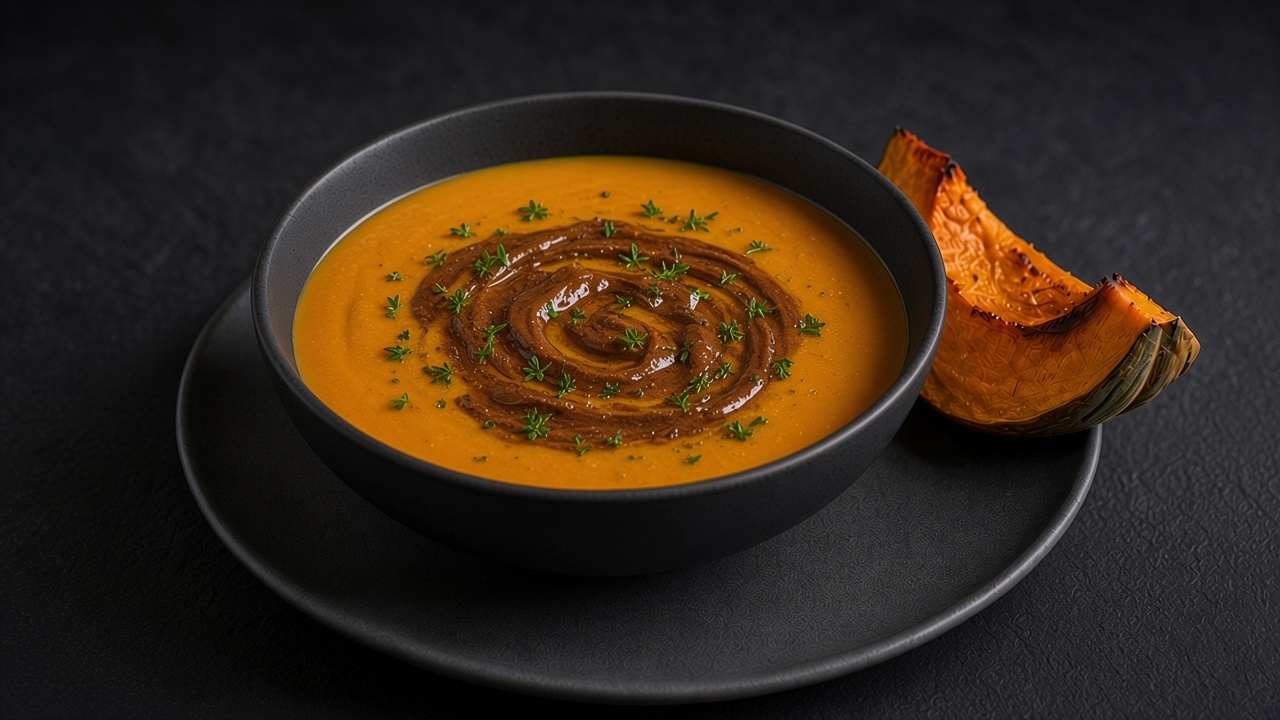
Kabocha Mash with Browned Butter
By Joe
Source: Bon Appétit — Bon Appétit, Winter Squash Mash.
A winter squash mash recipe for 6 servings, written from a single tested source, with times and temperatures kept as the source set them.
Always check the labels of the products you use.
Method
- 1
Bake. Heat oven to 175°C. Spray big rimmed baking tray with nonstick spray. Drizzle olive oil inside each kabocha (1 tablespoon) squash half and brush to coat. Put squash halves, cut side down, on ready baking tray. Roast till squash is very tender when pierced with knife, around 1 hour 10 minutes. Cool a little. Scoop out squash flesh into bowl and mash till almost smooth. Melt butter in skillet over a medium-high flame till starting to brown, around 2 minutes. Add garlic and thyme and mix 1 minute. Add butter mixture and broth to squash and mash (1 cup) till there are no lumps left. Season well with salt and pepper. (Can be ready 2 hours ahead. Leave to stand at room temperature. Add more broth if wanted and rewarm in microwave before continuing.) Mix 2 tablespoons parsley into squash. Scatter squash with leftover 1 tablespoon parsley and serve.
Storage
Keep covered and eat within a few days; freeze leftovers if the dish allows it.
EU nutrition claims
- Low fat: 2.4 g fat per 100 g (limit ≤ 3 g)
- Low sugars: 2.1 g sugars per 100 g (limit ≤ 5 g)
- Low salt: 0.03 g salt per 100 g (limit ≤ 0.3 g)
- Source of fibre: 2.9 g fibre per 100 kcal (needs ≥ 1.5 g)
Per 100 g of the finished dish, worked out from the nutrition per serving and the lowest likely cooked weight (about 722 g a serving), so the true values are, if anything, lower. Thresholds from the Annex to EU Regulation (EC) No 1924/2006. How we decide
Free sugars
0 g per serving
0 % of the 50 g daily maximum · 0 % of the ideal 25 g
Free sugars under 50 g a day, ideally about 25 g, based on WHO free-sugar guidance (not endorsed by WHO). The share shown is the share of one serving. WHO
Equipment
- mixing bowl
- scales
- baking tin or tray
Nutrition per serving Calculated from USDA FoodData Central
| Per serving | Amount |
|---|---|
| Energy | 461 kcal |
| Protein | 7.9 g |
| Carbohydrate | 79.8 g |
| of which sugars | 15.3 g |
| of which free sugars | 0 g |
| Fat | 17.5 g |
| of which saturates | 8 g |
| Fibre | 13.4 g |
| Salt | 0.22 g |
Protein per 100 kcal
1.7 g High protein needs ≥ 5 g per 100 kcal (20% of energy) and ≥ 10 g per serving
Calculated from USDA FoodData Central ingredient values