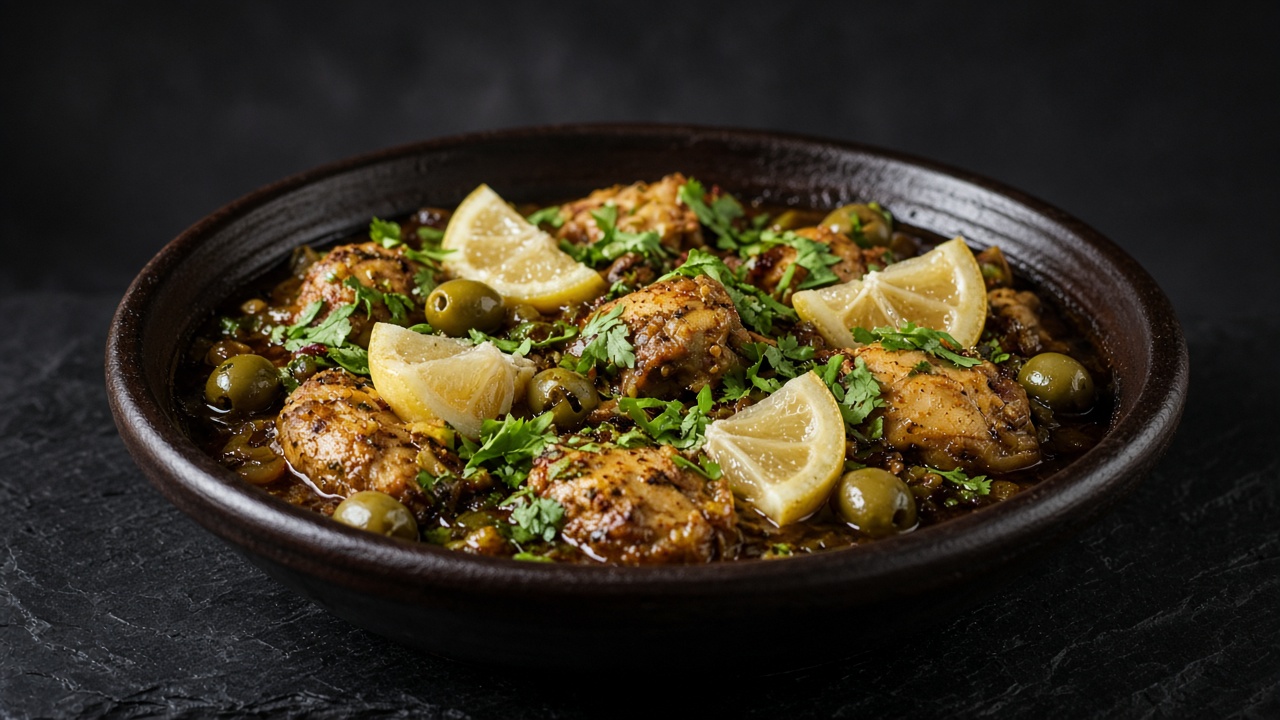
Lamb Tagine with Preserved Lemon and Green Olives
By Joe
Source: NYT Cooking and America's Test Kitchen.
This follows the classic lamb tagine method, but swaps the fruit and almonds for preserved lemon rind and green olives added in the last 15 min, with less salt in the base since both are salty. The result is bright, tangy and savoury.
Based on the listed ingredients, none of the 14 major EU allergens. Always check product labels.
Method
- 1
Season the lamb. This variation uses the classic tagine method, with less base salt and lemon and olives instead of fruit and nuts. Season the lamb all over with the tagine salt and pepper while the oven heats to 160°C (fan 140°C). The salt is reduced here because the preserved lemon and olives bring plenty of their own.
- 2
Brown the meat. In the casserole, heat the oil over medium-high heat and brown the lamb in 2-3 batches for 6-8 min each, leaving space between the pieces. Remove each batch once deeply coloured; this browning is where much of the savoury flavour comes from.
- 3
Soften onions and spices. Lower the heat to medium and cook the onions for 8-10 min until soft and golden. Add the garlic, fresh and ground ginger, turmeric, coriander, ground cinnamon and cinnamon stick and stir for 1 min until fragrant, so the spices bloom in the oil.
- 4
Braise low and slow. Return the lamb with its juices, add the saffron and its water, the 500 ml water and the coriander stalks, and scrape up the browned bits. Bring to a simmer, cover tightly and braise in the oven for 2 h-2 h 30 min, stirring once or twice, until the lamb is very tender.
- 5
Add lemon and olives. For the last 15 min in the oven, stir in the preserved lemon strips and olives. Adding them late keeps the olives firm and the lemon flavour bright rather than bitter.
- 6
Adjust the sauce. Remove the coriander stalks and cinnamon stick. If the sauce is thin, simmer uncovered on the hob for 5-10 min until it clings to the meat, then stir in the lemon juice for a final lift of freshness.
- 7
Serve. Scatter the tagine with parsley and coriander leaves and serve with lemon wedges and bread or couscous.
Storage
Cool within 2 hours, refrigerate for up to 3 days or freeze for up to 3 months. Reheat until piping hot (74°C), adding a splash of water if the sauce has thickened.
Why this label?
34.9 g protein for 620 kcal = 5.6 g per 100 kcal, so protein gives about 23% of the energy. High protein needs at least 20% (5 g per 100 kcal), the condition in the Annex to EU Regulation (EC) No 1924/2006. How we decide
EU nutrition claims
- Low sugars: 2.1 g sugars per 100 g (limit ≤ 5 g)
Per 100 g of the finished dish, worked out from the nutrition per serving and the lowest likely cooked weight (about 131 g a serving), so the true values are, if anything, lower. Thresholds from the Annex to EU Regulation (EC) No 1924/2006. How we decide
Free sugars
0.1 g per serving
0.2 % of the 50 g daily maximum · 0.4 % of the ideal 25 g
Free sugars under 50 g a day, ideally about 25 g, based on WHO free-sugar guidance (not endorsed by WHO). The share shown is the share of one serving. WHO
Equipment
- large heavy casserole (Dutch oven, 5-6 litres) with tight lid, or a tagine with a heat diffuser
- tongs
- wooden spoon
Nutrition per serving Calculated from USDA FoodData Central
| Per serving | Amount |
|---|---|
| Energy | 620 kcal |
| Protein | 34.9 g |
| Carbohydrate | 9.4 g |
| of which sugars | 2.8 g |
| of which free sugars | 0.1 g |
| Fat | 49.1 g |
| of which saturates | 19.3 g |
| Fibre | 3 g |
| Salt | 2.1 g |
Protein per 100 kcal
5.6 g meets High protein (≥ 5 g per 100 kcal = 20% of energy, and ≥ 10 g per serving)
Calculated from USDA FoodData Central ingredient values