Always check the labels of the products you use.
Method
- 1
Make Dough. Whisk bread flour (360 g), salt (8 g) and yeast (3 g) in a large bowl, add water (270 ml) and oil (15 ml) and stir hard until no dry flour remains, cover and leave somewhere warm 15 min.
- 2
Fold. With a wet hand lift a section of dough, press it into the middle, give the bowl a quarter turn and repeat 3-6 times until it resists, rest 15 min, fold again, then cover and leave 1-1.5 h until slightly puffy.
- 3
Pan. Oil the tray (33 x 45 cm) with remaining oil (15 ml), turn the dough in it and stretch with fingertips to cover about three quarters, rest 30 min, stretch to the edges, cover and prove 45-60 min.
- 4
Prepare Potatoes. Stir salt (2 tbsp) into warm water (950 ml), slice the potatoes (450 g yellow waxy-floury) very thinly (2-3 mm) and soak them, drain and dry well in a clean tea towel, toss with onion (½ medium, 170 g sliced), oil (15 ml), rosemary (1½ tsp chopped), chilli flakes (½ tsp) and salt (1 tsp).
- 5
Heat Oven. Meanwhile put a shelf (and stone if using) at the bottom and heat the oven to 260 °C.
- 6
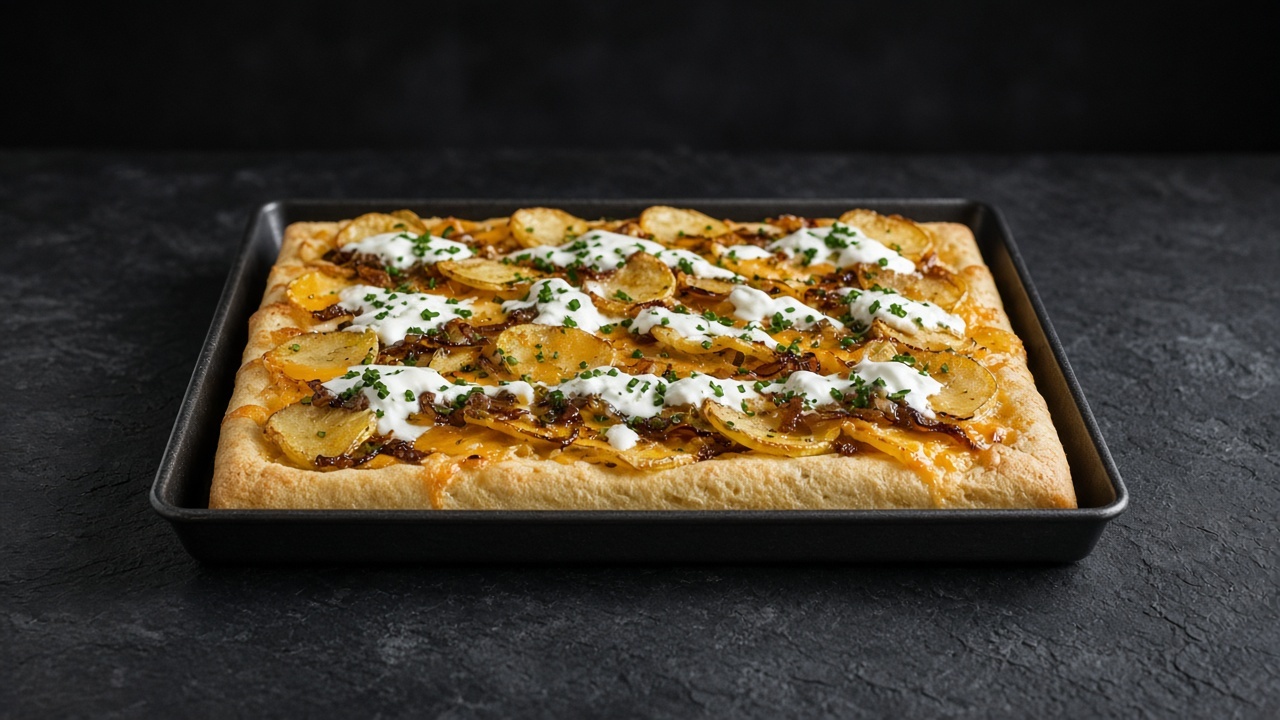
Build and Bake. Spread the potato mixture in a single layer over the dough, scatter cheddar (140 g grated), lower the oven to 230 °C and bake on the bottom shelf 25-30 min until bubbling and deep golden underneath (check with a fish slice; move up for 2-4 min if the top is pale).
- 7
Finish. Cool briefly, slide onto a rack, scatter chives (3 tbsp chopped) and drizzle with soured cream mixed with milk (60 g soured cream with 1 tbsp milk).
Storage
Cool completely, then keep chilled for up to 2 days and reheat in foil in a low oven until hot, then serve. Cool leftovers in a shallow container and refrigerate within 2 hours (within 1 hour on a day above 32°C).
EU nutrition claims
- Source of protein: 3.3 g protein per 100 kcal, about 13% of energy (needs ≥ 12%)
- Low sugars: 1.8 g sugars per 100 g (limit ≤ 5 g)
Per 100 g of the finished dish, worked out from the nutrition per serving and the lowest likely cooked weight (about 146 g a serving), so the true values are, if anything, lower. Thresholds from the Annex to EU Regulation (EC) No 1924/2006. How we decide
Free sugars
0 g per serving
0 % of the 50 g daily maximum · 0 % of the ideal 25 g
Free sugars under 50 g a day, ideally about 25 g, based on WHO free-sugar guidance (not endorsed by WHO). The share shown is the share of one serving. WHO
Equipment
- large bowl
- rimmed baking tray, about 33 x 45 cm
- pizza stone or baking steel (optional)
- sharp knife or mandoline
- clean tea towel
- small bowl
- squeeze bottle (optional)
- fish slice
- wire rack
Nutrition per serving Calculated from USDA FoodData Central
| Per serving | Amount |
|---|---|
| Energy | 466 kcal |
| Protein | 15.3 g |
| Carbohydrate | 60.7 g |
| of which sugars | 2.6 g |
| of which free sugars | 0 g |
| Fat | 18 g |
| of which saturates | 6.7 g |
| Fibre | 3.7 g |
| Salt | 3.15 g |
Protein per 100 kcal
3.3 g High protein needs ≥ 5 g per 100 kcal (20% of energy) and ≥ 10 g per serving
Calculated from USDA FoodData Central ingredient values