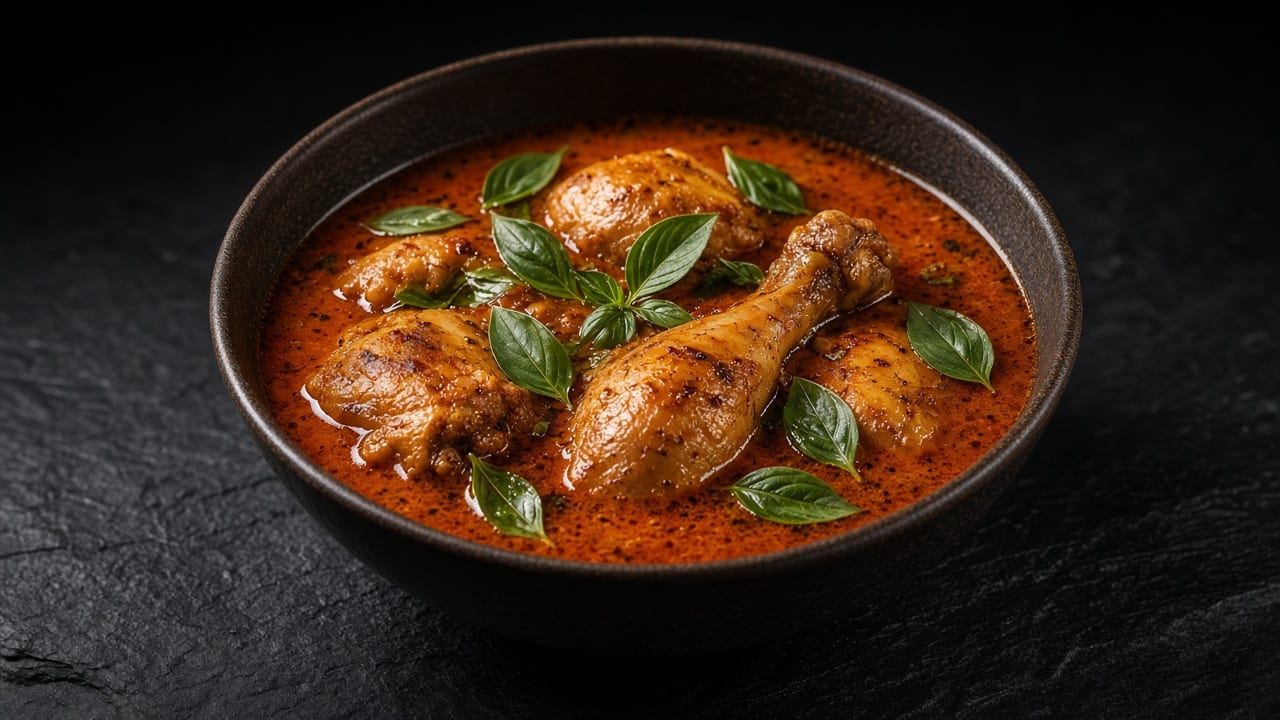
Nigerian Chicken Pepper Soup with Red Pepper Broth
By Joe
Source: NYT Cooking.
A lighter, faster pepper soup: chicken legs cooked in a blended red pepper, onion, ginger and Scotch bonnet base with warm pepper-soup spices, finished with basil.
Based on the listed ingredients, none of the 14 major EU allergens. Always check product labels.
Method
- 1
Blend the pepper base. Blend the red pepper, onion, Scotch bonnet, ginger and garlic with 100 ml of the water to a smooth orange purée.
- 2
Coat the chicken. Put the chicken in the pot with the purée, all the spice mix (or 1.5 tbsp ready-made Nigerian pepper-soup spice) and half the salt. Stir to coat and leave 10 min.
- 3
Cook down. Cover and cook over medium heat for 10 min, stirring now and then, until the purée darkens a little and the chicken has firmed up.
- 4
Simmer. Add the rest of the water, bring to the boil, then simmer partly covered for 30-35 min until the chicken is tender and reaches 75 °C next to the bone.
- 5
Season. Add the rest of the salt and taste. The broth should be peppery and warming; simmer a few minutes more to concentrate it if you like.
- 6
Serve. Turn off the heat, stir in the basil and serve in deep bowls, with boiled plantain or rice on the side.
Storage
Keep in the fridge for up to 3 days or freeze for up to 3 months. Reheat until boiling. Cool leftovers in a shallow container and refrigerate within 2 hours (within 1 hour on a day above 32°C).
Why this label?
35.2 g protein for 339 kcal = 10.4 g per 100 kcal, so protein gives about 42% of the energy. High protein needs at least 20% (5 g per 100 kcal), the condition in the Annex to EU Regulation (EC) No 1924/2006. How we decide
EU nutrition claims
- Low sugars: 0.9 g sugars per 100 ml (limit ≤ 2.5 g)
Per 100 ml of the finished dish, worked out from the nutrition per serving and the lowest likely cooked weight (about 326 ml a serving), so the true values are, if anything, lower. Thresholds from the Annex to EU Regulation (EC) No 1924/2006. How we decide
Free sugars
0 g per serving
0 % of the 50 g daily maximum · 0 % of the ideal 25 g
Free sugars under 50 g a day, ideally about 25 g, based on WHO free-sugar guidance (not endorsed by WHO). The share shown is the share of one serving. WHO
Equipment
- blender
- large pot with lid
- ladle
Nutrition per serving Calculated from USDA FoodData Central
| Per serving | Amount |
|---|---|
| Energy | 339 kcal |
| Protein | 35.2 g |
| Carbohydrate | 7.7 g |
| of which sugars | 2.9 g |
| of which free sugars | 0 g |
| Fat | 17.8 g |
| of which saturates | 4.7 g |
| Fibre | 1.9 g |
| Salt | 2.33 g |
Protein per 100 kcal
10.4 g meets High protein (≥ 5 g per 100 kcal = 20% of energy, and ≥ 10 g per serving)
Calculated from USDA FoodData Central ingredient values