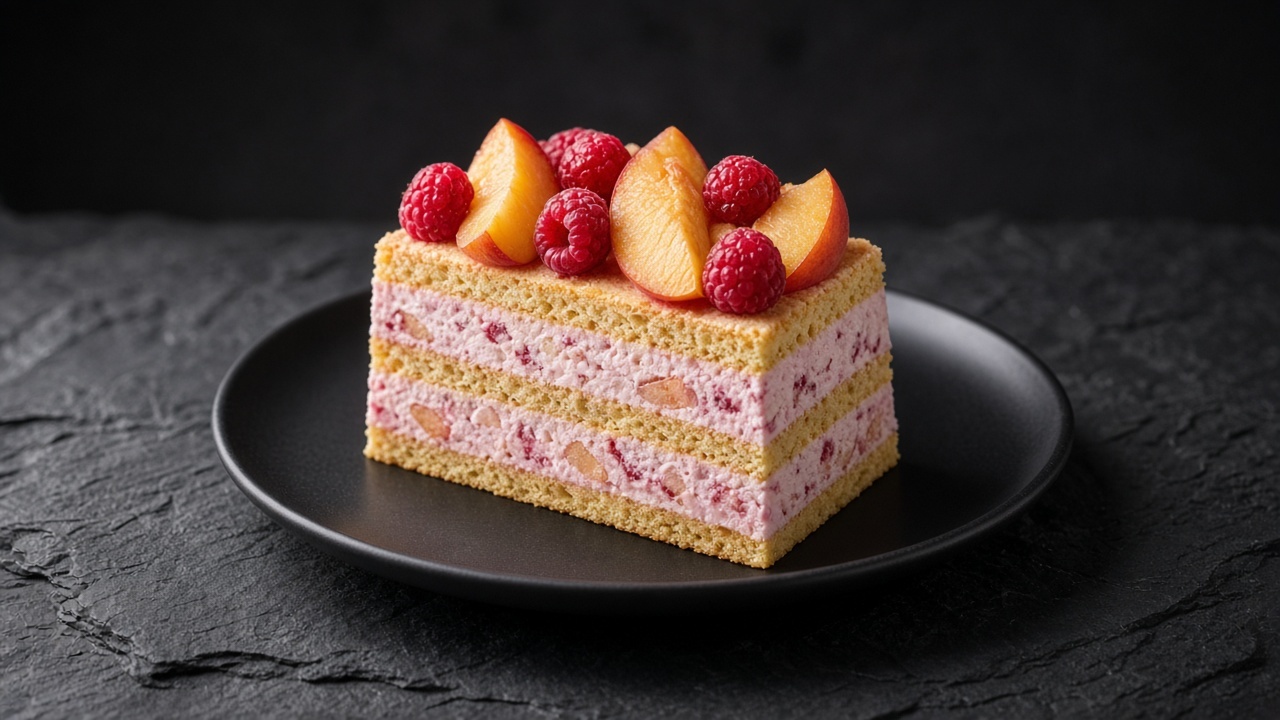
Peach and Raspberry Ice Cream Cake
By Joe
Source: NYT Cooking.
Thin layers of sponge are stacked with peach and raspberry ripple cream, then frozen into a loaf and finished with a pile of fresh peach and raspberry on top.
Always check the labels of the products you use.
Method
- 1
Macerate. Toss the 170 g chopped peach with 1 tbsp caster sugar in one bowl and the 240 g raspberries with the other 1 tbsp caster sugar in another, then leave both to stand for at least 1 h.
- 2
Whisk. Whisk the 95 g plain flour with ¾ tsp baking powder and ¼ tsp fine salt in one bowl, then beat the 70 g soft butter with 100 g caster sugar until fluffy, about 3 min.
- 3
Batter. Beat in ½ tsp vanilla and the egg and egg yolk, then fold in the flour mixture alternately with the 2 tbsp whole milk.
- 4
Bake. Spread the batter thinly in the lined, buttered large tin and bake at 180 °C for 10-12 min until golden and springy, then cool for 10 min before turning out and peeling off the paper.
- 5
Cream. Mix the 154 g chopped peach jam, 120 ml evaporated milk, a pinch of salt and the macerated peaches with their juice, then whip the 360 ml double cream to stiff peaks and fold through.
- 6
Cut. Trim the sponge into 3 strips about 23 x 11 cm, leaving a 6 mm gap all round once placed in the film-lined loaf tin.
- 7
Layer. Build the cake with a third of the cream, a sponge strip pressed down so the cream rises around it, and half the drained raspberries, then repeat and finish with the last of the cream and the final sponge strip.
- 8
Freeze. Wrap well and freeze for at least 8 h.
- 9
Serve. Toss the sliced peach and 60 g raspberries with 1 tbsp caster sugar for 10 min, then invert the cake, let it stand for 5-10 min and pile the fruit on top.
Storage
Keep the cake well wrapped in the freezer and add the sugared fruit only when serving.
EU nutrition claims
- Low salt: 0.29 g salt per 100 g (limit ≤ 0.3 g)
Per 100 g of the finished dish, worked out from the nutrition per serving and the lowest likely cooked weight (about 115 g a serving), so the true values are, if anything, lower. Thresholds from the Annex to EU Regulation (EC) No 1924/2006. How we decide
Free sugars
19.2 g per serving
38.4 % of the 50 g daily maximum · 76.8 % of the ideal 25 g
Free sugars under 50 g a day, ideally about 25 g, based on WHO free-sugar guidance (not endorsed by WHO). The share shown is the share of one serving. WHO
Equipment
- 23 x 33 cm baking tin
- baking paper
- 23 x 13 cm loaf tin
- cling film
- bowls
- whisk
- electric mixer
- offset spatula
- serrated knife
Nutrition per serving Calculated from USDA FoodData Central
| Per serving | Amount |
|---|---|
| Energy | 333 kcal |
| Protein | 4.2 g |
| Carbohydrate | 37.1 g |
| of which sugars | 24 g |
| of which free sugars | 19.2 g |
| Fat | 19.5 g |
| of which saturates | 11.9 g |
| Fibre | 2.6 g |
| Salt | 0.33 g |
Protein per 100 kcal
1.3 g High protein needs ≥ 5 g per 100 kcal (20% of energy) and ≥ 10 g per serving
Calculated from USDA FoodData Central ingredient values