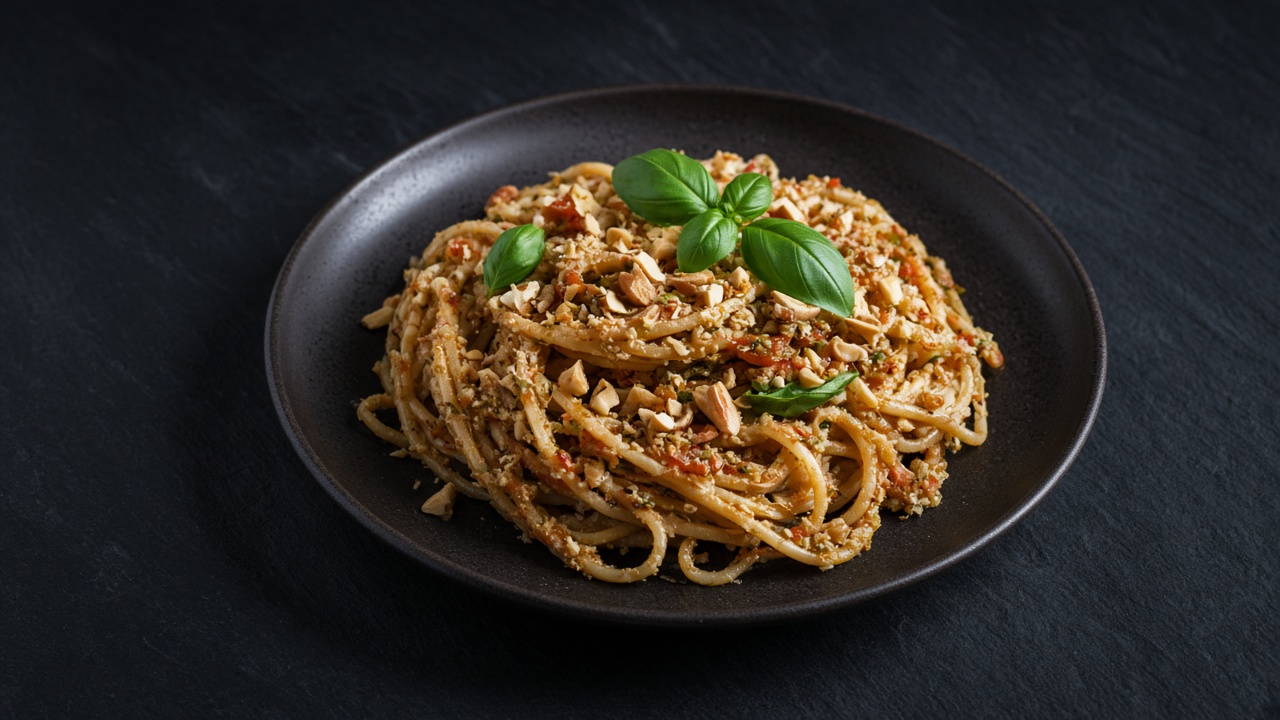
Linguine with Pesto alla Trapanese (Almond, Tomato and Basil)
By Joe
Source: Serious Eats — Daniel Gritzer, Pesto alla Trapanese (Sicilian Pesto With Almonds and Tomatoes).
A pesto alla trapanese (sicilian pesto with almonds and tomatoes) recipe for 4 servings, written from a single tested source, with times and temperatures kept as the source set them.
Always check the labels of the products you use.
Method
- 1
Finish. If Using a Mortar plus Pestle: Crush the garlic in the mortar using a pinch of salt in order to form a paste. Tip in almonds and beat and crush in a rough paste. Work in basil leaves plus mint (if using), pounding plus crushing in tiny bits. Smash in cheese, followed by tomatoes plus olive oil. This final sauce should be a rough paste. Add salt till it tastes right. If Using a Food Processor: Pulse garlic with almonds till roughly chopped. Tip in basil, mint (if using), cheese, tomatoes, plus olive oil and process to a rough paste. Add salt till it tastes right. Move 2/3 of the sauce to a big heatproof serving bowl. In one pot of salted boiling water, heat linguine till al dente. Move pasta to serving bowl, reserving some of this pasta-cooking water. Toss well, adding extra olive oil plus pasta-cooking water, one tablespoon after another each, till a silky sauce forms that’s not dry yet also not soupy. Add salt till it tastes right, if needed. Simply tip in more pasta-cooking water to loosen it if the sauce gets too dry at any point. Serve, spooning leftover sauce on top of every portion plus adding extra cheese as wanted.
Storage
Keep covered and eat within a few days; freeze leftovers if the dish allows it.
EU nutrition claims
- Source of protein: 3.3 g protein per 100 kcal, about 13% of energy (needs ≥ 12%)
- Low sugars: 2.8 g sugars per 100 g (limit ≤ 5 g)
- Low salt: 0.18 g salt per 100 g (limit ≤ 0.3 g)
Per 100 g of the finished dish, worked out from the nutrition per serving and the lowest likely cooked weight (about 242 g a serving), so the true values are, if anything, lower. Thresholds from the Annex to EU Regulation (EC) No 1924/2006. How we decide
Free sugars
0 g per serving
0 % of the 50 g daily maximum · 0 % of the ideal 25 g
Free sugars under 50 g a day, ideally about 25 g, based on WHO free-sugar guidance (not endorsed by WHO). The share shown is the share of one serving. WHO
Equipment
- mixing bowl
- scales
- food processor
- saucepan
Nutrition per serving Calculated from USDA FoodData Central
| Per serving | Amount |
|---|---|
| Energy | 764 kcal |
| Protein | 25.2 g |
| Carbohydrate | 93.1 g |
| of which sugars | 6.7 g |
| of which free sugars | 0 g |
| Fat | 32.9 g |
| of which saturates | 7.8 g |
| Fibre | 7 g |
| Salt | 0.44 g |
Protein per 100 kcal
3.3 g High protein needs ≥ 5 g per 100 kcal (20% of energy) and ≥ 10 g per serving
Calculated from USDA FoodData Central ingredient values