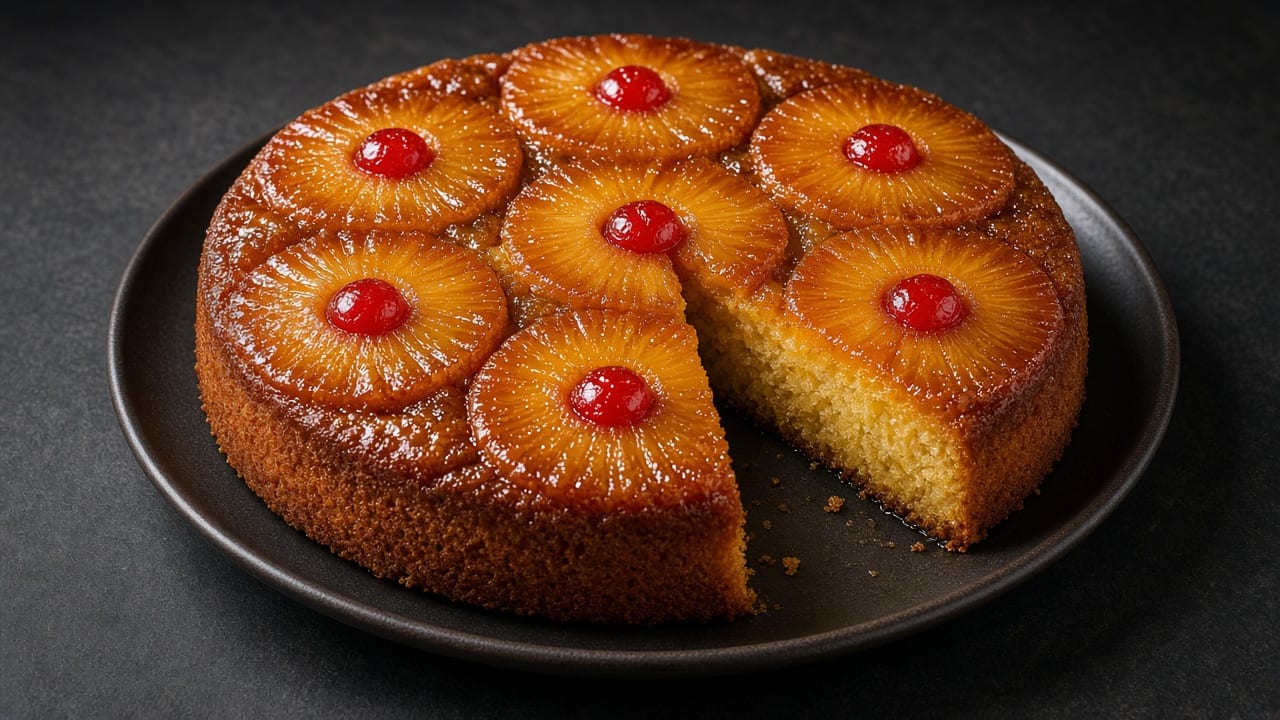
Fresh Pineapple Upside-Down Cake
By Joe
Source: Serious Eats and NYT Cooking.
This follows the classic upside-down method, but swaps in fresh pineapple over a cooked brown-sugar caramel and uses pineapple juice instead of milk in the batter, with about 5 minutes extra in the oven.
Always check the labels of the products you use.
Method
- 1
Preheat the oven. Heat the oven to 175°C (155°C fan) with a shelf in the middle, allowing at least 20 minutes for it to reach full temperature before the cake goes in. A properly heated oven helps the sponge rise evenly from the start rather than spreading before it sets.
- 2
Cook the caramel. Simmer the melted butter and brown sugar together in a small pan for 2 minutes, until thick and bubbling, then pour it into the tin. Lay the fresh pineapple over it in a single layer, tucking cherries into the gaps. Because fresh pineapple is juicier than tinned, cooking the caramel first thickens it enough to hold firm underneath the fruit.
- 3
Cream the butter and sugar. Beat the butter, caster sugar and salt for 3-4 minutes until pale and fluffy. Beat in the eggs one at a time, then mix in the vanilla. This builds the air structure that gives the sponge its rise.
- 4
Fold in flour and pineapple juice. On low speed, add the flour and baking powder in two additions, alternating with the pineapple juice, mixing just until smooth. Stop as soon as the flour disappears, since overmixing at this stage can make the crumb dense rather than light.
- 5
Spoon batter over the fruit. Spoon the batter over the pineapple in dollops, then spread it gently to the edges without disturbing the fruit underneath. Keeping a light hand here means the fruit stays exactly where you arranged it.
- 6
Bake until set. Bake for 45-50 minutes, a little longer than the original version, until golden and springy with a skewer coming out clean from the centre. Fresh pineapple holds more moisture than tinned, so the extra few minutes let the middle fully set.
- 7
Cool for exactly 10 minutes. Leave the cake in the tin for exactly 10 minutes. The caramel is still warm and loose at this point, which allows the fruit to let go cleanly; any longer and it sets hard against the tin.
- 8
Turn out and serve. Run a knife around the edge, place a serving plate larger than the tin on top, and flip the cake over in one confident movement. Lift off the tin and press back any fruit that's stuck behind, then serve warm or at room temperature.
Storage
Keep covered at room temperature for up to 1 day, or in the fridge for up to 3 days. Wrapped slices freeze for up to 2 months; thaw at room temperature and warm gently until just heated through before serving.
Free sugars
24.8 g per serving
49.6 % of the 50 g daily maximum · 99.2 % of the ideal 25 g
Free sugars under 50 g a day, ideally about 25 g, based on WHO free-sugar guidance (not endorsed by WHO). The share shown is the share of one serving. WHO
Equipment
- 23 cm round cake tin (5 cm deep, not loose-based), base-lined and greased
- small saucepan
- stand mixer or electric hand whisk
- serving plate larger than the tin
- skewer
Nutrition per serving Calculated from USDA FoodData Central
| Per serving | Amount |
|---|---|
| Energy | 340 kcal |
| Protein | 3.2 g |
| Carbohydrate | 48.8 g |
| of which sugars | 32.9 g |
| of which free sugars | 24.8 g |
| Fat | 15.4 g |
| of which saturates | 9.3 g |
| Fibre | 0.8 g |
| Salt | 0.43 g |
Protein per 100 kcal
0.9 g High protein needs ≥ 5 g per 100 kcal (20% of energy) and ≥ 10 g per serving
Calculated from USDA FoodData Central ingredient values