Based on the listed ingredients, none of the 14 major EU allergens. Always check product labels.
Method
- 1
Prep fruit. Remove the rind and cut 450 g watermelon flesh into small chunks. Spread the chunks on a tray lined with baking paper.
- 2
Initial freeze. Place the tray in the freezer for about 2 h until the fruit is solid.
- 3
Blend. Put the frozen chunks into a blender with 25 g caster sugar and 2 tbsp lemon juice. Process the mixture until it becomes liquid.
- 4
Second freeze. Pour the liquid into a shallow glass or ceramic dish and return it to the freezer for about 2 h.
- 5
Scrape. Use a fork to break up the ice crystals every 30 min during the freezing process.
- 6
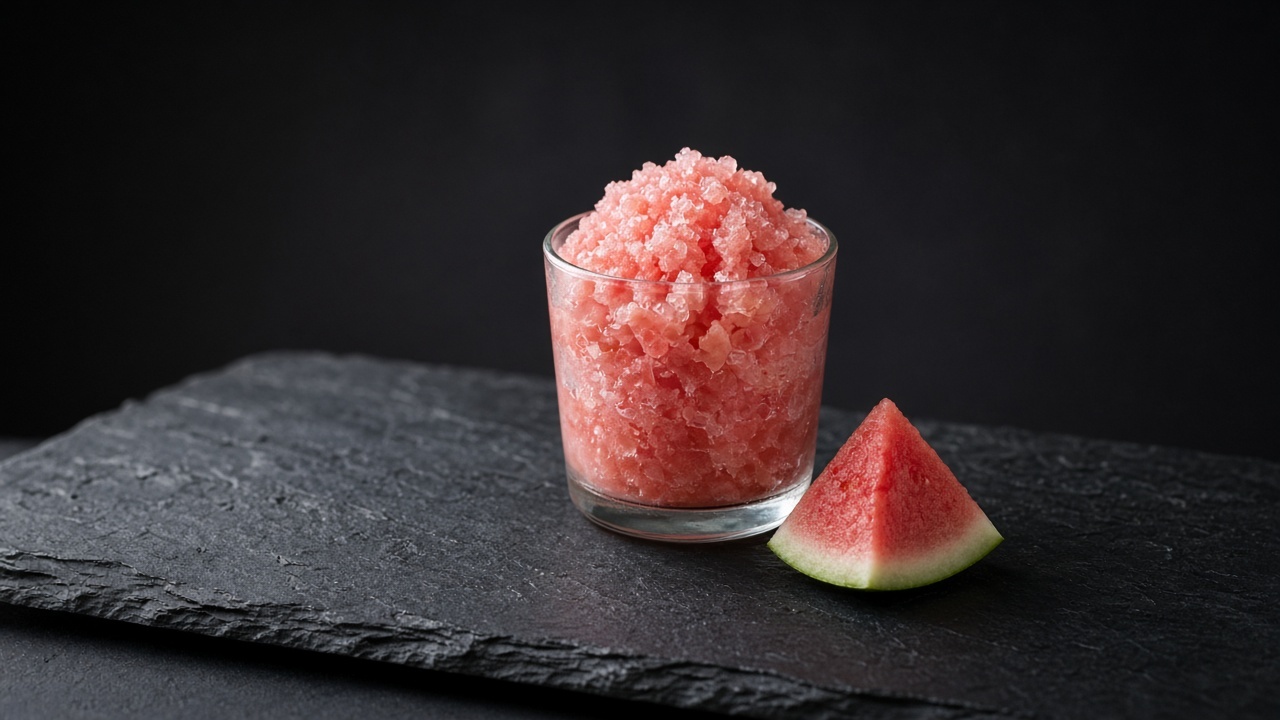
Serve. Continue until the texture is slushy and crunchy. Spoon the granita into chilled glasses to enjoy immediately.
Storage
Keep covered in the freezer for up to 1 week and use a fork or soften before serving.
EU nutrition claims
- Low fat: 0.2 g fat per 100 g (limit ≤ 3 g)
- Low saturated fat: 0 g saturated fat per 100 g, 0% of energy (limits ≤ 1.5 g and ≤ 10%)
- Low salt: 0 g salt per 100 g (limit ≤ 0.3 g)
Per 100 g of the finished dish, worked out from the nutrition per serving and the lowest likely cooked weight (about 123 g a serving), so the true values are, if anything, lower. Thresholds from the Annex to EU Regulation (EC) No 1924/2006. How we decide
Free sugars
6.4 g per serving
12.8 % of the 50 g daily maximum · 25.6 % of the ideal 25 g
Free sugars under 50 g a day, ideally about 25 g, based on WHO free-sugar guidance (not endorsed by WHO). The share shown is the share of one serving. WHO
Equipment
- tray lined with baking paper
- blender
- shallow glass or ceramic dish
- fork
- chilled glasses
Nutrition per serving Calculated from USDA FoodData Central
| Per serving | Amount |
|---|---|
| Energy | 60 kcal |
| Protein | 0.7 g |
| Carbohydrate | 15.3 g |
| of which sugars | 13.4 g |
| of which free sugars | 6.4 g |
| Fat | 0.2 g |
| of which saturates | 0 g |
| Fibre | 0.5 g |
| Salt | 0 g |
Protein per 100 kcal
1.2 g High protein needs ≥ 5 g per 100 kcal (20% of energy) and ≥ 10 g per serving
Calculated from USDA FoodData Central ingredient values