Based on the listed ingredients, none of the 14 major EU allergens. Always check product labels.
Method
- 1
Syrup. Combine 60 ml water and 65 g caster sugar in a small saucepan. Bring to the boil and simmer until dissolved, then leave to cool.
- 2
Blend. Place 680 g raspberries in a blender with the cooled syrup and ½ tsp rose water. Process until the mixture is smooth.
- 3
Strain. Pass the raspberry puree through a fine sieve into a bowl to remove the seeds. Chill the mixture for 2 h or overnight.
- 4
Prepare. Chill a 23 x 28 cm dish in the freezer. Use a stick blender to process the chilled raspberry liquid for 30 seconds before pouring it into the cold dish.
- 5
First freeze. Place the dish in the freezer. Every 30 min, use a fork to scrape the ice crystals from the edges to the centre.
- 6
Scrape. Continue scraping every 30 min until the mixture is evenly frozen but not solid. If it sets too hard, cut into chunks and pulse in a food processor.
- 7
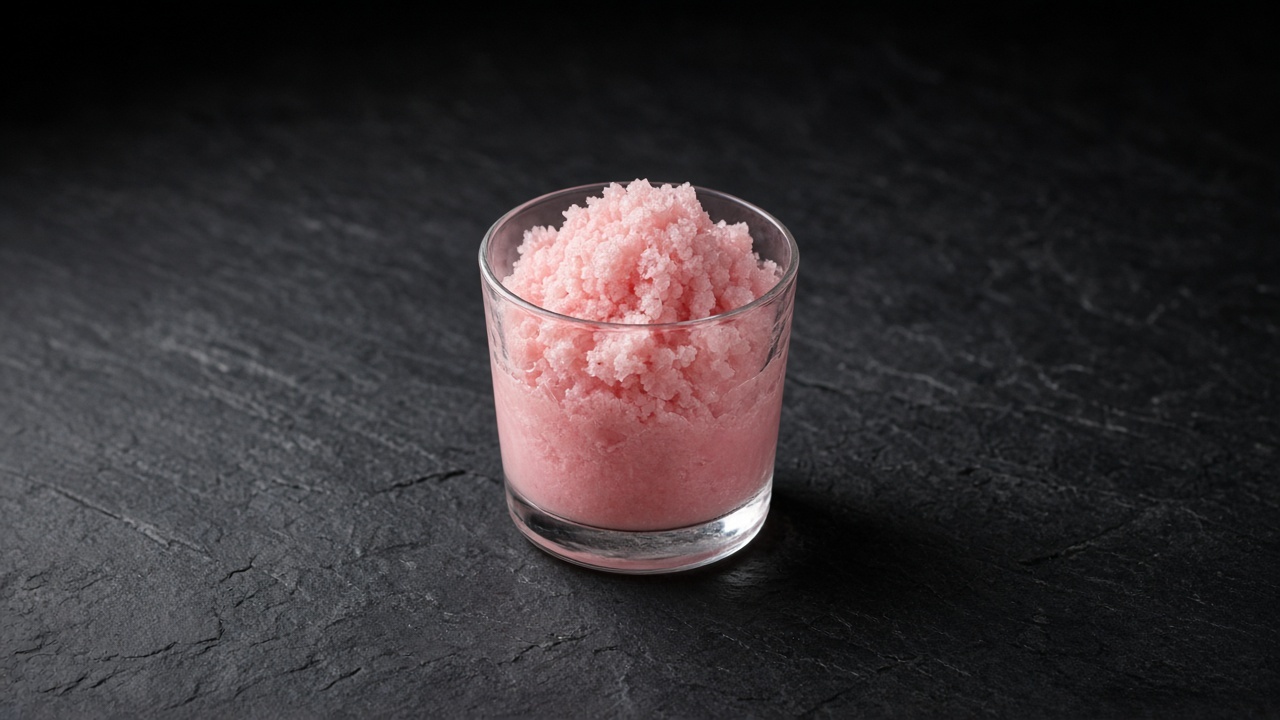
Serve. Spoon the light raspberry crystals into chilled glasses. Soften the granita in the fridge for 15 min before serving if it has become too firm.
Storage
Keep the granita covered in the freezer for up to 1 week and use a fork to fluff the crystals before serving.
EU nutrition claims
- Low fat: 0.7 g fat per 100 g (limit ≤ 3 g)
- Low saturated fat: 0 g saturated fat per 100 g, 0% of energy (limits ≤ 1.5 g and ≤ 10%)
- Low salt: 0 g salt per 100 g (limit ≤ 0.3 g)
- High fibre: 7.3 g fibre per 100 kcal (needs ≥ 3 g)
Per 100 g of the finished dish, worked out from the nutrition per serving and the lowest likely cooked weight (about 106 g a serving), so the true values are, if anything, lower. Thresholds from the Annex to EU Regulation (EC) No 1924/2006. How we decide
Free sugars
10.8 g per serving
21.6 % of the 50 g daily maximum · 43.2 % of the ideal 25 g
Free sugars under 50 g a day, ideally about 25 g, based on WHO free-sugar guidance (not endorsed by WHO). The share shown is the share of one serving. WHO
Equipment
- small saucepan
- blender
- fine sieve
- bowl
- stick blender
- 23 x 28 cm dish
- fork
- chilled glasses
Nutrition per serving Calculated from USDA FoodData Central
| Per serving | Amount |
|---|---|
| Energy | 101 kcal |
| Protein | 1.4 g |
| Carbohydrate | 24.4 g |
| of which sugars | 15.8 g |
| of which free sugars | 10.8 g |
| Fat | 0.7 g |
| of which saturates | 0 g |
| Fibre | 7.4 g |
| Salt | 0 g |
Protein per 100 kcal
1.4 g High protein needs ≥ 5 g per 100 kcal (20% of energy) and ≥ 10 g per serving
Calculated from USDA FoodData Central ingredient values