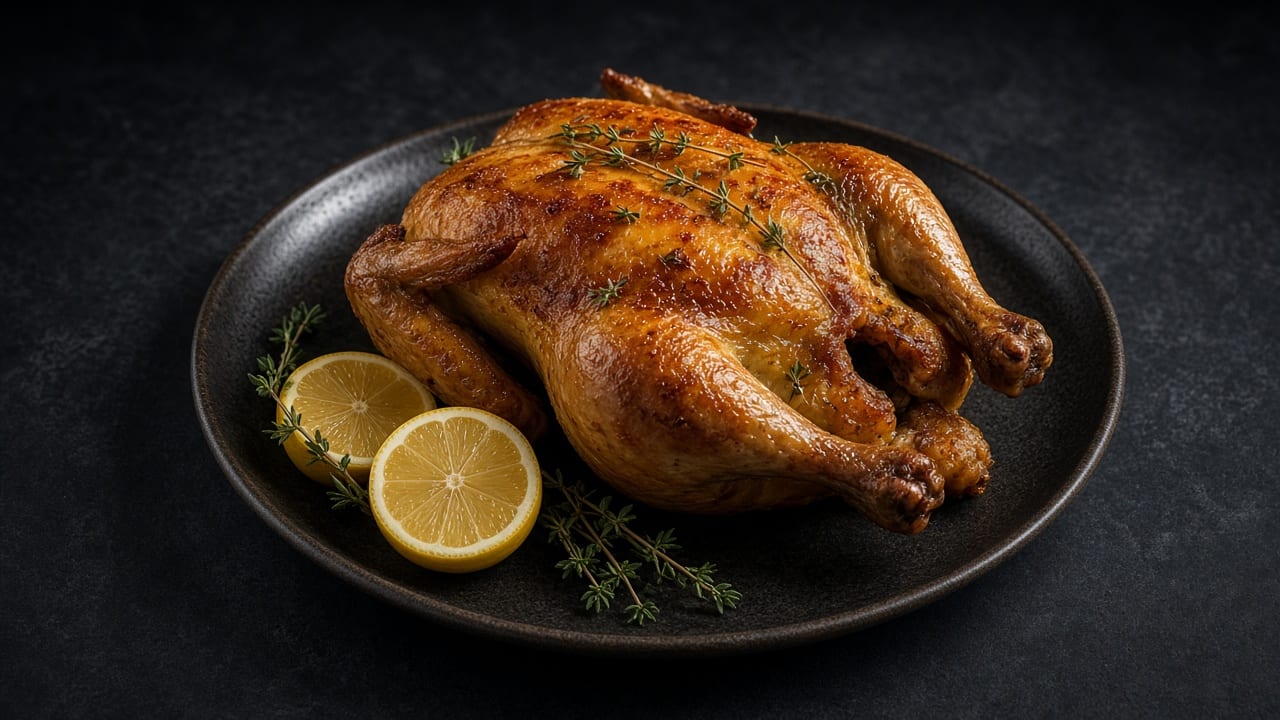
Roast Chicken with Lemon and Thyme
By Joe
Source: Serious Eats — Daniel Gritzer, How to Roast a Perfect Chicken.
A whole chicken seasoned with salt (and optional pepper and baking powder), started on its side in a hot pan, then roasted breast-side up until the breast is 65°C and the thighs are 75°C.
Always check the labels of the products you use.
Method
- 1
Season the bird. Mix the salt with the pepper and baking powder, if using. Season the chicken all over, inside and out, with this mixture (or with plain salt if you are leaving out the extras).
- 2
Tuck the wings and truss. Set the chicken breast-side up and tuck the wing tips behind its back. Loop a piece of string under the tail, tie the drumsticks together at the bony ends, then cross the string, run it along the crease where the legs meet the breast and over the wings so the bird sits in a compact bundle.
- 3
Heat the oven and start the chicken in a pan. Set a shelf in the middle of the oven and heat it to 220°C (200°C fan). Heat the oil in a 25 or 30 cm stainless-steel frying pan over medium-high heat until it shimmers. Rub the chicken lightly with oil and set it on its side in the pan so the whole thigh and drumstick are in contact with the metal — the wing will touch too, but the breast should barely sit in the pan. Sear until that side is well browned, then turn and brown the other thigh.
- 4
Roast breast-side up. Turn the chicken breast-side up in the same pan and put it in the oven. Roast until the centre of the thickest part of the breast is 65°C and the thigh, near but not touching the bone, is 75°C, about 40 minutes.
- 5
Rest and carve. Lift the chicken onto a board and leave it to rest for 10 to 20 minutes, then carve and serve.
Storage
Leftover chicken keeps in the fridge for up to 3 days. Reheat until steaming hot in the centre (74°C).
Why this label?
65.1 g protein for 784 kcal = 8.3 g per 100 kcal, so protein gives about 33% of the energy. High protein needs at least 20% (5 g per 100 kcal), the condition in the Annex to EU Regulation (EC) No 1924/2006. How we decide
EU nutrition claims
- Sugar-free: 0 g sugars per 100 g (limit ≤ 0.5 g)
Per 100 g of the finished dish, worked out from the nutrition per serving and the lowest likely cooked weight (about 193 g a serving), so the true values are, if anything, lower. Thresholds from the Annex to EU Regulation (EC) No 1924/2006. How we decide
Free sugars
0 g per serving
0 % of the 50 g daily maximum · 0 % of the ideal 25 g
Free sugars under 50 g a day, ideally about 25 g, based on WHO free-sugar guidance (not endorsed by WHO). The share shown is the share of one serving. WHO
Equipment
- 25 or 30 cm stainless-steel ovenproof frying pan
- butcher's string
- probe thermometer
- carving board
Nutrition per serving Calculated from USDA FoodData Central
| Per serving | Amount |
|---|---|
| Energy | 784 kcal |
| Protein | 65.1 g |
| Carbohydrate | 0.3 g |
| of which sugars | 0 g |
| of which free sugars | 0 g |
| Fat | 56.2 g |
| of which saturates | 15.6 g |
| Fibre | 0 g |
| Salt | 3.12 g |
Protein per 100 kcal
8.3 g meets High protein (≥ 5 g per 100 kcal = 20% of energy, and ≥ 10 g per serving)
Calculated from USDA FoodData Central ingredient values