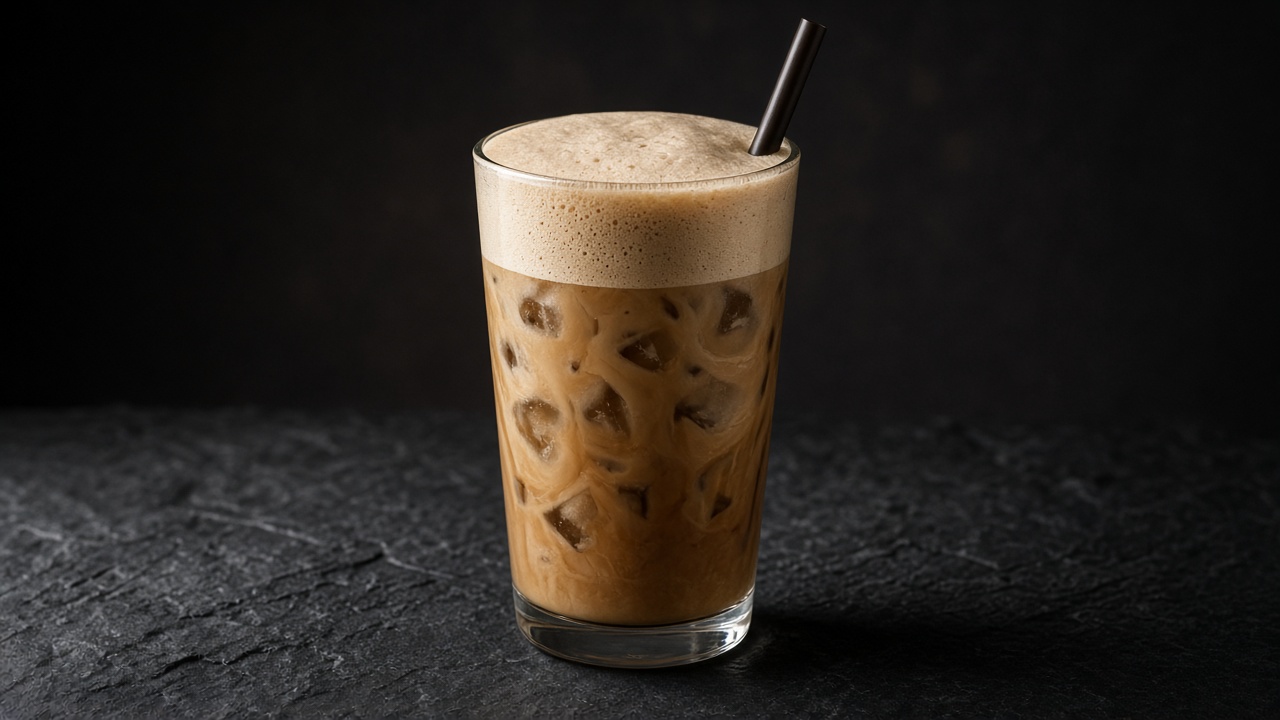
Shaken Iced Coffee Frappé with Milk
By Joe
Source: Serious Eats — Leah Colins, Mocha Frappé.
A mocha frappé recipe for 1 serving, written from a single tested source, with times and temperatures kept as the source set them.
Always check the labels of the products you use.
Method
- 1
Mix. Mix cold water, brown sugar, instant coffee, cocoa powder, plus vanilla in a tall glass or big measuring cup. Put the metal beat end of the milk frother in the liquid just below the surface to avoid splashing. Shift the frother vertically up plus down while keeping it submerged; froth for a period of 30 seconds to 1 minute, till very foamy. Taste and add salt if it needs it with more sugar, if wanted, next froth again. Add ice to glass; mix vigorously using a spoon till well chilled and ice breaks down to smaller (5–6 mm) cubes, around 2 minutes. Tilt glass on an angle, plus slowly tip milk in glass along tilted side so foam does not deflate. Eat at once. In a cocktail shaker, mix cold water, brown sugar, instant coffee, cocoa powder, plus vanilla; put a lid on and shake vigorously till very bubbly, 30 seconds to 1 minute. (Alternatively, use one milk frother, see directions below.) Tip in ice to cocktail shaker; put a lid on and shake again till well chilled and ice starts to break down, around 1 minute. Taste and add salt if it needs it with sugar and shake again, if wanted. Tip coffee, ice, plus foam in a glass, spooning any residual foam upon top. Tilt glass on an angle, plus slowly tip milk in glass along tilted side so foam does not deflate. Eat at once.
Storage
Keep covered and eat within a few days; freeze leftovers if the dish allows it.
EU nutrition claims
- Source of protein: 4.3 g protein per 100 kcal, about 17% of energy (needs ≥ 12%)
- Low salt: 0.21 g salt per 100 ml (limit ≤ 0.3 g)
Per 100 ml of the finished dish, worked out from the nutrition per serving and the lowest likely cooked weight (about 81 ml a serving), so the true values are, if anything, lower. Thresholds from the Annex to EU Regulation (EC) No 1924/2006. How we decide
Caffeine · Free sugars
- Per serving: about 63 mg caffeine (serving: 1 glass (2 tsp instant coffee)). Source: 2 g instant coffee × USDA FDC SR Legacy #171893 (instant coffee powder, 3140 mg/100 g; 1 tsp = 1 g).
- Scaling: making more servings does not change the caffeine in each serving; what counts is how many servings you drink in a day. 1 serving: 63 mg · 2 servings: 126 mg · 3 servings: 189 mg · 4 servings: 252 mg (above EFSA 200 mg at once).
- General guideline: EFSA Scientific Opinion on the safety of caffeine (2015): for healthy adults, up to 200 mg in a single dose and up to 400 mg per day do not raise safety concerns. 1 serving = 16 % of 400 mg. EFSA
8 g per serving
16 % of the 50 g daily maximum · 32 % of the ideal 25 g
Free sugars under 50 g a day, ideally about 25 g, based on WHO free-sugar guidance (not endorsed by WHO). The share shown is the share of one serving. WHO
Equipment
- mixing bowl
- scales
Nutrition per serving Calculated from USDA FoodData Central
| Per serving | Amount |
|---|---|
| Energy | 147 kcal |
| Protein | 6.3 g |
| Carbohydrate | 22.4 g |
| of which sugars | 14.1 g |
| of which free sugars | 8 g |
| Fat | 5.7 g |
| of which saturates | 3.4 g |
| Fibre | 3 g |
| Salt | 0.17 g |
Protein per 100 kcal
4.3 g High protein needs ≥ 5 g per 100 kcal (20% of energy) and ≥ 10 g per serving
Calculated from USDA FoodData Central ingredient values