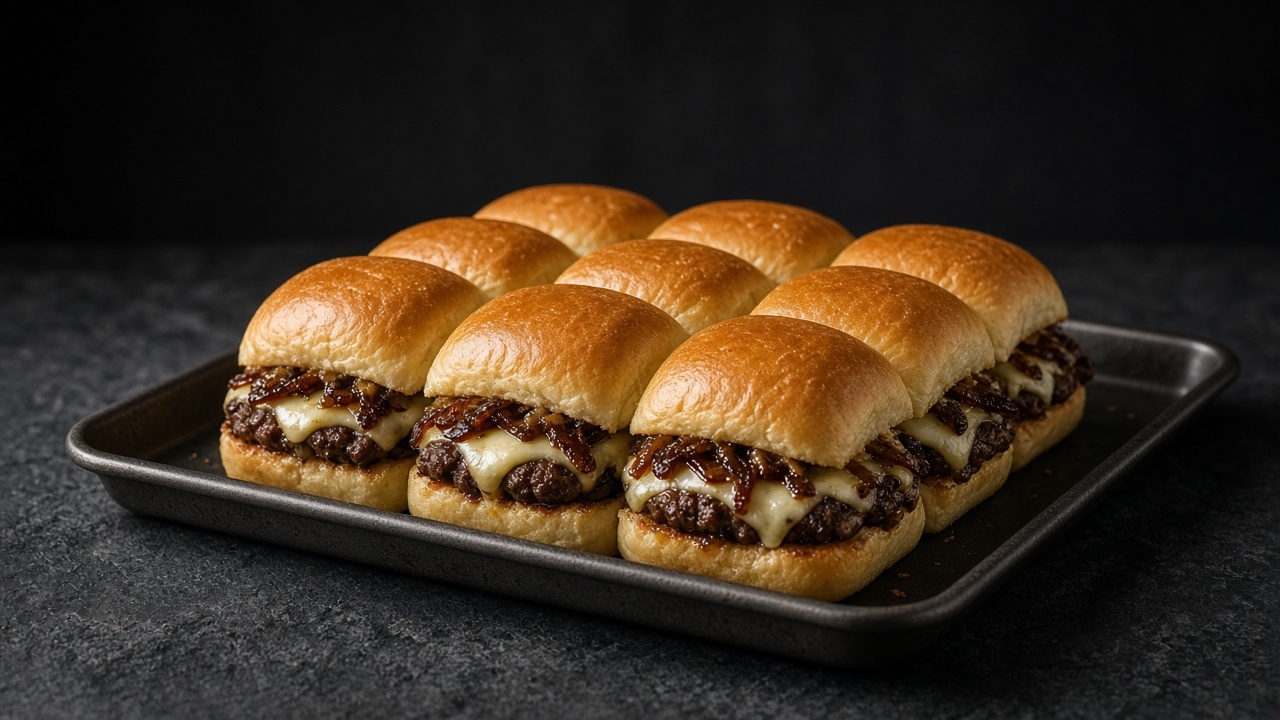
Always check the labels of the products you use.
Method
- 1
Mix. Whisk together 3 tbsp mayonnaise, 1 tbsp ketchup, 2 tsp sweet pickle relish and ¼ tsp ground black pepper; set aside.
- 2
Form. Roll 680 g lean beef mince into 12 balls of about 57 g each, which can be made up to a day ahead and chilled.
- 3
Roast. Preheat the oven to 230 °C with a rack at the bottom, toss 1 finely chopped medium onion with 1 tsp vegetable oil and a little salt and pepper on a rimmed baking tray, then roast for 10-12 min until soft, stirring and spreading out at least 3 times.
- 4
Smash. Make 12 spaced piles of the roasted onion on the tray, season each beef ball with salt and pepper, set one on each pile and smash flat with an oiled glass to about 9 cm across.
- 5
Bake. Roast the flattened patties for 7-8 min until the edges are set and the centre reaches 71 °C on an instant-read thermometer.
- 6
Cheese. Quarter 6 slices of American cheese and put 2 pieces on each patty, set the bun bottoms then bun tops on top and return to the oven for 2 min to warm through.
- 7
Flip. Lift off the bun tops, flip each stack onto a serving platter so the bun bottom sits underneath with the onions on top, add a dollop of sauce and replace the bun top.
Storage
These sliders are best enjoyed straight away. Cool leftovers in a shallow container and refrigerate within 2 hours (within 1 hour on a day above 32°C).
Why this label?
32.4 g protein for 506 kcal = 6.4 g per 100 kcal, so protein gives about 26% of the energy. High protein needs at least 20% (5 g per 100 kcal), the condition in the Annex to EU Regulation (EC) No 1924/2006. How we decide
EU nutrition claims
- Low sugars: 3.6 g sugars per 100 g (limit ≤ 5 g)
Per 100 g of the finished dish, worked out from the nutrition per serving and the lowest likely cooked weight (about 171 g a serving), so the true values are, if anything, lower. Thresholds from the Annex to EU Regulation (EC) No 1924/2006. How we decide
Free sugars
5 g per serving
10 % of the 50 g daily maximum · 20 % of the ideal 25 g
Free sugars under 50 g a day, ideally about 25 g, based on WHO free-sugar guidance (not endorsed by WHO). The share shown is the share of one serving. WHO
Equipment
- small bowl
- whisk
- rimmed baking tray
- flat-bottomed drinking glass
- fish slice
- instant-read thermometer
- serving platter
Nutrition per serving Calculated from USDA FoodData Central
| Per serving | Amount |
|---|---|
| Energy | 506 kcal |
| Protein | 32.4 g |
| Carbohydrate | 34.3 g |
| of which sugars | 6.1 g |
| of which free sugars | 5 g |
| Fat | 25.7 g |
| of which saturates | 9.3 g |
| Fibre | 1.6 g |
| Salt | 2.3 g |
Protein per 100 kcal
6.4 g meets High protein (≥ 5 g per 100 kcal = 20% of energy, and ≥ 10 g per serving)
Calculated from USDA FoodData Central ingredient values