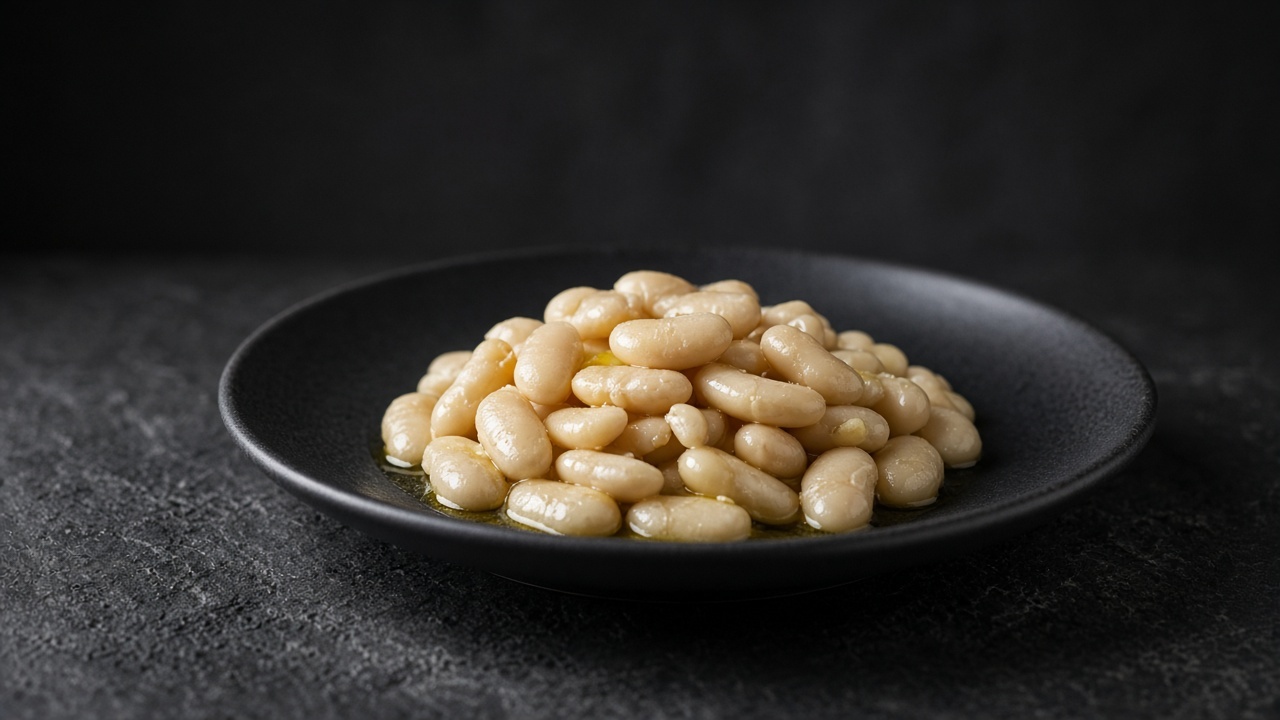
Simmered White Beans
By Joe
Source: America's Test Kitchen.
Dried cannellini beans are salt-soaked overnight, then simmered gently and left to steep off the heat until they're fully tender but still holding their shape. It's a plain, reliable base for soups, salads or a simple side with just oil and herbs.
Based on the listed ingredients, none of the 14 major EU allergens. Always check product labels.
Method
- 1
Brine the beans. Dissolve the brining salt in the cold water in a large container. Add the beans and let them soak at room temperature for at least 8 hours, or up to 24 hours.
- 2
Simmer. Drain the beans in a colander and rinse well. Combine the beans, the fresh water and the 3 tsp salt in a large casserole (Dutch oven) and bring to the boil over high heat. Reduce the heat to medium and cook at a gentle simmer — bubbles should just break the surface — until the beans are barely tender, 40-50 min.
- 3
Steep. Turn off the heat, cover the pot, and let the beans steep in the hot water until fully tender, 20-30 min more.
- 4
Serve or store. Serve the beans straight from the pot with a slotted spoon, or drain in a colander for later use.
Storage
Refrigerate in an airtight container for up to 3 days, or cool, transfer to freezer bags, and freeze for up to 1 month.
Why this label?
12.3 g protein for 194 kcal = 6.3 g per 100 kcal, so protein gives about 25% of the energy. High protein needs at least 20% (5 g per 100 kcal), the condition in the Annex to EU Regulation (EC) No 1924/2006. How we decide
EU nutrition claims
- Low fat: 2.5 g fat per 100 g (limit ≤ 3 g)
- Low saturated fat: 0.6 g saturated fat per 100 g, 0.9% of energy (limits ≤ 1.5 g and ≤ 10%)
- Low sugars: 3.7 g sugars per 100 g (limit ≤ 5 g)
- High fibre: 4.5 g fibre per 100 kcal (needs ≥ 3 g)
Per 100 g of the finished dish, worked out from the nutrition per serving and the lowest likely cooked weight (about 32 g a serving), so the true values are, if anything, lower. Thresholds from the Annex to EU Regulation (EC) No 1924/2006. How we decide
Free sugars
0 g per serving
0 % of the 50 g daily maximum · 0 % of the ideal 25 g
Free sugars under 50 g a day, ideally about 25 g, based on WHO free-sugar guidance (not endorsed by WHO). The share shown is the share of one serving. WHO
Equipment
- large container for soaking
- colander
- large casserole (Dutch oven) or large saucepan
- slotted spoon
Nutrition per serving Calculated from USDA FoodData Central
| Per serving | Amount |
|---|---|
| Energy | 194 kcal |
| Protein | 12.3 g |
| Carbohydrate | 35.4 g |
| of which sugars | 1.2 g |
| of which free sugars | 0 g |
| Fat | 0.8 g |
| of which saturates | 0.2 g |
| Fibre | 8.8 g |
| Salt | 2.51 g |
Protein per 100 kcal
6.3 g meets High protein (≥ 5 g per 100 kcal = 20% of energy, and ≥ 10 g per serving)
Calculated from USDA FoodData Central ingredient values