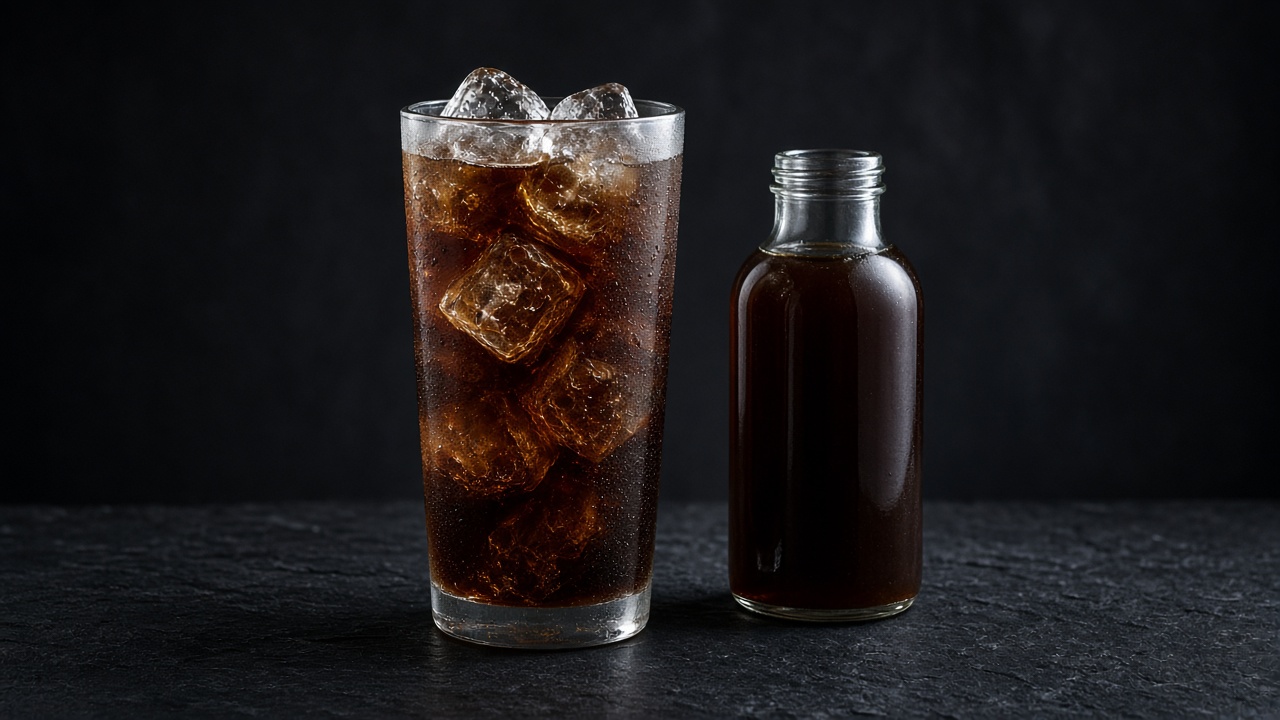
Always check the labels of the products you use.
Method
- 1
Mix. In a big, nonreactive vessel, mix ground coffee and water, mixing to fully saturate all the coffee grounds. Put a lid on and leave to stand at room temperature for no less than 8 plus upwards to 12 hours.
- 2
Chill. Strain this cold brew concentrate through a fine sieve lined with cheesecloth or a big coffee filter or other filtering mid-sized to remove grounds and sediment. Move cold brew concentrate to an airtight container and chill till well chilled.
- 3
Finish. To offer, tip the chilled cold brew concentrate over ice plus dilute till it tastes right using cold water, milk, or a milk substitute.
Storage
Keep covered in the fridge and use within a few days.
Caffeine · Free sugars
- Per serving: at least 55 mg caffeine (serving: 1 glass (about 137 ml concentrate)). Source: about 137 ml brewed per serving × USDA FDC SR Legacy #171890 (brewed coffee, 40 mg/100 g) This brew uses more coffee per ml than standard brewed coffee, so the real amount is likely higher..
- Scaling: making more servings does not change the caffeine in each serving; what counts is how many servings you drink in a day. 1 serving: 55 mg · 2 servings: 110 mg · 3 servings: 165 mg · 4 servings: 220 mg (above EFSA 200 mg at once).
- General guideline: EFSA Scientific Opinion on the safety of caffeine (2015): for healthy adults, up to 200 mg in a single dose and up to 400 mg per day do not raise safety concerns. 1 serving = 14 % of 400 mg. EFSA
0 g per serving
0 % of the 50 g daily maximum · 0 % of the ideal 25 g
Free sugars under 50 g a day, ideally about 25 g, based on WHO free-sugar guidance (not endorsed by WHO). The share shown is the share of one serving. WHO
Equipment
- mixing bowl
- scales
Nutrition per serving Calculated from USDA FoodData Central
| Per serving | Amount |
|---|---|
| Energy | 0 kcal |
| Protein | 0.1 g |
| Carbohydrate | 0 g |
| of which sugars | 0 g |
| of which free sugars | 0 g |
| Fat | 0 g |
| of which saturates | 0 g |
| Fibre | 0 g |
| Salt | 0.02 g |
Protein per 100 kcal
0 g High protein needs ≥ 5 g per 100 kcal (20% of energy) and ≥ 10 g per serving
Calculated from USDA FoodData Central ingredient values