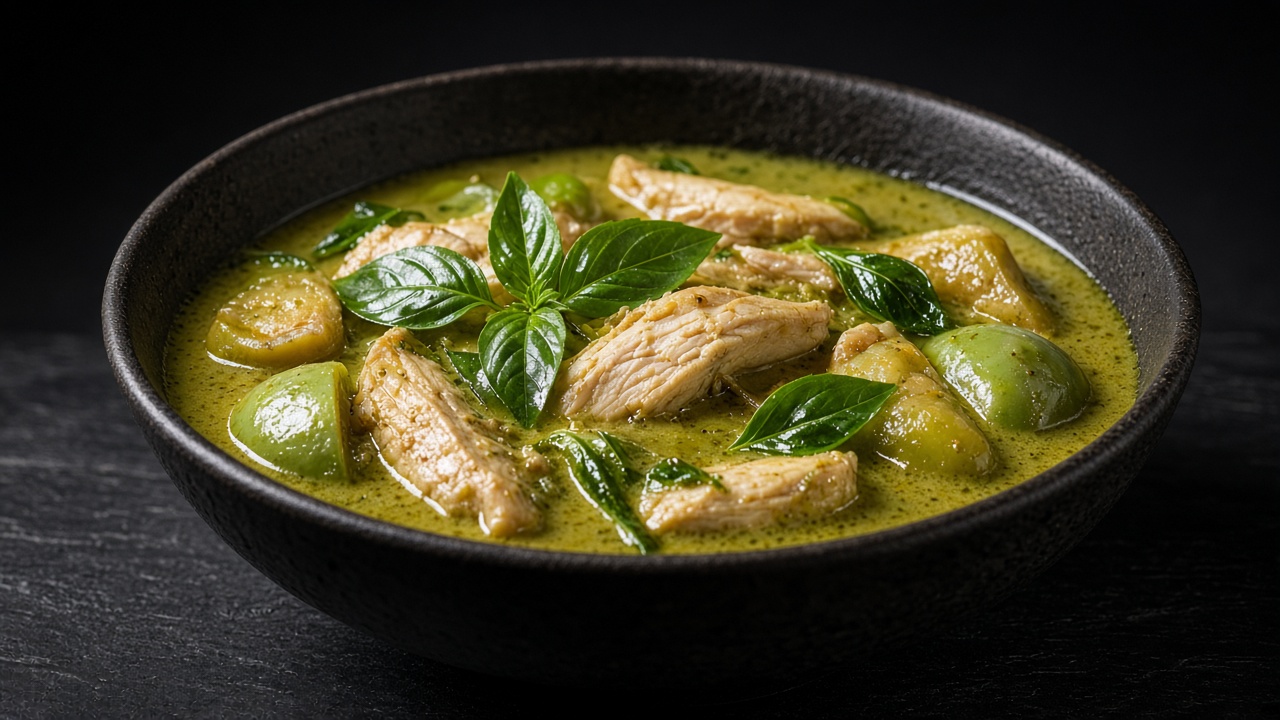
Thai Green Coconut Curry with Chicken, Aubergine and Basil
By Joe
Source: NYT Cooking and Serious Eats.
A vibrant, fragrant green curry where chicken thighs and tender aubergine simmer in a properly cracked coconut paste, finished with wilted Thai basil and lime leaf.
Always check the labels of the products you use.
Method
- 1
Prepare the components. Whisk 120 ml of the coconut milk with the 160 ml water and set it aside for later. Keep 8 lime leaves whole for cooking, and stack, roll and slice the other 2 into hair-thin strips to scatter over at the end. Having everything measured out matters here, since the paste moves quickly once it starts frying.
- 2
Fry the paste. Put the coconut oil and 120 ml coconut milk in the saucepan over medium heat and simmer for 1 minute, stirring, until slightly thickened. Stir in the curry paste firmly, scraping the sides, then turn the heat up to medium-high and cook for about 1 minute, stirring, until it starts to spit. The brief blast of higher heat cooks off the raw edge from the fresh chillies and garlic in the paste.
- 3
Crack the coconut milk. Turn the heat back to medium and add the remaining 160 ml coconut milk 2 tbsp at a time, stirring and scraping constantly for 5-6 minutes, until the paste darkens slightly and oil separates out from it. This separating oil, known as cracking the paste, shows that its aromatic oils have fully rendered out into the sauce. Rushing this stage leaves the curry tasting thin and raw.
- 4
Add the chicken. Stir in the fish sauce and sugar for 30 seconds, just until the sugar dissolves, then add the chicken and whole lime leaves and stir to coat. Pour in the thinned coconut milk and bring to a simmer. Cook for about 10 minutes, stirring now and then, until the sauce has thickened slightly and the chicken reaches 74°C in its thickest piece, checked with a probe thermometer.
- 5
Finish with basil. Drain the aubergines and add them to the pan, simmering for 3 minutes until just tender but still with some bite. Take the pan off the heat and stir in the basil until it wilts, then scatter over the sliced lime leaves. Adding the basil off the heat keeps its colour bright and its aroma fresh, as prolonged cooking would turn it dull and bitter. Serve with jasmine rice.
Storage
Cool quickly and refrigerate within 1 hour; use within 3 days and reheat only once until piping hot (74°C). This curry also freezes well for up to 3 months.
Why this label?
27.9 g protein for 467 kcal = 6 g per 100 kcal, so protein gives about 24% of the energy. High protein needs at least 20% (5 g per 100 kcal), the condition in the Annex to EU Regulation (EC) No 1924/2006. How we decide
EU nutrition claims
- Low sugars: 4.2 g sugars per 100 g (limit ≤ 5 g)
Per 100 g of the finished dish, worked out from the nutrition per serving and the lowest likely cooked weight (about 202 g a serving), so the true values are, if anything, lower. Thresholds from the Annex to EU Regulation (EC) No 1924/2006. How we decide
Free sugars
6.2 g per serving
12.4 % of the 50 g daily maximum · 24.8 % of the ideal 25 g
Free sugars under 50 g a day, ideally about 25 g, based on WHO free-sugar guidance (not endorsed by WHO). The share shown is the share of one serving. WHO
Equipment
- small bowl
- medium saucepan (about 3 l)
- silicone spatula
- instant-read probe thermometer
Nutrition per serving Calculated from USDA FoodData Central
| Per serving | Amount |
|---|---|
| Energy | 467 kcal |
| Protein | 27.9 g |
| Carbohydrate | 13.8 g |
| of which sugars | 8.5 g |
| of which free sugars | 6.2 g |
| Fat | 34.5 g |
| of which saturates | 26 g |
| Fibre | 2 g |
| Salt | 2.34 g |
Protein per 100 kcal
6 g meets High protein (≥ 5 g per 100 kcal = 20% of energy, and ≥ 10 g per serving)
Calculated from USDA FoodData Central ingredient values