Always check the labels of the products you use.
Method
- 1
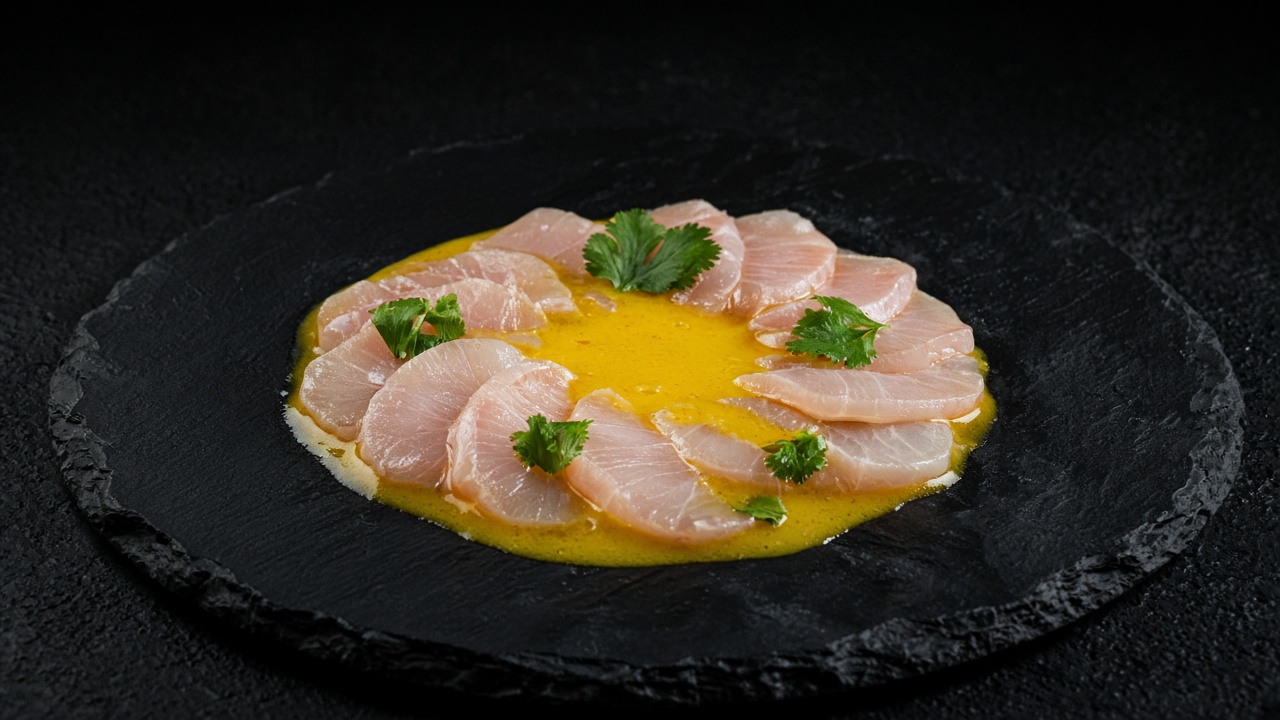
How this differs. The classic thin citrus sauce is swapped for a velvety purée of cooked yellow pepper and extra ají amarillo, and the fish is fanned in a circle with no corn. The result is fruitier, rounder and more vivid in colour.
- 2
Soften the pepper. Drop the pepper quarters into boiling water and simmer for 15 min until completely soft. Cool them in cold water, then peel off the skins, which would otherwise make the sauce bitter and stringy.
- 3
Blend the cream. Purée the pepper with the ají paste, garlic, lime and lemon juice, stock, oil and salt for a full minute until it looks like silk. Chill for at least 20 min so it is cold when it meets the fish.
- 4
Cut and arrange. Slice the fish 5 mm thick on a slight angle. Spoon a pool of the cream onto each chilled plate, fan the slices around it in a ring and season with the fish salt.
- 5
Rest briefly, then serve. Give it 2-3 min so the acid in the sauce lightly firms the underside of the fish, then scatter with coriander and serve.
Storage
Serve as soon as it is plated and discard leftover fish. The ají cream keeps 1 day covered in the fridge.
Why this label?
19.5 g protein for 150 kcal = 13 g per 100 kcal, so protein gives about 52% of the energy. High protein needs at least 20% (5 g per 100 kcal), the condition in the Annex to EU Regulation (EC) No 1924/2006. How we decide
EU nutrition claims
- Low saturated fat: 0.7 g saturated fat per 100 g, 6% of energy (limits ≤ 1.5 g and ≤ 10%)
- Sugar-free: 0.4 g sugars per 100 g (limit ≤ 0.5 g)
Per 100 g of the finished dish, worked out from the nutrition per serving and the lowest likely cooked weight (about 152 g a serving), so the true values are, if anything, lower. Thresholds from the Annex to EU Regulation (EC) No 1924/2006. How we decide
Free sugars
0.3 g per serving
0.6 % of the 50 g daily maximum · 1.2 % of the ideal 25 g
Free sugars under 50 g a day, ideally about 25 g, based on WHO free-sugar guidance (not endorsed by WHO). The share shown is the share of one serving. WHO
Equipment
- saucepan
- slotted spoon
- blender
- very sharp long knife
- 4 chilled round plates
Nutrition per serving Calculated from USDA FoodData Central
| Per serving | Amount |
|---|---|
| Energy | 150 kcal |
| Protein | 19.5 g |
| Carbohydrate | 5.2 g |
| of which sugars | 0.6 g |
| of which free sugars | 0.3 g |
| Fat | 5.7 g |
| of which saturates | 1 g |
| Fibre | 0.7 g |
| Salt | 1.11 g |
Protein per 100 kcal
13 g meets High protein (≥ 5 g per 100 kcal = 20% of energy, and ≥ 10 g per serving)
Calculated from USDA FoodData Central ingredient values