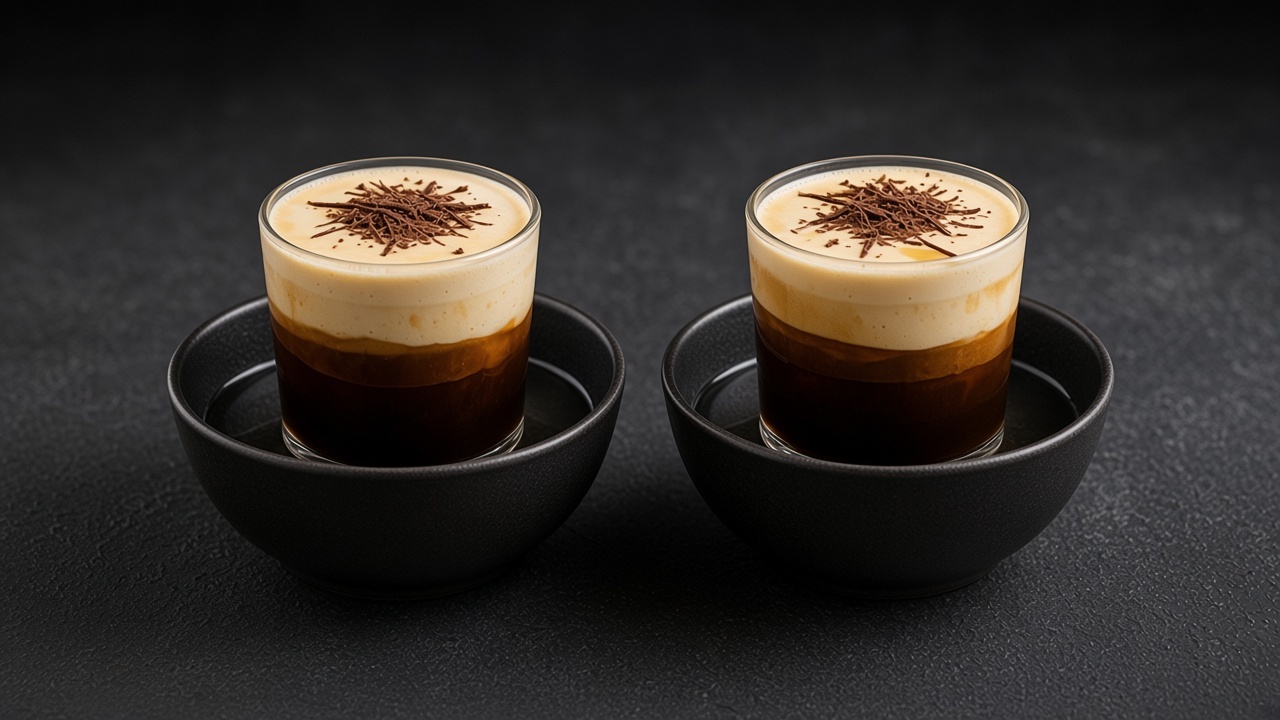
Vietnamese Egg Coffee with Condensed Milk Foam
By Joe
Source: BBC Good Food — Miriam Nice, Vietnamese egg coffee.
A vietnamese egg coffee recipe for 4 servings, written from a single tested source, with times and temperatures kept as the source set them.
Always check the labels of the products you use.
Method
- 1
Mix. Set the egg yolks, condensed milk plus vanilla extract in a big bowl. Beat with electric beaters for no less than 5 mins or till pale and foamy.
- 2
Step 2. Set 4 heatproof glasses or ramekins into a little larger bowls that have been half-filled using boiling water (this will hold this coffee in the glasses hot for longer). Tip the freshly brewed coffee in the glasses, reserving 2 tbsp, next top with scoops of the egg mixture.
- 3
Step 3. Drizzle the leftover coffee upon top so that it stains the topping plus sinks in. Strew over a pinch of this grated dark chocolate, if you like.
- 4
Finish. Eat at once, with spoons.
Storage
Keep covered and eat within a few days; freeze leftovers if the dish allows it.
EU nutrition claims
- Low salt: 0.24 g salt per 100 ml (limit ≤ 0.3 g)
Per 100 ml of the finished dish, worked out from the nutrition per serving and the lowest likely cooked weight (about 84 ml a serving), so the true values are, if anything, lower. Thresholds from the Annex to EU Regulation (EC) No 1924/2006. How we decide
Caffeine · Free sugars
- Per serving: about 106 mg caffeine (serving: 1 glass (50 ml espresso)). Source: 50 ml espresso × USDA FDC SR Legacy #171891 (espresso, 212 mg/100 g); the optional pinch of dark chocolate adds about 1 mg.
- Scaling: making more servings does not change the caffeine in each serving; what counts is how many servings you drink in a day. 1 serving: 106 mg · 2 servings: 212 mg (above EFSA 200 mg at once) · 3 servings: 318 mg (above EFSA 200 mg at once) · 4 servings: 424 mg (above EFSA 400 mg a day).
- General guideline: EFSA Scientific Opinion on the safety of caffeine (2015): for healthy adults, up to 200 mg in a single dose and up to 400 mg per day do not raise safety concerns. 1 serving = 27 % of 400 mg. EFSA
28.3 g per serving
56.6 % of the 50 g daily maximum · 113.2 % of the ideal 25 g
Free sugars under 50 g a day, ideally about 25 g, based on WHO free-sugar guidance (not endorsed by WHO). The share shown is the share of one serving. WHO
Equipment
- mixing bowl
- scales
Nutrition per serving Calculated from USDA FoodData Central
| Per serving | Amount |
|---|---|
| Energy | 228 kcal |
| Protein | 6.8 g |
| Carbohydrate | 29.7 g |
| of which sugars | 28.4 g |
| of which free sugars | 28.3 g |
| Fat | 9.1 g |
| of which saturates | 4.5 g |
| Fibre | 0 g |
| Salt | 0.2 g |
Protein per 100 kcal
3 g High protein needs ≥ 5 g per 100 kcal (20% of energy) and ≥ 10 g per serving
Calculated from USDA FoodData Central ingredient values