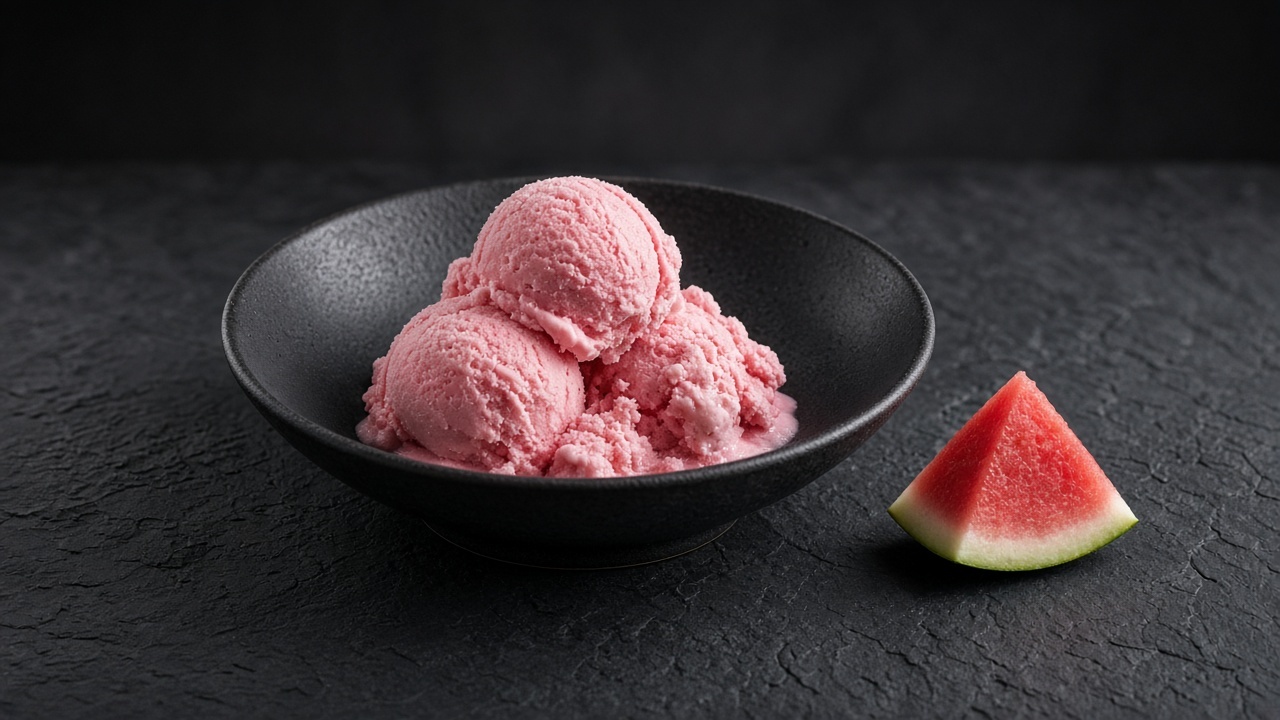
Always check the labels of the products you use.
Method
- 1
Freeze the melon. Spread the chunks in one layer on the lined tray, so they do not stick together, and freeze for at least 4 h, until hard.
- 2
Process. Tip the frozen chunks into the food processor with the yoghurt, sugar and lemon juice and pulse, then run, scraping down the sides, just until smooth. Stop before it turns slushy.
- 3
Set. Spread it in the dish and freeze for about 1 h, until it holds a scoop. Eat the same day.
Storage
Best eaten the day it is made; it freezes very hard. If frozen overnight, soften for 20 min and process again briefly.
EU nutrition claims
- Low fat: 0.4 g fat per 100 g (limit ≤ 3 g)
- Low saturated fat: 0.2 g saturated fat per 100 g, 4.5% of energy (limits ≤ 1.5 g and ≤ 10%)
- Low salt: 0.01 g salt per 100 g (limit ≤ 0.3 g)
Per 100 g of the finished dish, worked out from the nutrition per serving and the lowest likely cooked weight (about 228 g a serving), so the true values are, if anything, lower. Thresholds from the Annex to EU Regulation (EC) No 1924/2006. How we decide
Free sugars
6.7 g per serving
13.4 % of the 50 g daily maximum · 26.8 % of the ideal 25 g
Free sugars under 50 g a day, ideally about 25 g, based on WHO free-sugar guidance (not endorsed by WHO). The share shown is the share of one serving. WHO
Equipment
- food processor
- baking tray lined with baking paper
- shallow glass or ceramic dish
Nutrition per serving Calculated from USDA FoodData Central
| Per serving | Amount |
|---|---|
| Energy | 99 kcal |
| Protein | 1.9 g |
| Carbohydrate | 22.9 g |
| of which sugars | 20 g |
| of which free sugars | 6.7 g |
| Fat | 1 g |
| of which saturates | 0.5 g |
| Fibre | 0.8 g |
| Salt | 0.03 g |
Protein per 100 kcal
1.9 g High protein needs ≥ 5 g per 100 kcal (20% of energy) and ≥ 10 g per serving
Calculated from USDA FoodData Central ingredient values