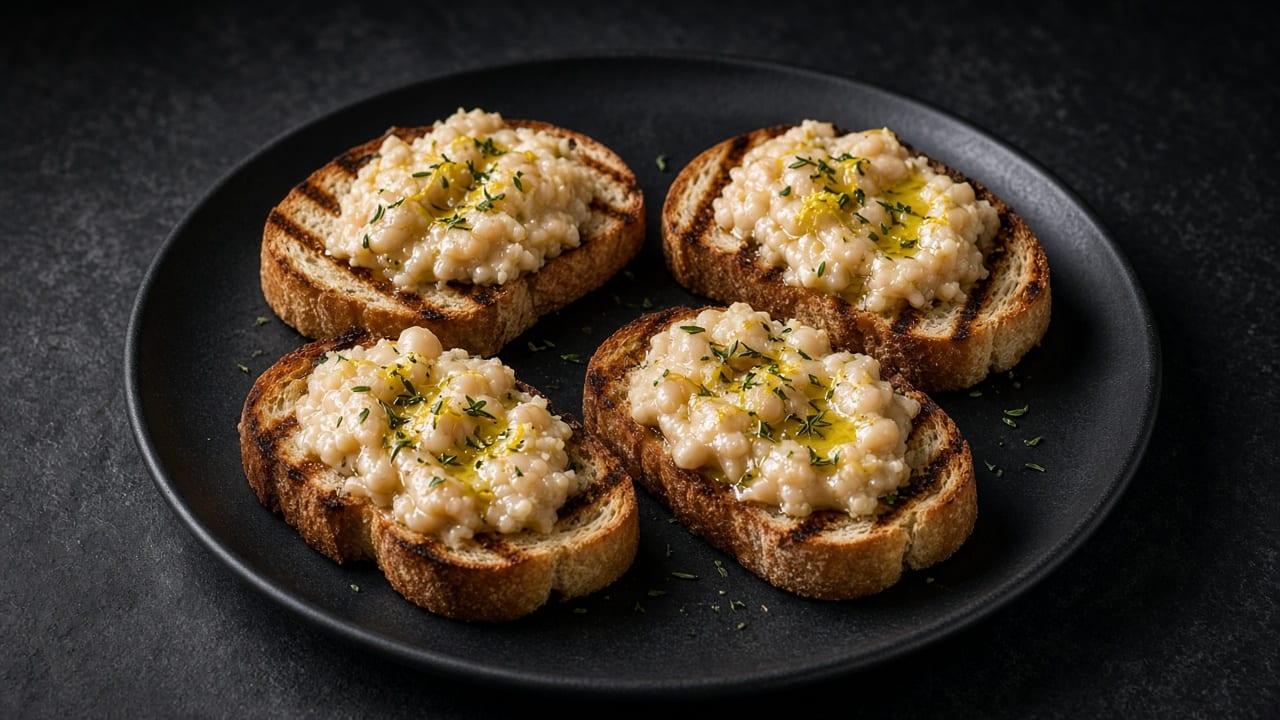
White Bean Bruschetta with Sage and Lemon
By Joe
Source: NYT Cooking.
Grilled garlic-rubbed bread piled with a warm, rough mash of cannellini beans cooked in sage-scented olive oil and brightened with lemon.
Always check the labels of the products you use.
Method
- 1
Soften. Warm the olive oil in a frying pan over medium-low heat, then add the shallot and chopped sage and cook for 3-4 minutes, until soft and fragrant but not browned. Gentle heat draws the sage's flavour into the oil without turning it bitter.
- 2
Warm the beans. Tip in the beans with 3 tbsp water and heat for 3 minutes, stirring now and then. Warm beans soak up the flavoured oil and soften slightly, which makes them easier to mash.
- 3
Mash. Off the heat, crush the beans with a fork or masher to a rough, spreadable mash, leaving some whole for texture. Stir in the lemon juice, zest, salt and pepper, then taste; the acid lifts the earthy beans.
- 4
Toast. Grill or griddle the bread for 1-2 minutes a side, until crisp with dark marks. While it is still hot, rub one side of each slice with the cut garlic; the rough surface grates the clove like a fine rasp.
- 5
Top. Spread the warm beans thickly over the garlic side of each toast. Drizzle with the olive oil and scatter with parsley, then serve straight away while the toast is still crisp.
Storage
Keep leftover bean mash covered in the fridge for up to 3 days and warm it gently before using. Toast the bread fresh; assembled bruschetta does not keep. Cool leftovers in a shallow container and refrigerate within 2 hours (within 1 hour on a day above 32°C).
EU nutrition claims
- Source of protein: 3.9 g protein per 100 kcal, about 16% of energy (needs ≥ 12%)
- Low saturated fat: 1.2 g saturated fat per 100 g, 4.1% of energy (limits ≤ 1.5 g and ≤ 10%)
- Low sugars: 2.6 g sugars per 100 g (limit ≤ 5 g)
- Source of fibre: 1.9 g fibre per 100 kcal (needs ≥ 1.5 g)
Per 100 g of the finished dish, worked out from the nutrition per serving and the lowest likely cooked weight (about 148 g a serving), so the true values are, if anything, lower. Thresholds from the Annex to EU Regulation (EC) No 1924/2006. How we decide
Free sugars
2.8 g per serving
5.6 % of the 50 g daily maximum · 11.2 % of the ideal 25 g
Free sugars under 50 g a day, ideally about 25 g, based on WHO free-sugar guidance (not endorsed by WHO). The share shown is the share of one serving. WHO
Equipment
- frying pan
- fork or potato masher
- griddle pan or grill
- pastry brush
Nutrition per serving Calculated from USDA FoodData Central
| Per serving | Amount |
|---|---|
| Energy | 399 kcal |
| Protein | 15.5 g |
| Carbohydrate | 58.8 g |
| of which sugars | 3.8 g |
| of which free sugars | 2.8 g |
| Fat | 12 g |
| of which saturates | 1.8 g |
| Fibre | 7.6 g |
| Salt | 2.29 g |
Protein per 100 kcal
3.9 g High protein needs ≥ 5 g per 100 kcal (20% of energy) and ≥ 10 g per serving
Calculated from USDA FoodData Central ingredient values