Always check the labels of the products you use.
Method
- 1
Roast Squash. Preheat the oven to 200 °C (180 °C fan), line a baking tray with foil and oil lightly; lay 450 g butternut squash (seeded, cut side down, skin up) on the tray and roast 45-60 minutes until completely soft.
- 2
Purée. Cool, scoop the flesh from the skin and purée in a food processor until you have about 180 g.
- 3
Dry Mix. Sift 70 g wholemeal flour, 70 g buckwheat flour, 70 g plain flour, 2 tsp baking powder, 1 tsp bicarbonate of soda, 1 tsp caster sugar and ½ tsp fine salt together into a bowl.
- 4
Wet Mix. Beat 2 large eggs in a medium bowl, whisk in 360 ml buttermilk and the 180 g squash purée, then mix in 2 tbsp oil.
- 5
Sage Oil. Heat 1 tbsp oil in a small frying pan over medium-high heat, fry 1 tbsp sage leaves about 10 seconds until starting to crisp, remove from the heat and cool, then add both oil and sage to the wet mixture.
- 6
Combine. Whisk the flour mixture quickly into the wet ingredients.
- 7
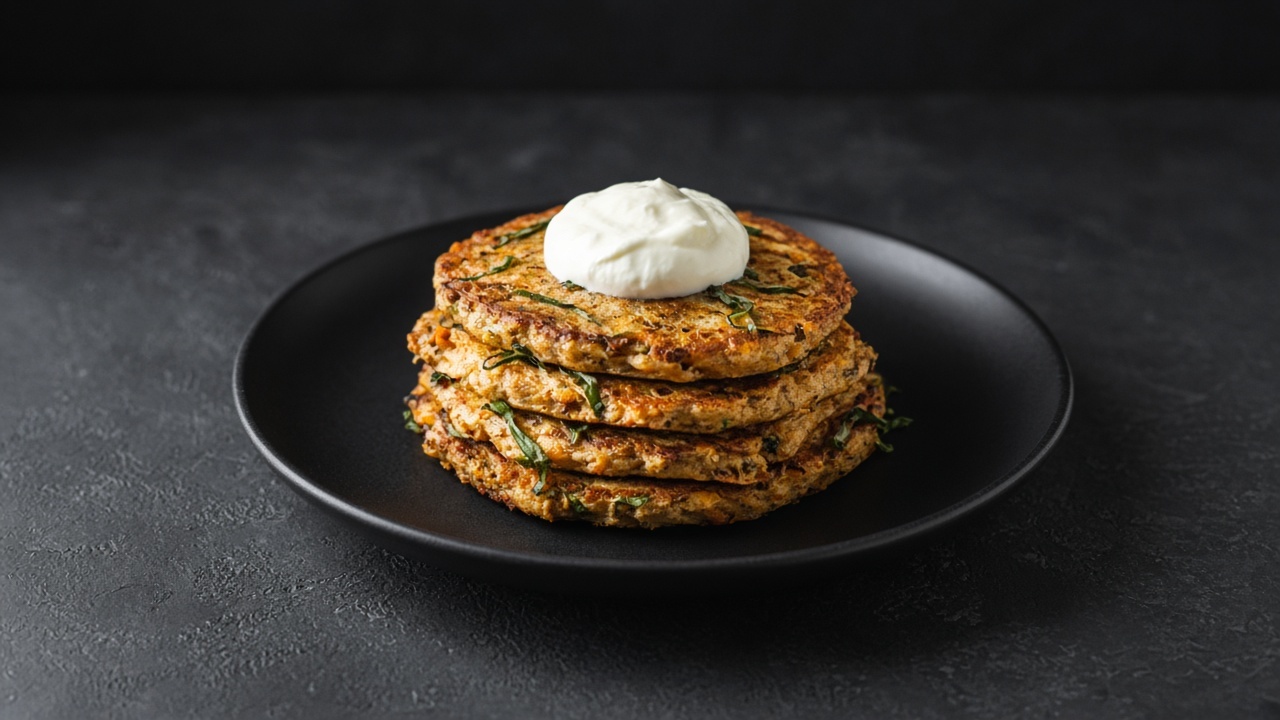
Cook. Heat a griddle over medium-high, oil lightly and drop 1-2 tbsp batter per blini (5-7 cm across); cook each batch until bubbles break through, flip and cook until lightly browned, keeping finished blini warm under a clean cloth.
Storage
Serve whilst warm. Cool leftovers in a shallow container and refrigerate within 2 hours (within 1 hour on a day above 32°C).
EU nutrition claims
- Source of protein: 3.4 g protein per 100 kcal, about 14% of energy (needs ≥ 12%)
- Source of fibre: 1.6 g fibre per 100 kcal (needs ≥ 1.5 g)
Per 100 g of the finished dish, worked out from the nutrition per serving and the lowest likely cooked weight (about 62 g a serving), so the true values are, if anything, lower. Thresholds from the Annex to EU Regulation (EC) No 1924/2006. How we decide
Free sugars
0.4 g per serving
0.8 % of the 50 g daily maximum · 1.6 % of the ideal 25 g
Free sugars under 50 g a day, ideally about 25 g, based on WHO free-sugar guidance (not endorsed by WHO). The share shown is the share of one serving. WHO
Equipment
- baking tray
- foil
- food processor
- sieve
- medium bowl
- whisk
- small frying pan
- griddle or large non-stick frying pan
- palette knife
Nutrition per serving Calculated from USDA FoodData Central
| Per serving | Amount |
|---|---|
| Energy | 158 kcal |
| Protein | 5.4 g |
| Carbohydrate | 22.4 g |
| of which sugars | 3.3 g |
| of which free sugars | 0.4 g |
| Fat | 5.9 g |
| of which saturates | 1.2 g |
| Fibre | 2.5 g |
| Salt | 0.96 g |
Protein per 100 kcal
3.4 g High protein needs ≥ 5 g per 100 kcal (20% of energy) and ≥ 10 g per serving
Calculated from USDA FoodData Central ingredient values