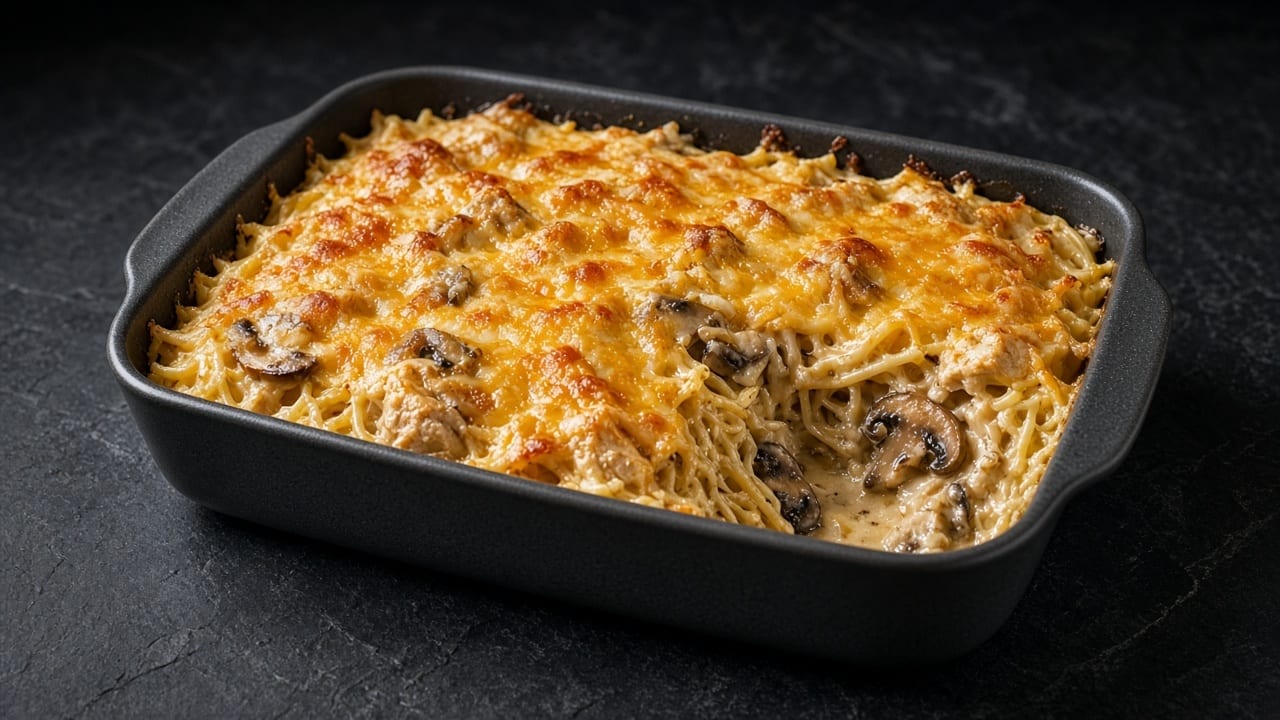
Baked Chicken Spaghetti
By Joe
Source: NYT Cooking.
A creamy, cheesy baked spaghetti with poached chicken, soft vegetables and tomatoes with green chilli, baked until golden and bubbling.
Always check the labels of the products you use.
Method
- 1
Poach the chicken. Cover the breasts with cold water in the saucepan, add the bay leaf and bring to a bare simmer. Cook 12-15 min until the thickest part reads 74 °C, then lift out, cool a little and shred. Gentle heat keeps the meat moist.
- 2
Heat the oven. Set it to 180 °C (160 °C fan) and butter the baking dish.
- 3
Cook the pasta. Boil the spaghetti in 3 litres salted water for about 2 min less than the packet time, as it finishes in the oven. Drain and tip into the mixing bowl.
- 4
Soften the vegetables. Melt the butter in the frying pan over medium heat and cook the onion, mushrooms, celery and green pepper for 10-12 min until soft. Add the garlic for the last 2 min.
- 5
Make the sauce. Stir in the flour and cook 2 min until it smells nutty. Add the milk a splash at a time, stirring out lumps, then the stock, onion and garlic powders, salt and pepper. Simmer 5 min until thick, then stir in the tomatoes and chilli.
- 6
Combine. Add the sauce, chicken, half the Cheddar and all the Parmesan to the pasta and mix well. Spread in the dish and scatter over the rest of the Cheddar.
- 7
Bake. Bake uncovered for about 35 min, until bubbling at the edges and golden on top. Rest 5 min before serving.
Storage
Cool, cover and refrigerate within 2 hours for up to 3 days, or freeze portions for up to 2 months. Reheat covered in a 180 °C oven until piping hot (74 °C).
Why this label?
36.1 g protein for 539 kcal = 6.7 g per 100 kcal, so protein gives about 27% of the energy. High protein needs at least 20% (5 g per 100 kcal), the condition in the Annex to EU Regulation (EC) No 1924/2006. How we decide
EU nutrition claims
- Low sugars: 3.5 g sugars per 100 g (limit ≤ 5 g)
Per 100 g of the finished dish, worked out from the nutrition per serving and the lowest likely cooked weight (about 200 g a serving), so the true values are, if anything, lower. Thresholds from the Annex to EU Regulation (EC) No 1924/2006. How we decide
Free sugars
0 g per serving
0 % of the 50 g daily maximum · 0 % of the ideal 25 g
Free sugars under 50 g a day, ideally about 25 g, based on WHO free-sugar guidance (not endorsed by WHO). The share shown is the share of one serving. WHO
Equipment
- medium saucepan
- instant-read thermometer
- large frying pan or sauté pan
- large mixing bowl
- 23 x 33 cm baking dish
- large pot (at least 5 litres)
- colander or tongs
- heatproof mug for pasta water
Nutrition per serving Calculated from USDA FoodData Central
| Per serving | Amount |
|---|---|
| Energy | 539 kcal |
| Protein | 36.1 g |
| Carbohydrate | 45.2 g |
| of which sugars | 7 g |
| of which free sugars | 0 g |
| Fat | 23.5 g |
| of which saturates | 12.8 g |
| Fibre | 3.5 g |
| Salt | 1.65 g |
Protein per 100 kcal
6.7 g meets High protein (≥ 5 g per 100 kcal = 20% of energy, and ≥ 10 g per serving)
Calculated from USDA FoodData Central ingredient values