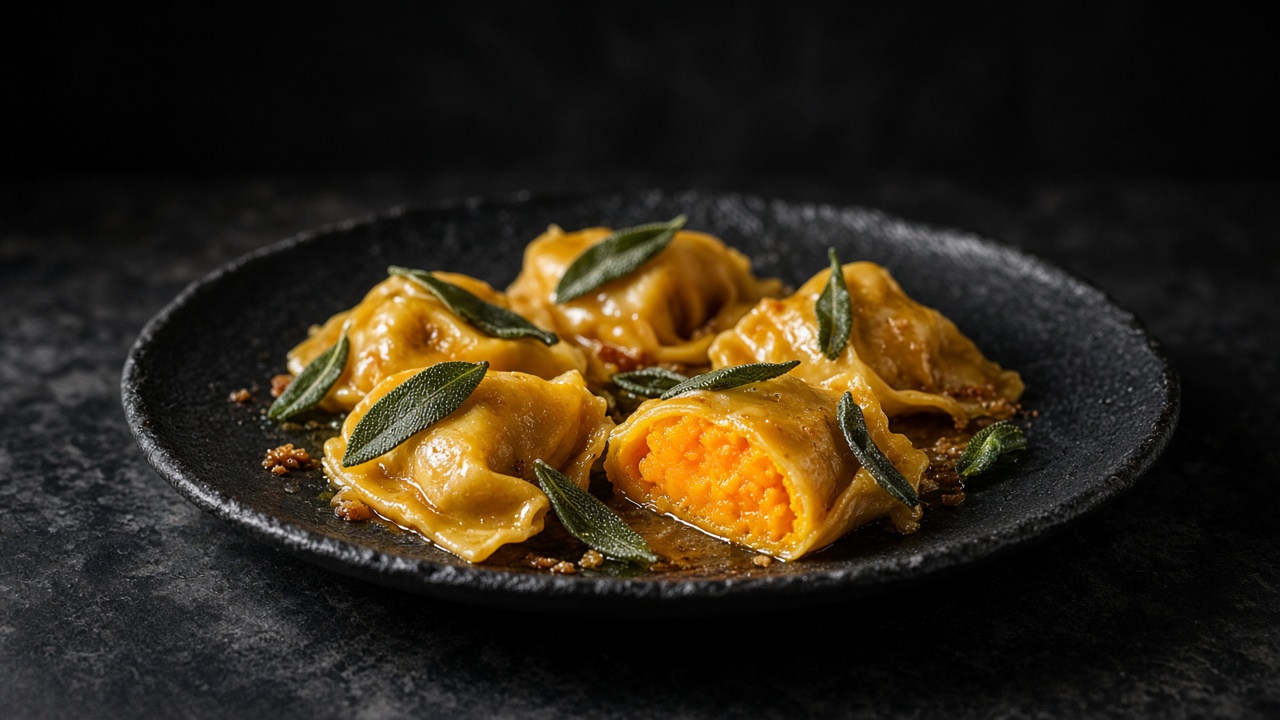
Butternut Squash Ravioli with Brown Butter and Sage
By Joe
Source: Serious Eats and NYT Cooking.
This follows the same dough, filling and sealing method as our ricotta ravioli, with a roasted butternut squash filling in place of ricotta and a nutty brown butter and sage sauce instead of plain melted butter.
Always check the labels of the products you use.
Method
- 1
Roast the squash. Preheat the oven to 200°C (180°C fan) at least 20 minutes ahead, rub the cut sides of the squash with olive oil and roast cut side down for 45-55 minutes, until completely soft and caramelised at the edges.
- 2
Mash and season the filling. Once the squash is cool enough to handle, after about 10 minutes, scoop out the flesh (around 400g) and mash or blitz it smooth with the Parmesan, nutmeg, salt and pepper. If the mixture looks wet, stir it in a hot dry pan for 3-5 minutes to steam off extra moisture, since a dry filling seals more reliably inside the pasta. Chill the filling before using.
- 3
Mix the dough. Tip the flour onto the worktop and shape a mound with a 12cm well, then add the eggs, yolks and salt. Beat with a fork, drawing in flour from the inner wall until a soft paste forms, then fold in the rest with a bench scraper.
- 4
Knead until smooth. Knead for 8-10 minutes, pushing with the heel of your hand and folding the dough back on itself, until it's smooth, firm and springs back slowly when poked. The egg, at around 67% of the flour's weight, gives the dough its firm, silky texture once the gluten has developed. Wet your hands if it cracks, or dust in a little extra flour if it feels tacky.
- 5
Rest the dough. Wrap the dough and leave it to rest for 30-60 minutes at room temperature, giving the gluten time to relax so it rolls out without springing back.
- 6
Roll, fill and cut. Roll, fill and cut the ravioli exactly as for the classic ricotta version: thin sheets down to under 1mm, 2 tsp mounds of filling 5cm apart, water-sealed edges with the air pressed out, then cut and laid on semolina-dusted trays.
- 7
Brown the butter. Melt the butter in a frying pan over medium heat and swirl the pan for 3-4 minutes, until the foam subsides, the milk solids turn a hazelnut brown and the butter smells distinctly nutty. Add the sage leaves and fry for 30 seconds until they turn crisp, then take the pan off the heat and stir in the lemon juice, which stops the butter browning any further.
- 8
Cook and glaze. Bring 4 litres of water to the boil with the 32g of salt and cook the ravioli in 2 batches for 3-4 minutes. Lift them straight into the brown butter with a slotted spoon along with 80ml of the cooking water, then swirl over medium heat for 1 minute to glaze. Serve with the Parmesan for the table.
Storage
Uncooked ravioli keep in the fridge for up to 1 day on a floured tray, or freeze in a single layer for up to 1 month and cook from frozen with an extra minute. Reheat cooked leftovers gently in a pan until piping hot. Cool leftovers in a shallow container and refrigerate within 2 hours (within 1 hour on a day above 32°C).
EU nutrition claims
- Source of protein: 3.2 g protein per 100 kcal, about 13% of energy (needs ≥ 12%)
- Low sugars: 2.1 g sugars per 100 g (limit ≤ 5 g)
Per 100 g of the finished dish, worked out from the nutrition per serving and the lowest likely cooked weight (about 181 g a serving), so the true values are, if anything, lower. Thresholds from the Annex to EU Regulation (EC) No 1924/2006. How we decide
Free sugars
0 g per serving
0 % of the 50 g daily maximum · 0 % of the ideal 25 g
Free sugars under 50 g a day, ideally about 25 g, based on WHO free-sugar guidance (not endorsed by WHO). The share shown is the share of one serving. WHO
Equipment
- roasting tray lined with baking paper
- food processor or potato masher
- clean worktop or large board
- fork
- bench scraper
- cling film
- pasta machine (or long rolling pin)
- pastry brush and small bowl of water
- 6-7 cm round cutter or fluted pasta wheel
- 2 baking trays dusted with semolina
- large pot (at least 5 litres)
- slotted spoon
- large frying pan (30 cm)
Nutrition per serving Calculated from USDA FoodData Central
| Per serving | Amount |
|---|---|
| Energy | 671 kcal |
| Protein | 21.8 g |
| Carbohydrate | 78.5 g |
| of which sugars | 3.8 g |
| of which free sugars | 0 g |
| Fat | 30.3 g |
| of which saturates | 14.9 g |
| Fibre | 5.5 g |
| Salt | 1.7 g |
Protein per 100 kcal
3.2 g High protein needs ≥ 5 g per 100 kcal (20% of energy) and ≥ 10 g per serving
Calculated from USDA FoodData Central ingredient values