Always check the labels of the products you use.
Method
- 1
Crostini. Heat the oven to 180 °C (160 °C fan). Brush the bread slices lightly with oil and bake for 10-12 minutes, until crisp with golden edges. Baking dries them right through, so they stay crunchy under the soft spread.
- 2
Sear the livers. Heat the 3 tbsp oil in a frying pan over medium-high heat. Lay the livers in a single layer and cook for 2-3 minutes a side, until well browned outside; dry livers in an uncrowded pan brown instead of stewing.
- 3
Finish cooking. Turn the heat down, add the garlic and chopped sage and cook for 1-2 minutes more, until the livers are no longer pink in the centre and read 74 °C. Lower heat lets the middle cook through without the garlic burning.
- 4
Blend. Scrape everything, including the pan oil, into a food processor with the anchovies, lemon juice, salt and pepper, and blend until smooth. Taste and adjust; the anchovies melt into the spread and add depth rather than a fishy taste.
- 5
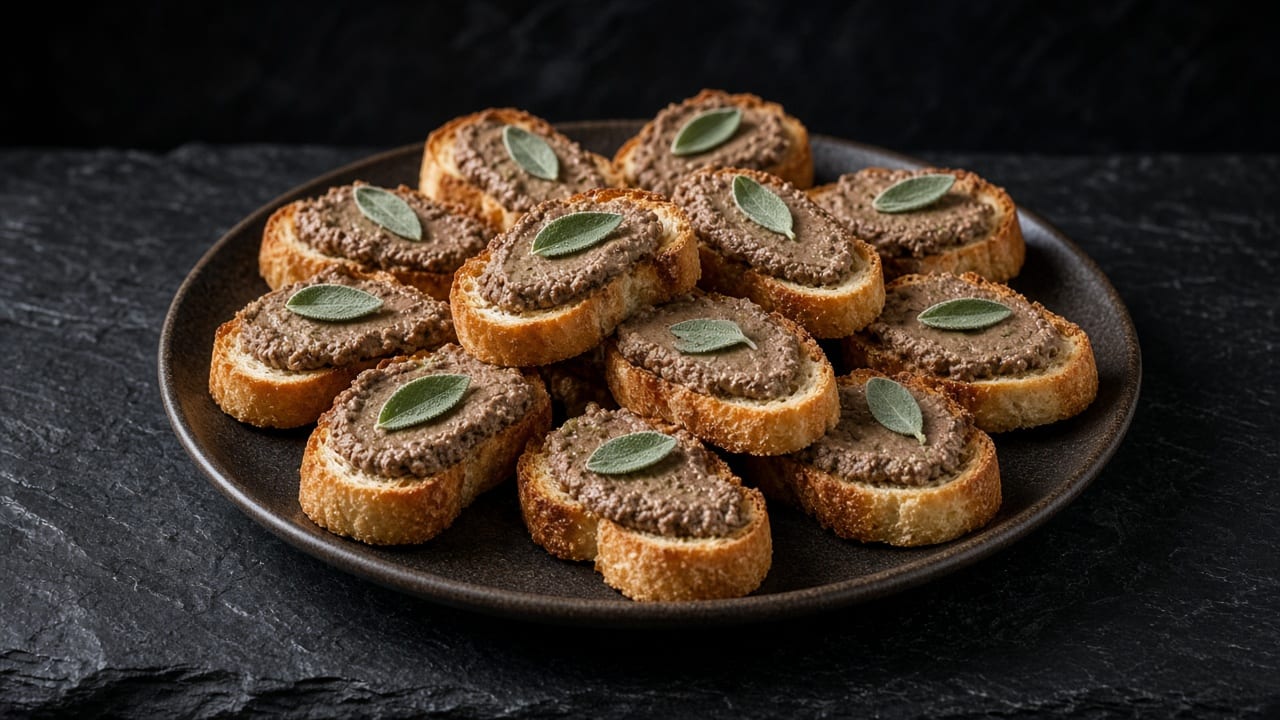
Assemble. Spread a heaped tablespoon of pâté on each crostino and press a sage leaf on top. Serve warm or at room temperature, when the flavour is fullest.
Storage
Keep the pâté covered in the fridge for up to 2 days; bring it to room temperature before spreading. Crostini keep in an airtight tin for 3 days. Do not freeze the assembled crostini. Cool leftovers in a shallow container and refrigerate within 2 hours (within 1 hour on a day above 32°C).
Why this label?
11 g protein for 198 kcal = 5.6 g per 100 kcal, so protein gives about 22% of the energy. High protein needs at least 20% (5 g per 100 kcal), the condition in the Annex to EU Regulation (EC) No 1924/2006. How we decide
EU nutrition claims
- Low sugars: 2.1 g sugars per 100 g (limit ≤ 5 g)
Per 100 g of the finished dish, worked out from the nutrition per serving and the lowest likely cooked weight (about 67 g a serving), so the true values are, if anything, lower. Thresholds from the Annex to EU Regulation (EC) No 1924/2006. How we decide
Free sugars
1.4 g per serving
2.8 % of the 50 g daily maximum · 5.6 % of the ideal 25 g
Free sugars under 50 g a day, ideally about 25 g, based on WHO free-sugar guidance (not endorsed by WHO). The share shown is the share of one serving. WHO
Equipment
- oven
- baking tray
- pastry brush
- frying pan
- instant-read thermometer
- food processor or stick blender
Nutrition per serving Calculated from USDA FoodData Central
| Per serving | Amount |
|---|---|
| Energy | 198 kcal |
| Protein | 11 g |
| Carbohydrate | 16.6 g |
| of which sugars | 1.4 g |
| of which free sugars | 1.4 g |
| Fat | 9.7 g |
| of which saturates | 1.8 g |
| Fibre | 0.9 g |
| Salt | 0.95 g |
Protein per 100 kcal
5.6 g meets High protein (≥ 5 g per 100 kcal = 20% of energy, and ≥ 10 g per serving)
Calculated from USDA FoodData Central ingredient values