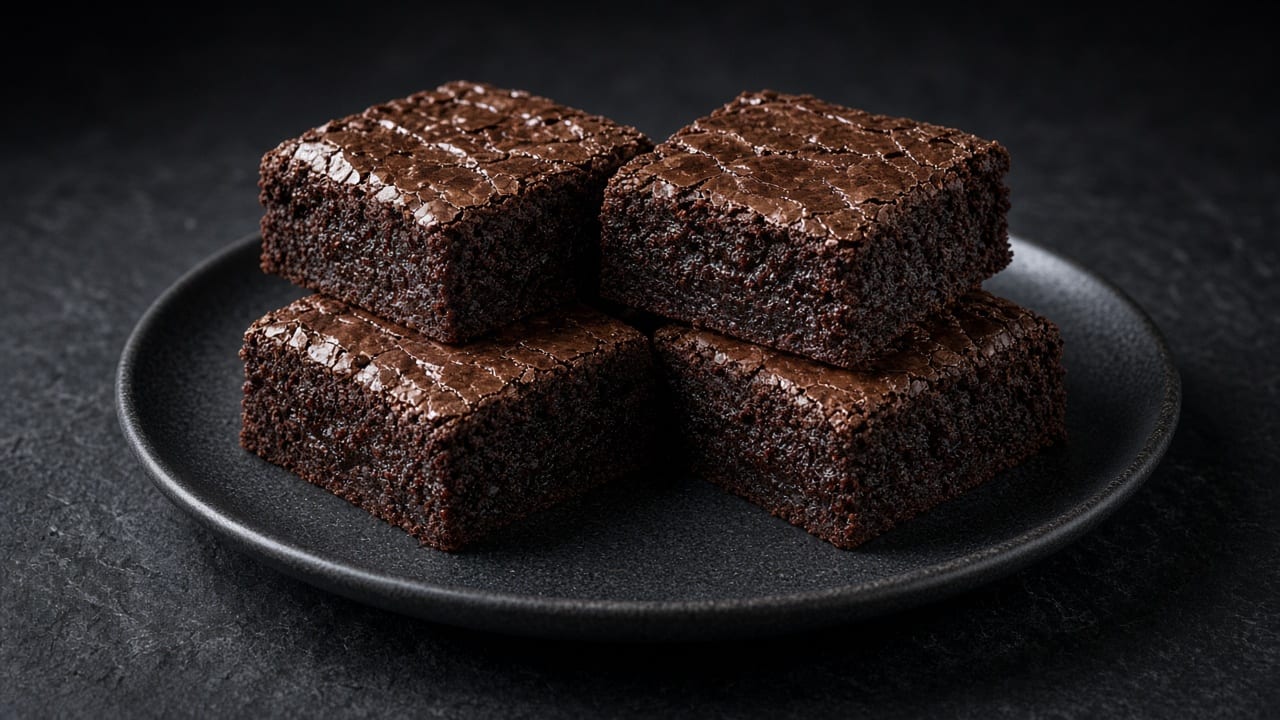
Always check the labels of the products you use.
Method
- 1
Heat the oven and line the tin. Set a shelf in the middle and heat the oven to 180°C (160°C fan). Line a 23 × 33 × 5 cm anodised aluminium tin with foil over the base and the long sides; the short ends can stay uncovered. A light oil spray on the foil is optional.
- 2
Brown the butter and melt the chocolate. In a large pan over medium-low heat, melt the butter. Once it is liquid, raise the heat to medium and let it simmer, stirring with a heatproof spatula, as it spatters. Keep going, scraping up the browned bits, until the butter is golden and the spattering fades. Take the pan off the heat and stir in the chopped chocolate; the mix will be quite loose.
- 3
Whip the eggs and sugars. In a mixer bowl, with the whisk attached, combine both sugars, the salt, eggs, vanilla and espresso powder if you are using it. Beat on medium-high until the mixture is very thick and billowy, about 8 minutes — judge by how it looks, because mixers and bowls vary. While that runs, sift the flour with the cocoa.
- 4
Combine and fold. Slow the mixer and stream in the warm chocolate butter. Once it is mixed in, add the cocoa and flour in one go and stop as soon as it is roughly combined. Finish by hand, scraping the bottom so no dry patches remain.
- 5
Bake until just set. Spread the batter in the tin and bake until the top is shiny and only just set, about 30 minutes, or until a probe in the centre reads 96°C (angle it so it does not hit the tin). Those timings are for anodised aluminium; glass, ceramic or non-stick will behave differently.
- 6
Cool completely, then cut. Let the slab go completely cold in the tin so the crumb can set. Free the short sides with a knife, lift out on the foil, and cut 24 squares of about 6 cm.
Storage
Store in an airtight container with baking paper between the layers for about 1 week at room temperature, or freeze for up to 3 months.
Caffeine · Free sugars
- Per serving: about 1 mg caffeine (serving: 1 of 24 servings). Source: 1 g instant coffee/espresso powder × USDA FDC SR Legacy #171893 (instant coffee powder, 3142 mg/100 g); divided by 24 servings (only if you add the optional coffee).
- Scaling: making more servings does not change the caffeine in each serving; what counts is how many servings you drink in a day. 1 serving: 1 mg · 2 servings: 2 mg · 3 servings: 3 mg · 4 servings: 4 mg.
- General guideline: EFSA Scientific Opinion on the safety of caffeine (2015): for healthy adults, up to 200 mg in a single dose and up to 400 mg per day do not raise safety concerns. 1 serving = 0 % of 400 mg. EFSA
22.7 g per serving
45.4 % of the 50 g daily maximum · 90.8 % of the ideal 25 g
Free sugars under 50 g a day, ideally about 25 g, based on WHO free-sugar guidance (not endorsed by WHO). The share shown is the share of one serving. WHO
Equipment
- 23 × 33 × 5 cm anodised aluminium baking tin, lined with foil
- large saucepan or saucier, about 2.8 litres
- stand mixer with whisk (or a large bowl and electric whisk)
- sieve
- silicone spatula
- probe thermometer (optional)
Nutrition per serving Calculated from USDA FoodData Central
| Per serving | Amount |
|---|---|
| Energy | 274 kcal |
| Protein | 3.6 g |
| Carbohydrate | 31.3 g |
| of which sugars | 22.9 g |
| of which free sugars | 22.7 g |
| Fat | 16.4 g |
| of which saturates | 9.7 g |
| Fibre | 2.3 g |
| Salt | 0.22 g |
Protein per 100 kcal
1.3 g High protein needs ≥ 5 g per 100 kcal (20% of energy) and ≥ 10 g per serving
Calculated from USDA FoodData Central ingredient values