Always check the labels of the products you use.
Method
- 1
Boil the sheets. Heat the oven to 190 °C (170 °C fan) and oil the baking sheet and the dish. Boil the sheets in 4 litres salted water until al dente, drain, lay them on the oiled sheet and turn to coat so they do not stick. Cut 2 in half.
- 2
Panade. Mash the bread and milk to a paste, then knead in the beef, salt and pepper. The soaked bread keeps the meat tender through the long bake.
- 3
Meat sauce. Heat the oil in the empty pot over medium heat, cook the onion 5 min, add the garlic, oregano and chilli for 1 min, then the beef, breaking it small, for about 4 min until no longer pink. Stir in the tomatoes and simmer 5 min.
- 4
Cream sauce. Whisk the cottage cheese, pecorino, cream, garlic, cornflour and pepper together. The cornflour stops it turning greasy in the oven.
- 5
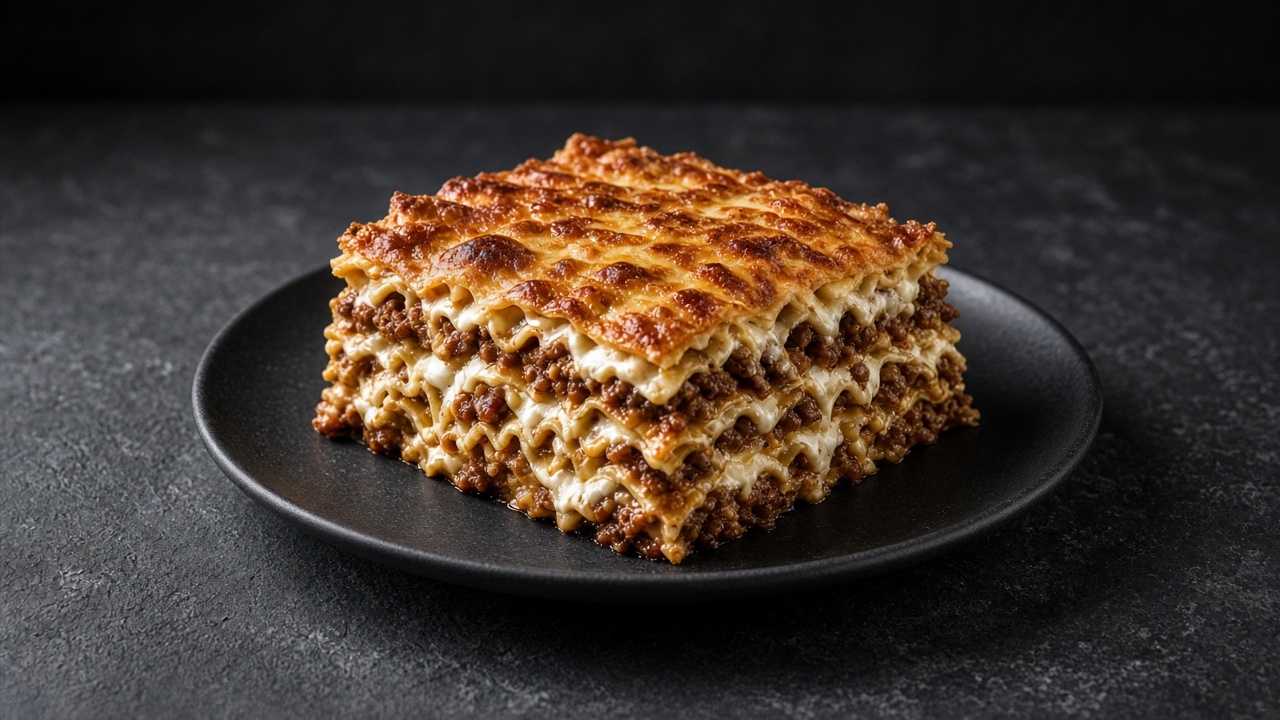
Layer. Lay 3 sheets lengthways in the dish with a half sheet to fill the gap. Spread over about 360 ml meat sauce, 120 ml cream sauce and 60 g mozzarella. Repeat 3 more times, moving the half sheet to the other end each time, then top with the last 3 sheets, the rest of the cream sauce and mozzarella, and the pecorino.
- 6
Bake. Cover with oiled foil, set on the baking tray and bake 30 min. Uncover and bake 25-30 min more until spotty brown and 74 °C in the centre. Rest 30 min before slicing.
Storage
Cool, cover and refrigerate within 2 hours for up to 3 days, or freeze portions for up to 2 months. Reheat covered in a 180 °C oven until piping hot (74 °C) in the centre.
Why this label?
28.5 g protein for 475 kcal = 6 g per 100 kcal, so protein gives about 24% of the energy. High protein needs at least 20% (5 g per 100 kcal), the condition in the Annex to EU Regulation (EC) No 1924/2006. How we decide
EU nutrition claims
- Low sugars: 4 g sugars per 100 g (limit ≤ 5 g)
Per 100 g of the finished dish, worked out from the nutrition per serving and the lowest likely cooked weight (about 128 g a serving), so the true values are, if anything, lower. Thresholds from the Annex to EU Regulation (EC) No 1924/2006. How we decide
Free sugars
0.3 g per serving
0.6 % of the 50 g daily maximum · 1.2 % of the ideal 25 g
Free sugars under 50 g a day, ideally about 25 g, based on WHO free-sugar guidance (not endorsed by WHO). The share shown is the share of one serving. WHO
Equipment
- large flameproof casserole
- rimmed baking sheet
- mixing bowl
- wooden spoon
- 23 x 33 cm baking dish
- foil
- baking tray (to catch drips)
Nutrition per serving Calculated from USDA FoodData Central
| Per serving | Amount |
|---|---|
| Energy | 475 kcal |
| Protein | 28.5 g |
| Carbohydrate | 33 g |
| of which sugars | 5.1 g |
| of which free sugars | 0.3 g |
| Fat | 25.3 g |
| of which saturates | 13.5 g |
| Fibre | 2.7 g |
| Salt | 1.62 g |
Protein per 100 kcal
6 g meets High protein (≥ 5 g per 100 kcal = 20% of energy, and ≥ 10 g per serving)
Calculated from USDA FoodData Central ingredient values