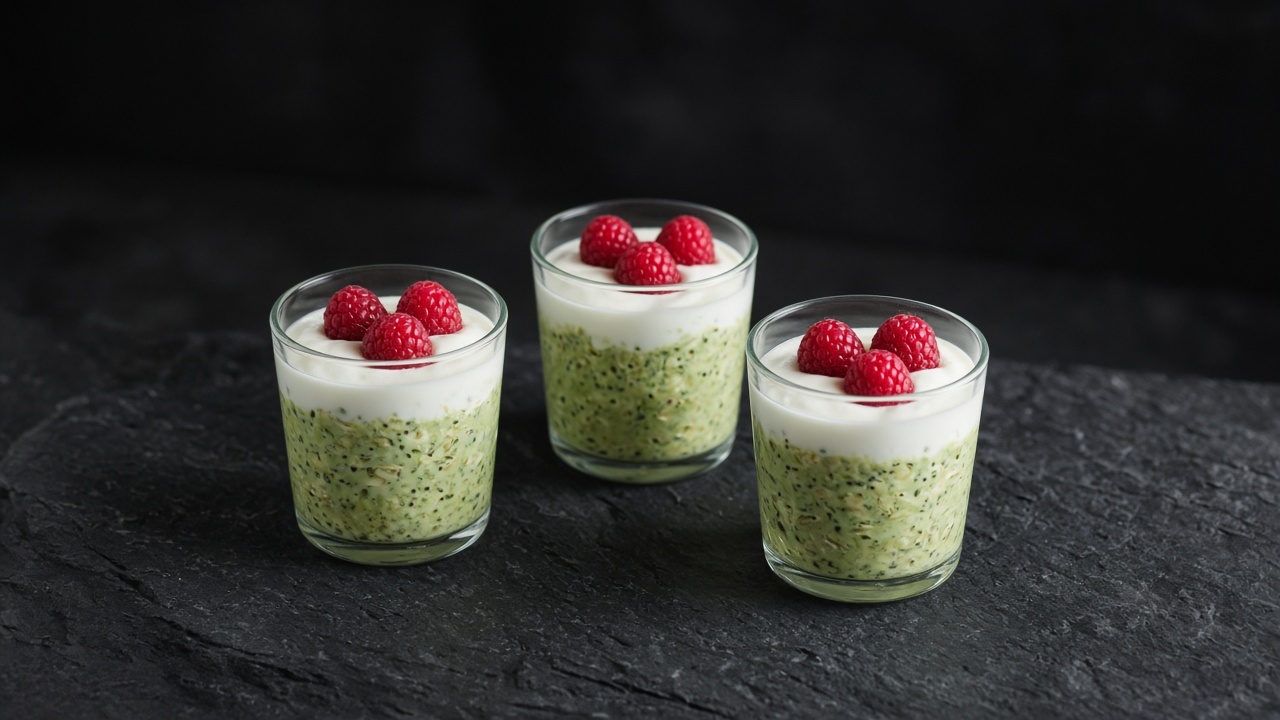
Always check the labels of the products you use.
Method
- 1
Prepare matcha. Sift 1 tsp unsweetened matcha powder into a lidded tub (about 1000 ml).
- 2
Add liquid. Pour in 480 ml oat milk or whole milk, 35 ml maple syrup and ¼ tsp vanilla.
- 3
Whisk. Whisk thoroughly until smooth with no matcha lumps.
- 4
Add oats. Stir in 95 g rolled oats and 2 tbsp chia seeds.
- 5
Chill. Cover and refrigerate at least 3 h or overnight.
- 6
Finish. Before eating, stir well and loosen with a little more milk if you like, then divide between 4 bowls or glasses.
- 7
Top. Crown each with 30 g Greek-style yoghurt and 37.5 g raspberries or other fresh fruit.
Storage
Keep covered in the fridge for up to 3 days; stir before eating and add more milk if the mixture is too thick. Cool leftovers in a shallow container and refrigerate within 2 hours (within 1 hour on a day above 32°C).
EU nutrition claims
- Source of protein: 4.1 g protein per 100 kcal, about 17% of energy (needs ≥ 12%)
- Low salt: 0.17 g salt per 100 g (limit ≤ 0.3 g)
- Source of fibre: 2.5 g fibre per 100 kcal (needs ≥ 1.5 g)
Per 100 g of the finished dish, worked out from the nutrition per serving and the lowest likely cooked weight (about 100 g a serving), so the true values are, if anything, lower. Thresholds from the Annex to EU Regulation (EC) No 1924/2006. How we decide
Free sugars
7 g per serving
14 % of the 50 g daily maximum · 28 % of the ideal 25 g
Free sugars under 50 g a day, ideally about 25 g, based on WHO free-sugar guidance (not endorsed by WHO). The share shown is the share of one serving. WHO
Equipment
- lidded tub (about 1000 ml)
- whisk
- tea strainer or small sieve
- spoon
Nutrition per serving Calculated from USDA FoodData Central
| Per serving | Amount |
|---|---|
| Energy | 271 kcal |
| Protein | 11.2 g |
| Carbohydrate | 37.7 g |
| of which sugars | 16.3 g |
| of which free sugars | 7 g |
| Fat | 8.9 g |
| of which saturates | 3.5 g |
| Fibre | 6.8 g |
| Salt | 0.17 g |
Protein per 100 kcal
4.1 g High protein needs ≥ 5 g per 100 kcal (20% of energy) and ≥ 10 g per serving
Calculated from USDA FoodData Central ingredient values