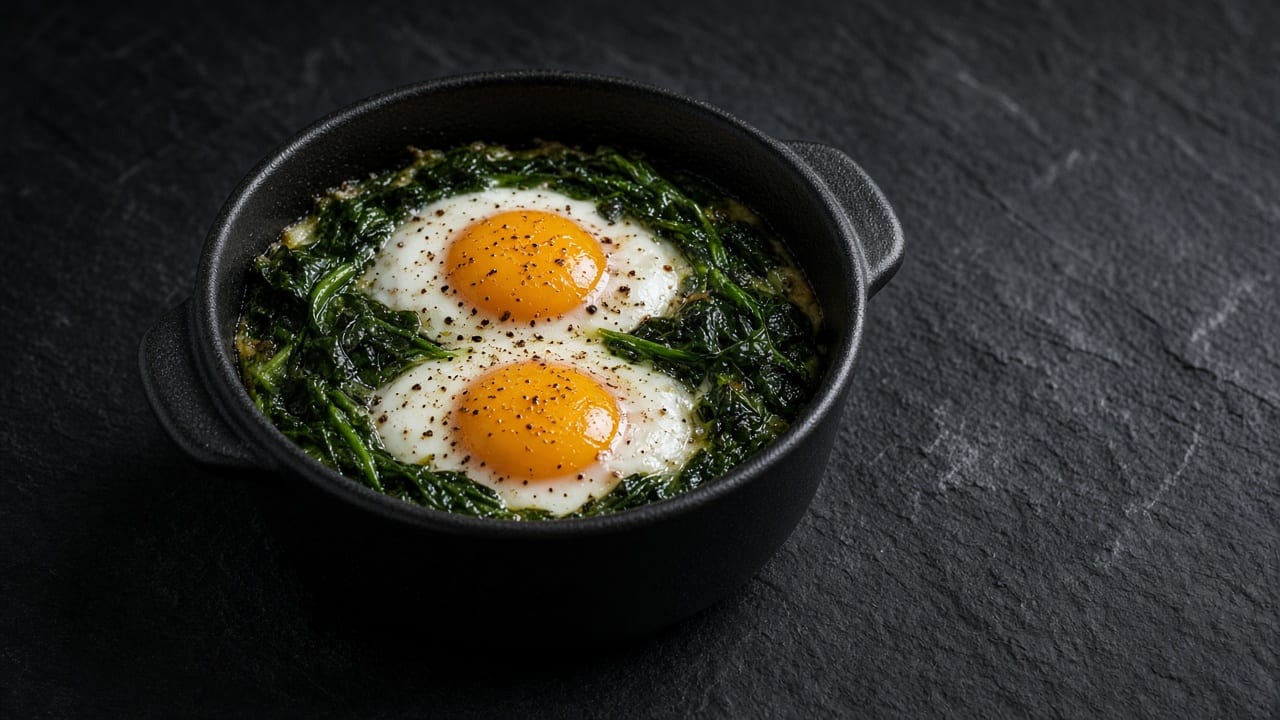
Oven-Baked Eggs in Ramekins with Creamed Spinach
By Joe
Source: NYT Cooking and America's Test Kitchen.
A heartier version of the cream and toast baked eggs in ramekins: the same water-bath method, but the eggs sit in a nest of creamed spinach with shallot, nutmeg and hard cheese instead of plain cream. Baked until the yolks are fully set and served with toast.
Always check the labels of the products you use.
Method
- 1
Oven, kettle, ramekins. This follows the classic baked-egg method, with creamed spinach replacing the plain cream. Heat the oven to 190 °C (170 °C fan) and boil a kettle. Grease the ramekins with a little of the butter and stand them in the deep roasting tin.
- 2
Soften the shallot. Melt the remaining butter in the large frying pan over medium heat and cook the shallot for 3 minutes until soft and translucent. Cooking it first takes away its raw sharpness so it blends sweetly into the sauce.
- 3
Wilt and squeeze. Add the spinach in batches, stirring for 2-3 minutes until it has all wilted, then tip it into the colander and press out the liquid firmly. Spinach holds a surprising amount of water, and removing it keeps the filling thick so it does not flood the ramekins.
- 4
Make it creamy. Return the spinach to the pan with the cream and nutmeg and simmer for 1-2 minutes until thick. Off the heat, stir in the cheese, which melts into the cream and helps bind the spinach together.
- 5
Nest the eggs. Divide the spinach among the ramekins and press a hollow into the centre of each with a spoon. Crack 2 eggs into each hollow and season with the salt. The hollow keeps the eggs in the middle, where they bake evenly.
- 6
Bake in water. Pour hot water from the kettle into the tin to come halfway up the ramekins. Bake for 16-20 minutes, checking from 14 minutes, until the whites are firm and the yolks are fully set with no liquid yolk (71 °C in the centre of the yolk); deeper ramekins take longer.
- 7
Finish and serve. Lift the ramekins out with oven gloves onto plates, as they will be very hot. Grind over the pepper and serve with fingers of toast for dipping into the spinach.
Storage
Best eaten freshly baked. Refrigerate leftovers within 1 hour, use within 1 day and reheat until piping hot (74 °C).
Why this label?
20.8 g protein for 372 kcal = 5.6 g per 100 kcal, so protein gives about 22% of the energy. High protein needs at least 20% (5 g per 100 kcal), the condition in the Annex to EU Regulation (EC) No 1924/2006. How we decide
EU nutrition claims
- Low sugars: 4.5 g sugars per 100 g (limit ≤ 5 g)
Per 100 g of the finished dish, worked out from the nutrition per serving and the lowest likely cooked weight (about 93 g a serving), so the true values are, if anything, lower. Thresholds from the Annex to EU Regulation (EC) No 1924/2006. How we decide
Free sugars
2.3 g per serving
4.6 % of the 50 g daily maximum · 9.2 % of the ideal 25 g
Free sugars under 50 g a day, ideally about 25 g, based on WHO free-sugar guidance (not endorsed by WHO). The share shown is the share of one serving. WHO
Equipment
- 4 ramekins (about 180 ml each)
- deep roasting tin
- kettle
- pastry brush
- instant-read thermometer
- oven gloves
- toaster
- large frying pan
- colander
Nutrition per serving Calculated from USDA FoodData Central
| Per serving | Amount |
|---|---|
| Energy | 372 kcal |
| Protein | 20.8 g |
| Carbohydrate | 25.6 g |
| of which sugars | 4.2 g |
| of which free sugars | 2.3 g |
| Fat | 20.9 g |
| of which saturates | 9.7 g |
| Fibre | 3.1 g |
| Salt | 1.57 g |
Protein per 100 kcal
5.6 g meets High protein (≥ 5 g per 100 kcal = 20% of energy, and ≥ 10 g per serving)
Calculated from USDA FoodData Central ingredient values