Always check the labels of the products you use.
Method
- 1
Crepes. Whisk 210 g flour with ½ tsp salt, whisk in 4 eggs and half of 540 ml milk to a smooth paste, then stir in the rest of the milk and 45 g melted butter; rest the batter 30 min, then cook 12 thin crêpes in an oiled 25 cm pan, about 1 min a side, and stack them.
- 2
Roast. Heat a roasting tin in a 220°C oven, toss 900 g cauliflower florets with two-thirds of a mix of 42 g melted butter, 80 ml olive oil, ½ tsp pepper and 2 tsp mustard powder, season with 1½ tsp salt, then roast for 10 min.
- 3
Add. Toss the halved leeks and 340 g parsnips with the remaining butter-oil mix and 1 tsp salt, turn the cauliflower, add the leeks and parsnips to the tin and roast for 20 min, turning halfway.
- 4
Finish. Lower the oven to 160°C and roast until everything is golden and tender, 20-30 min, then chop all the vegetables into 6-12 mm pieces.
- 5
Sauce. Whisk 3 egg yolks with 2 tbsp cream in a bowl, simmer 720 ml vegetable stock in one pan, and in another cook 42 g butter with 3 tbsp flour over medium-low heat for about 3 min without browning.
- 6
Thicken. Off the heat whisk the hot stock gradually into the butter and flour until smooth, return to low heat for 2-3 min until slightly thickened, then whisk into the yolk mixture and return to medium-low heat until steaming, 2-3 min, without boiling.
- 7
Combine. Set aside 240 ml of the sauce and stir the rest into the chopped roasted vegetables.
- 8
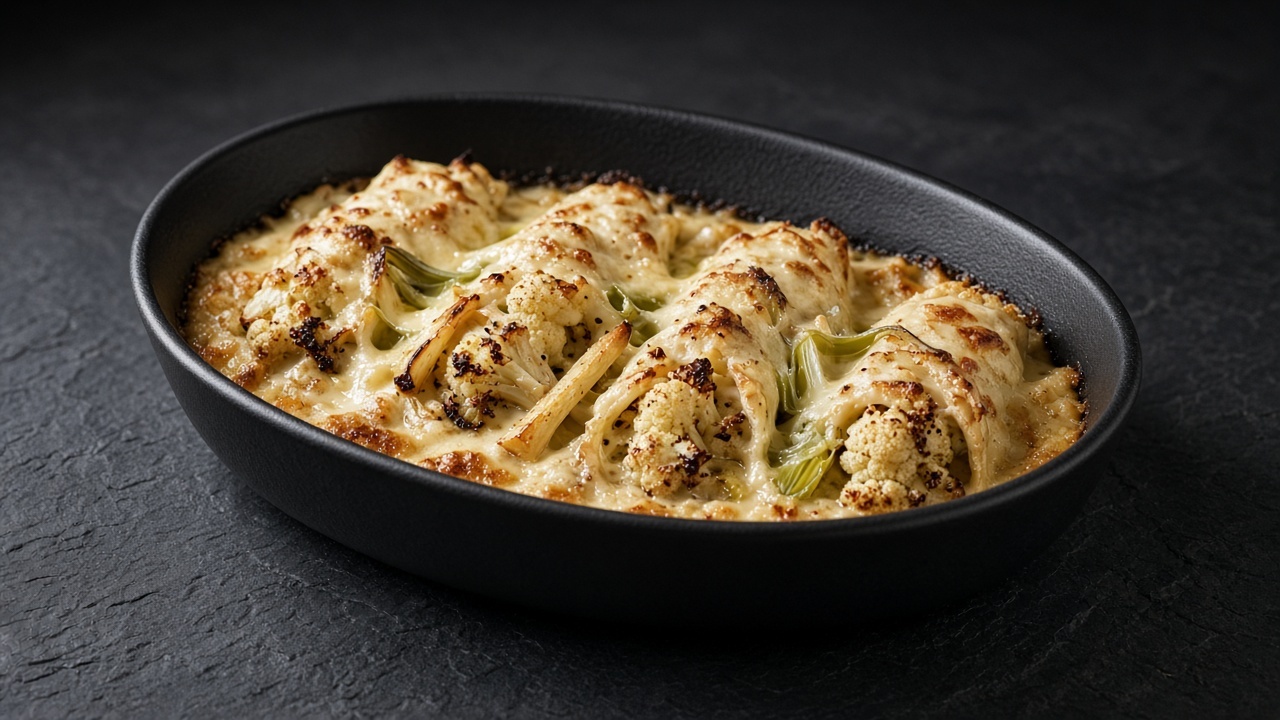
Assemble. Butter a baking dish, spoon the filling along each crêpe, roll up and lay seam-down in the dish, then spoon over the reserved sauce.
- 9
Bake. Bake at 180°C until bubbling at the edges and hot through, about 20 min, checking the centre of the filling reaches 74°C.
Storage
Serve this bake hot from the oven; let any leftovers cool, then keep them covered in the fridge and reheat in the oven until piping hot throughout. Cool leftovers in a shallow container and refrigerate within 2 hours (within 1 hour on a day above 32°C).
EU nutrition claims
- Low sugars: 4.3 g sugars per 100 g (limit ≤ 5 g)
Per 100 g of the finished dish, worked out from the nutrition per serving and the lowest likely cooked weight (about 309 g a serving), so the true values are, if anything, lower. Thresholds from the Annex to EU Regulation (EC) No 1924/2006. How we decide
Free sugars
0 g per serving
0 % of the 50 g daily maximum · 0 % of the ideal 25 g
Free sugars under 50 g a day, ideally about 25 g, based on WHO free-sugar guidance (not endorsed by WHO). The share shown is the share of one serving. WHO
Equipment
- large roasting tin
- 2 large bowls
- medium bowl
- 2 small saucepans
- whisk
- 25 cm non-stick frying pan
- 60 ml ladle
- chopping board
- sharp knife
- 23 x 33 cm baking dish
- instant-read thermometer
Nutrition per serving Calculated from USDA FoodData Central
| Per serving | Amount |
|---|---|
| Energy | 690 kcal |
| Protein | 17.7 g |
| Carbohydrate | 61.1 g |
| of which sugars | 13.4 g |
| of which free sugars | 0 g |
| Fat | 43.2 g |
| of which saturates | 18.7 g |
| Fibre | 7.9 g |
| Salt | 4.19 g |
Protein per 100 kcal
2.6 g High protein needs ≥ 5 g per 100 kcal (20% of energy) and ≥ 10 g per serving
Calculated from USDA FoodData Central ingredient values