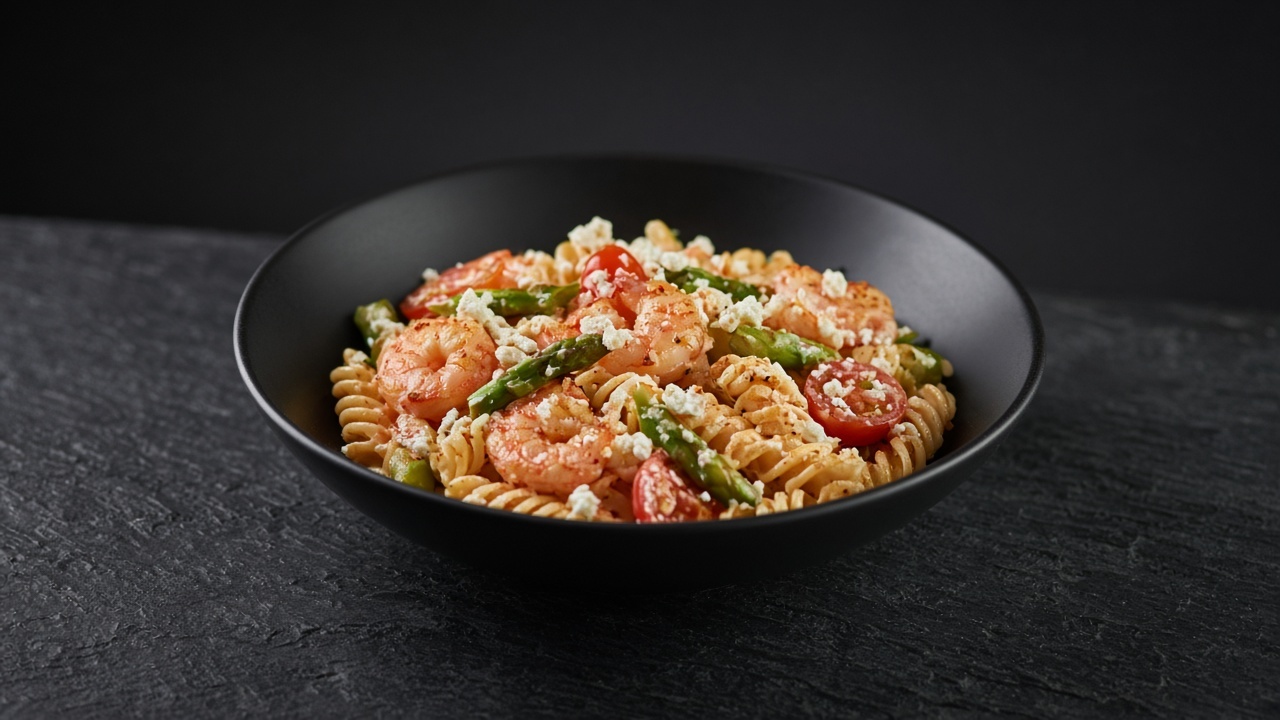
Roasted Red Pepper Pasta Salad with Prawns, Asparagus and Feta
By Joe
Source: America's Test Kitchen.
Rotini, tender prawns, asparagus and cherry tomatoes in a creamy roasted red pepper, feta and almond dressing with a little chilli.
Always check the labels of the products you use.
Method
- 1
Blanch asparagus and prawns. Bring the salted water to the boil. Cook the asparagus 2 min and lift into iced water; then add the prawns off the boil for 3 min until pink and opaque (63 °C) and lift them out too. Drain both well.
- 2
Cook the pasta. Cook the pasta in the same water, drain, rinse cold and shake dry.
- 3
Blend the dressing. Blend the peppers, mayonnaise, feta, almonds, lemon zest and juice, garlic, chilli and pepper until smooth and pink.
- 4
Assemble. Toss the pasta, asparagus, prawns and tomatoes with the dressing and crumble over the remaining feta.
Storage
Keeps covered in the fridge for up to 1 day; loosen with a splash of water or oil and check the seasoning before serving. Not suitable for freezing. Cool leftovers in a shallow container and refrigerate within 2 hours (within 1 hour on a day above 32°C).
Why this label?
24.3 g protein for 459 kcal = 5.3 g per 100 kcal, so protein gives about 21% of the energy. High protein needs at least 20% (5 g per 100 kcal), the condition in the Annex to EU Regulation (EC) No 1924/2006. How we decide
EU nutrition claims
- Low sugars: 2 g sugars per 100 g (limit ≤ 5 g)
Per 100 g of the finished dish, worked out from the nutrition per serving and the lowest likely cooked weight (about 252 g a serving), so the true values are, if anything, lower. Thresholds from the Annex to EU Regulation (EC) No 1924/2006. How we decide
Free sugars
0.2 g per serving
0.4 % of the 50 g daily maximum · 0.8 % of the ideal 25 g
Free sugars under 50 g a day, ideally about 25 g, based on WHO free-sugar guidance (not endorsed by WHO). The share shown is the share of one serving. WHO
Equipment
- large pot (at least 5 litres)
- colander
- food processor or blender
- large mixing bowl
- rubber spatula
- slotted spoon
- bowl of iced water
- instant-read thermometer
Nutrition per serving Calculated from USDA FoodData Central
| Per serving | Amount |
|---|---|
| Energy | 459 kcal |
| Protein | 24.3 g |
| Carbohydrate | 50.4 g |
| of which sugars | 5 g |
| of which free sugars | 0.2 g |
| Fat | 18 g |
| of which saturates | 4.7 g |
| Fibre | 4.7 g |
| Salt | 2.36 g |
Protein per 100 kcal
5.3 g meets High protein (≥ 5 g per 100 kcal = 20% of energy, and ≥ 10 g per serving)
Calculated from USDA FoodData Central ingredient values