Always check the labels of the products you use.
Method
- 1
Blanch the spinach. Boil a large pot of water with the salt, add the spinach for just 5 s until wilted, then lift it into iced water to cool. Drain, wrap in a tea towel and wring hard until dry, then chop. Squeezing out the water is what stops the lasagne going soggy.
- 2
White sauce. Melt the butter in the saucepan over medium heat and cook the shallots and garlic about 4 min until soft. Stir in the flour for 1-2 min without browning, whisk in the milk and bring to the boil. Add the bay, nutmeg, salt and pepper, then simmer gently 10 min, whisking now and then. Remove the bay and whisk in the 15 g Parmesan.
- 3
Divide the sauce. Keep 120 ml plain sauce for the base and stir the chopped spinach into the rest.
- 4
Cheese layer. Blend the cottage cheese and egg in the processor until completely smooth.
- 5
Soften the sheets. Heat the oven to 220 °C (200 °C fan). Soak the sheets in 5 cm of just-boiled water in the baking dish for 5 min until pliable, then lay them on tea towels. Dry and grease the dish.
- 6
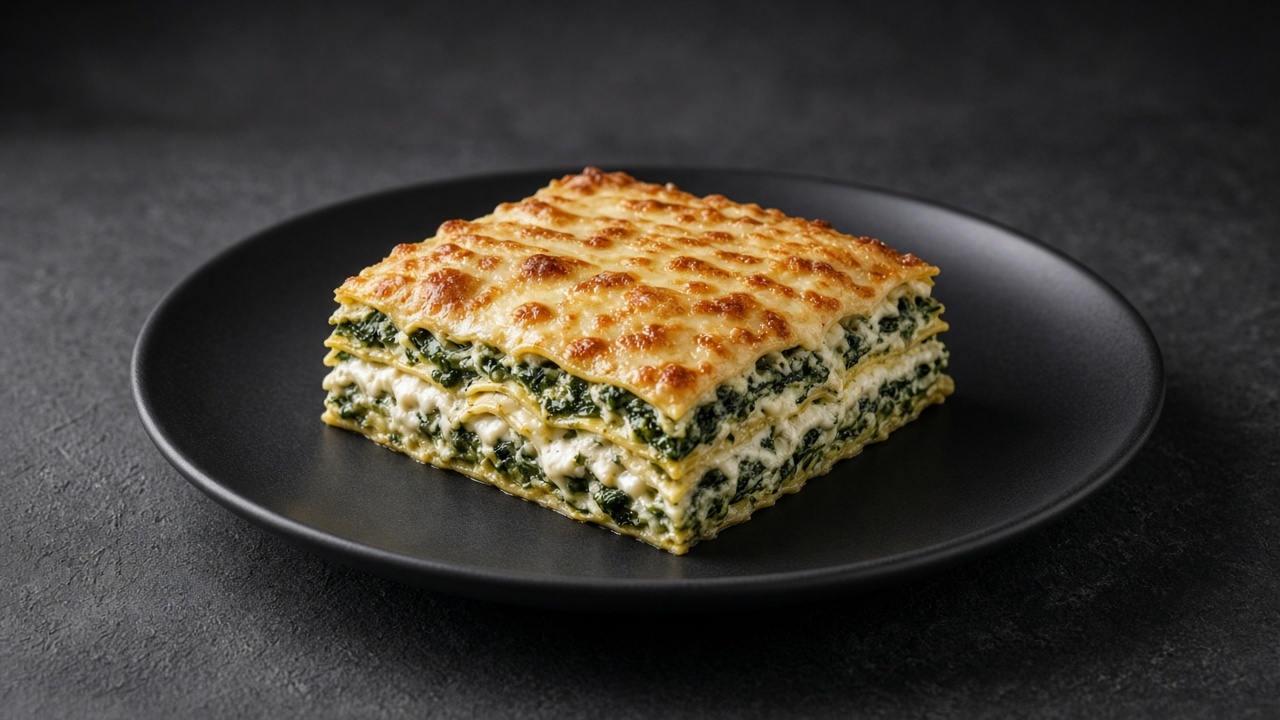
Layer. Spread the plain sauce over the base and lay 3 sheets on top. Spread over some spinach sauce, scatter over the Parmesan and top with 3 sheets. Spread over more spinach sauce, scatter over half the fontina and top with 3 sheets. Spread over more spinach sauce, then the cottage-cheese mixture. Finish with the last 3 sheets, the rest of the spinach sauce and the remaining fontina.
- 7
Bake. Cover with greased foil and bake about 20 min until bubbling at the edges, then uncover and bake 10-15 min until spotty brown. Rest 15 min before cutting.
Storage
Cool, cover and refrigerate within 2 hours for up to 3 days, or freeze portions for up to 2 months. Reheat covered in a 180 °C oven until piping hot (74 °C) in the centre.
Why this label?
23.3 g protein for 444 kcal = 5.2 g per 100 kcal, so protein gives about 21% of the energy. High protein needs at least 20% (5 g per 100 kcal), the condition in the Annex to EU Regulation (EC) No 1924/2006. How we decide
EU nutrition claims
- Low sugars: 4.7 g sugars per 100 g (limit ≤ 5 g)
Per 100 g of the finished dish, worked out from the nutrition per serving and the lowest likely cooked weight (about 195 g a serving), so the true values are, if anything, lower. Thresholds from the Annex to EU Regulation (EC) No 1924/2006. How we decide
Free sugars
0 g per serving
0 % of the 50 g daily maximum · 0 % of the ideal 25 g
Free sugars under 50 g a day, ideally about 25 g, based on WHO free-sugar guidance (not endorsed by WHO). The share shown is the share of one serving. WHO
Equipment
- large pot
- bowl of iced water
- clean tea towel
- medium saucepan
- whisk
- food processor
- 23 x 33 cm baking dish
- foil
- baking tray (to catch drips)
Nutrition per serving Calculated from USDA FoodData Central
| Per serving | Amount |
|---|---|
| Energy | 444 kcal |
| Protein | 23.3 g |
| Carbohydrate | 35.6 g |
| of which sugars | 9.2 g |
| of which free sugars | 0 g |
| Fat | 23.6 g |
| of which saturates | 13.7 g |
| Fibre | 3.3 g |
| Salt | 3.64 g |
Protein per 100 kcal
5.2 g meets High protein (≥ 5 g per 100 kcal = 20% of energy, and ≥ 10 g per serving)
Calculated from USDA FoodData Central ingredient values